The Ten-Minute Kingdom
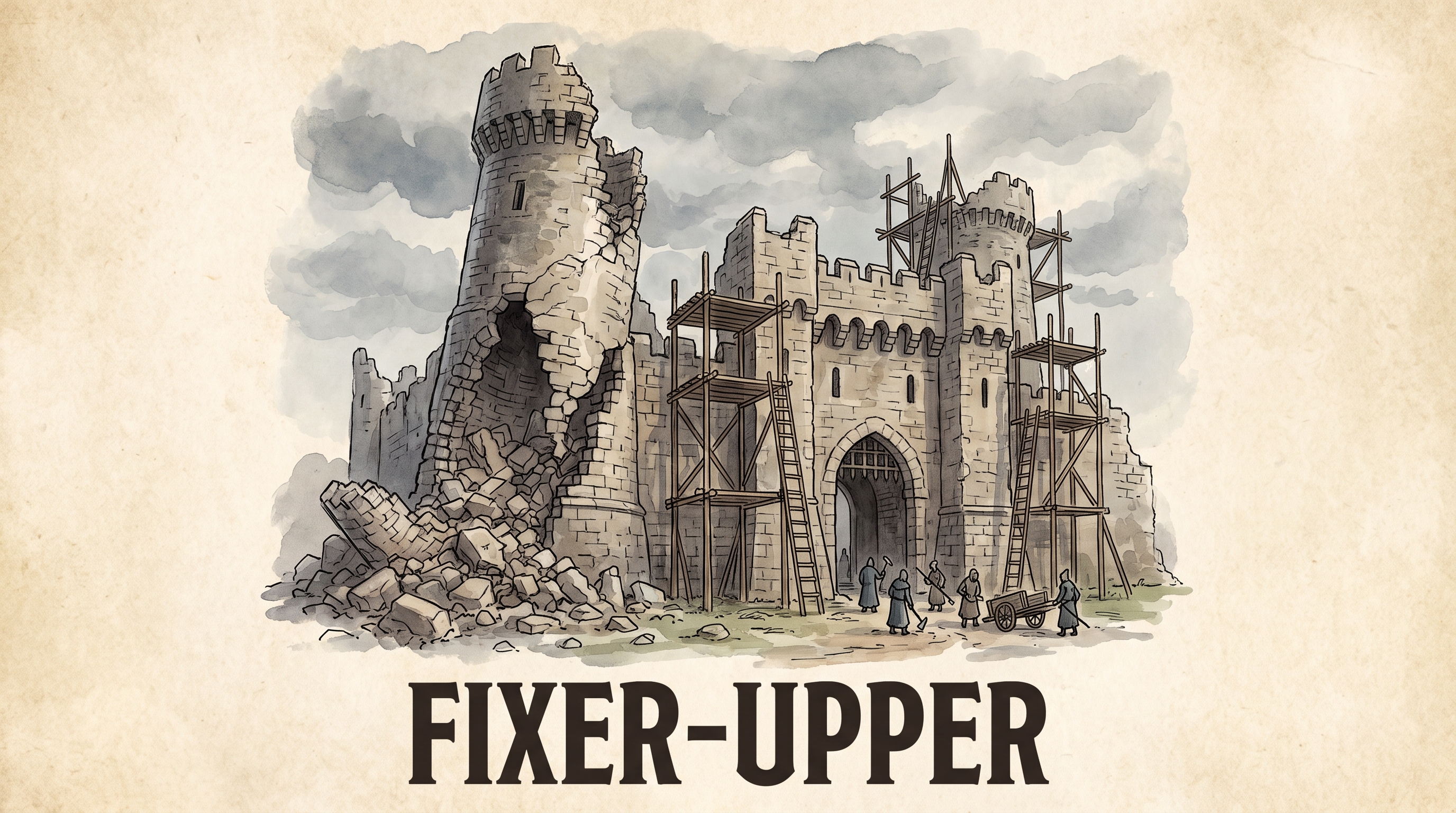
Two sessions. That’s how long it took me to wreck my own campaign.
Session twenty was the good one. My party stormed a hill fort, killed a corrupt baron, and stood on his balcony watching the sun come up. I handed them the deed. Everyone cheered. I went home and did what any reasonable person does when their players become landowners.
I built them a spreadsheet.
A spreadsheet. For a game about stabbing wizards in the face.
Session twenty-one opened with an upkeep roll. Within four minutes, two of my players were checking their phones. My paladin was asking thoughtful questions about grain reserves, which I answered in loving detail, because I am a naughty boy who spent nine hours on those grain reserves. Then my rogue said the words that still wake me up at 3 a.m.
“Cool. Can we go back to the dungeon?”
Look, if you got a castle in your campaign and the game somehow got worse, you are not bad at this. You just walked into a trap the entire hobby has been laying for fifty years. Let’s talk about why, and then let’s fix it in about ten minutes a session.
So did the official rules fix this?
Nope.
Well. Okay. Partly. Stay with me here, because this is the fun part.
The 2024 Dungeon Master’s Guide added Bastions, personal strongholds every character gets at level five. And one thing in there is genuinely smart: the rules assume your Bastion’s economy roughly breaks even, so nobody tracks turnip income. That single line deletes a mountain of math before you roll a die. Steal it. It’s free.
Everything built around that idea, though, got sealed in a jar. Justin Alexander of The Alexandrian wrote the definitive teardown, and his summary is brutal: “The campaign is over here. The bastion is over there. Stay in your lane.” Bastion events only fire when your characters are away. Your hirelings and defenders get no stat blocks, so you can’t fight beside them. Your Bastion money is kept separate from your money. Nothing goes in, nothing comes out.
Designer Brandes Stoddard, who liked the pieces but not the assembly, put the result plainly: “Bastions are window dressing rather than an interesting tool.” He also spotted the cruelest bit of the design. The order that triggers interesting events is the only order you can give while you’re away. Which means you are never home for the good stuff. Your castle throws a party and specifically waits until you leave.
Meanwhile, over in Pathfinder, the RPGBot guide to Kingmaker’s kingdom rules opens with a warning. “These rules are complicated.” It goes on to mention heavy math, trap options, and a kingdom that can collapse into anarchy before you finish building your first farm.
So one system gave us a subsystem too sealed off to matter, and the other gave us a second job. Cool. Both million-dollar ideas, by the way. MCDM’s Strongholds & Followers raised over $2.1 million on a $50,000 goal. People want this. Nobody has cracked it.
The number that changes everything
Here’s the stat that reorganized my brain.
D&D Beyond released character level data showing roughly 11% of characters never pass level one. About 14% reach level five. From there it falls off a cliff into single digits. EN World summarized the whole dataset under a headline that should be tattooed on every designer’s forearm: 90% of games stop by level 10.
Now go look at when domain rules turn on.
ACKS caps out at level 14 and expects your empire near the top. Bastion facilities unlock at 5, 9, 13, and 17. You want to own a pub? That’s a level 13 facility. A pub. The most level-one character concept in the entire hobby, gated behind a tier of play that nine out of ten tables will never touch.
We are writing kingdom rules for a table that does not exist.
That’s the whole problem in one sentence. Every guide starts with “once your party reaches name level,” and almost nobody reaches name level. So the fix isn’t better kingdom rules. The fix is smaller kingdom rules that show up way earlier and cost almost nothing to run.
I call the version I use now the Ten-Minute Kingdom. Five rules. Don’t make it weird.
Rule 1: Ten minutes, on an actual timer
Not “a bit of downtime.” Not “we’ll see how it goes.” Ten minutes, phone timer, visible on the table, once per month of real play.
Every article you read about domain play skips this, and it’s the only question GMs actually ask. When the timer runs, you resolve the domain turn. When it dings, you stop, even mid-sentence, and go back to the dungeon.
Two things happen. Your players stop dreading it, because dread needs a runway and ten minutes is not a runway. And you stop overpreparing, because you physically cannot spend nine hours on grain reserves for a ten-minute segment. Probably. I said probably.
The timer is not a limit. It’s a promise.
Rule 2: Hand them a ruin, never a reward
This is the best idea in domain play, and I stole it from a blog comment section, which is probably the most honest sentence in this article.
A blogger over at Against The Wicked City noticed something about video games. In Baldur’s Gate, Pillars of Eternity, and Dragon Age, the stronghold you inherit is always broken. Always. Crumbling walls, empty treasury, staff who quit. That is not laziness. That is the entire design.
Because think about the alternative. You give your party a working keep with competent officers, full granaries, and loyal guards. What do they do? Nothing. There is nothing to do. You handed them a boss fight with zero hit points.
So flip it. The keep they take should be on fire, metaphorically and ideally also literally. Well is poisoned. Garrison is eleven scared teenagers. Previous lord’s debts just walked through the gate wearing a nice hat.
My rule of thumb: a domain should always own at least one problem the party cannot fix from inside it. If they can solve it by sitting in the throne room and rolling, you built a chore. If they solve it by leaving and going somewhere dangerous, congratulations, you built an adventure.
Rule 3: Everybody gets a job
Here’s a failure of the system. One player wanted the castle. The other four are watching that player do math.
I went looking through the ten best articles on this topic and not one addressed it head on. Which is wild, because it kills more domain campaigns than complexity does.
The fix takes thirty seconds at the table. Split the domain into portfolios and give one to each player. Walls and soldiers. Coin and trade. The common folk. The neighbors and their ambassadors. The temple, the library, the weird tower nobody goes in.
Now your rogue isn’t watching your paladin do math. Your rogue owns the spy network and personally cares that the neighboring duchy is sniffing around. Every player gets one thing that is theirs, one thing that can be threatened, and one reason to speak during the domain turn.
Ars Magica figured this out decades ago with troupe play. Blades in the Dark figured it out with the crew sheet, where the whole group shares one set of goals. You don’t need either system. You need the shape.
Rule 4: Three clocks, zero spreadsheets
Your domain does not need statistics. It needs three progress clocks and a short list of stuff it owns.
The best implementation of this is in Mausritter, a game about mice, which should tell you something about how much crunch you actually need. Every faction gets a list of resources written as plain phrases (a secret tunnel, six bandit clans, a bribed magistrate) and a couple of goals with little boxes to tick. Roll a d6 between sessions. Resources help, rival resources hurt. Tick a box or don’t.
Blogger Patchwork Paladin runs the same trick and gives the sweet spot: three to five segments per clock, and if in doubt go smaller, because you can always add another clock. Assign a named person to each goal, ideally someone whose private wants cut against the goal a little. Now your clocks gossip.
For your party’s own domain, run three: one thing they’re building, one thing they’re fighting off, one thing they don’t know about yet. Ten minutes is plenty for three clocks. Ten minutes is not plenty for a population growth table.
Rule 5: Every domain problem is a dungeon in disguise
If a domain event resolves itself, delete it. If a domain event resolves with a roll, it’s filler. The only events worth keeping are the ones that point at a map.
Bandits on the north road becomes a bandit camp with a floor plan. A failing harvest becomes a blighted grove with something living in it. A restless population becomes a specific angry person in a specific building who can be talked to, bribed, or, knowing your group, set on fire.
Every single turn, one clock should spit out a place your party can walk into. That’s the connection the official rules never built, and it’s the entire reason your castle starts mattering. The domain isn’t a minigame sitting beside the campaign. It’s the thing that generates the campaign.
“But wait, the bookkeeping IS the point”
I need to be fair here, because there’s a real argument on the other side and I used to be wrong about it.
A commenter on that Alexandrian article pushed back hard. Stripping out all the upkeep to make domains more appealing is exactly why nobody cares about their stronghold. If it costs you nothing, it’s worth nothing. Investment comes from paying attention over time. They named Pendragon as the game that gets this right, and they aren’t wrong.
So here’s where I landed, and I think it settles the argument. Upkeep should cost attention, not arithmetic.
Making your players remember that the north wall is still broken, that the captain resents them, that winter is nine weeks out? That’s upkeep. That’s investment. Making them multiply population by tax rate? That’s a math worksheet with a portcullis drawn on it.
Charge them attention. Never charge them homework.
What to cut, in order
Whatever system you own right now, whether that’s Bastions or ACKS or a 320-page book you backed in 2019 and never opened, cut in this order:
- The economy. Assume it breaks even. The 2024 DMG got this right.
- Population tracking. Nobody at your table cares how many peasants there are. They care about one peasant with a name.
- Construction time. “It’s done next session” is a fine rule.
- Mass combat. Run the battle as a clock in the background and put the party somewhere that decides it.
Keep three things: events, clocks, and one resource the party can actually lose.
And when it’s over, let it be over
Nobody writes about this, so I will. Domain play should be allowed to end.
Your party can hand the keep to a trusted lieutenant. They can lose it and go back to being wanderers with a grudge. They can burn it down themselves, which one of my groups did, on purpose, for reasons that made sense at the time.
An ending is not a failure. Give them an exit ramp and they’ll engage with the whole thing more freely, because they know it isn’t a cage.
Go run one
Here’s your homework, and yes I appreciate the irony.
Next session, take whatever base your party is using now. The inn they always return to counts. The ship counts. The wizard’s tower counts. Give it three clocks. Give each player a portfolio. Set a ten-minute timer and run one domain turn.
You don’t need to reach level 13. You don’t need a 300-page book. You need three clocks and a timer, and you can start tonight, at level two, in a rented room above a tavern.
That’s the through-line. Domain play was never about kingdoms. It’s about giving your players something in the world that can be hurt.
Now go break their castle.
Sources: D&D Beyond level distribution data via TheGamer and EN World; The Alexandrian, “D&D 2024: The Bastion Bubble”; Brandes Stoddard, “Improving Bastions in D&D 2024”; RPGBot’s PF2 Kingmaker Kingdom Rules Guide; Against The Wicked City; Patchwork Paladin, “The Faction Turn”; Mausritter faction rules; MCDM Kickstarter figures via BackerKit.

Posted on September 7, 2026, in Blog. Bookmark the permalink. Leave a comment.





 Rokk Talk
Leave a comment
Comments 0