Why Your Undead Aren’t Scary: 7 Fixes That Work at Any Level
Three skeletons clatter out of a crypt. You describe the torchlight on their ribs, the rust on their swords, the creak of old bones. Your rogue yawns. Your wizard asks, “Bludgeoning vulnerable, right?” Your fighter is already doing the math out loud. Twelve seconds later, the skeletons are a pile of junk and somebody is checking their phone.
Ouch.
I ran that exact scene last spring. My friend Dev, who plays the loudest halfling bard in three counties, looked up and said, “Is this the tutorial level?” I wanted to curse myself. (I did curse myself. Quietly. Into my DM screen.)
Here’s the problem. Zombies and skeletons don’t feel like threats. They feel like hit-point bags in a Halloween costume. And you’re not alone. Even Keith Ammann, the guy who literally wrote the book on monster tactics, says in his undead tactics breakdown that skeletons and zombies stopped scaring players a long time ago.
So is the fix a bigger stat block? Nope. Most “scary undead” posts hand you a homebrew zombie with 40 extra hit points and call it a day. That’s not fear. That’s a longer grind.
The fix is fear design. What the monster wants. What it’s doing before the fight. What the players find after. I call it the Errand Method, and it works on a CR 1/4 skeleton at level 1 or level 15.
Why Your Undead Feel Like Trash Mobs
In MMO terms, your skeletons are trash mobs. They’re the little guys you mow down on the way to the boss. Players learn to ignore trash mobs because trash mobs don’t matter.
The rules don’t help. The basic zombie moves just 20 feet a round in both the 2014 and 2024 rules, which is slower than any PC. Its big trick, Undead Fortitude, lets it make a Constitution save to stay at 1 hit point. Sounds scary, right?
Then Lucas Asher at Veritas Tabletop ran the numbers. A 2024 zombie saves at +3, so any hit of 13 or more makes it fail around 70 to 75 percent of the time. Even at level 1, a rogue hitting for about 9 damage turns that save into a coin flip.
Old-school players miss the days when undead drained whole levels off your character. Posters on EN World were grumbling back in 2005 that undead lost their bite once level drain got weaker.
So the numbers won’t save you. Guess what will? Behavior. Giants of the North names the mistake in their undead guide: DMs keep “treating them like mortal soldiers who just happen to be gray.”
Yeah. Let’s stop doing that.
The Errand Method at a Glance
Every undead is on an errand. Fear lives in three beats: before, during, and after the fight.
| Beat | The question | Fixes |
|---|---|---|
| Before the fight | What does it want, and what is it doing right now? | 1, 2 |
| During the fight | Who is it, who is it after, and can it even die? | 3, 4, 5, 6 |
| After the fight | What did it leave behind? | 7 |
Let’s go.
Fix 1: Give Every Undead an Errand
Ammann’s big idea is that undead don’t fight to survive. They follow “what I think of as compulsions,” a drive planted by whatever raised them. A zombie doesn’t care about its hit points. It cares about the job.
So give it one. Before the session, write a single line: what does the necromancer (or the curse) want done? Dig. Guard. Carry. Count. That’s it.
- A skeleton guards a tomb door and nothing else.
- Zombies haul stones from a quarry to one spot deep in the woods.
- Ghouls collect every left hand in the graveyard. Just the left ones. Nobody knows why.
(That last one is gross. You’re welcome.)
The errand scales with level. At Tier 1, the skeletons guard one crypt. At Tier 3, a necromancer’s army is emptying the whole town graveyard into the river, and nobody knows what’s waiting downstream. Same trash mob. Much bigger question.
Fix 2: Let Players Find Them Mid-Errand
Now show the errand before anyone rolls initiative. The Monster Manual already hints at this. Ammann notes that idle skeletons fall back on habits from their old jobs, like a dead miner still swinging a pick. Zombies just stand there. Creepy, but we can do better.
Try this. The party opens a door and finds a skeleton mopping a floor. The floor rotted away decades ago. It’s mopping the air above a forty-foot drop. It doesn’t turn around.
Did your players attack? Maybe. But first, they asked why. That’s the whole point. A monster doing something weird is a puzzle, and a puzzle keeps players guessing.
One answer on a Quora thread about scary zombies nails this. The party catches zombies carving symbols into a stone monolith. The fight is easy. Then everyone stares at the half-finished carving and realizes nobody knows what it’s for. The fight ended. The fear didn’t.
Fix 3: Never Say the Z-Word (and Skip Initiative)
Your players know the stat block. Say “zombie” and your wizard’s brain opens the wiki. So don’t say it. That same Quora thread makes the case: describe what they see, never the monster’s name.
And keep it short. Dwiz at A Knight at the Opera puts it simply: “Players tune out during monologues.” Pick one or two details and stop.
Bad: “Four zombies shamble toward you.”
Better: “A woman in a nightgown is standing in the well. Just her head and shoulders above the water. She’s been there since you arrived.”
Then skip the initiative roll for the first beat. The Angry GM says it straight: “Nothing kills fright like an initiative roll.” Ask “What do you do?” and give them about three seconds. Roll initiative after the panic, not before.
(Quick aside: I just wrote “errand” eleven times. My spellcheck thinks I’m a delivery app.)
Fix 4: Make Them Somebody
Zombies are people. Or they were. The Angry GM’s advice is to keep pointing that out with clothes, jobs, ages, and a wedding ring on a gray finger.
This is where your campaign pays you back. Giants of the North recommends raising NPCs the party failed to save. Don’t say “a zombie.” Say “the blacksmith you couldn’t rescue last session.”
I tried this with a farmer named Pell, who gave the party free apples in session two. In session nine, Pell came shambling out of the orchard, still holding the basket. My paladin player stopped mid-attack and said, “Oh no. Oh no, not Pell.” Best worst moment of the whole campaign.
Here’s how it scales:
- Tier 1: the zombie is the missing farmer from the job posting.
- Tier 3: it’s the party’s old hireling.
- Tier 4: it’s a former PC. (Ask the player first. Seriously. Nobody likes you when you zombify their dead character without asking.)
Fix 5: Aim at What They Love, Not at Their AC
Here’s the level-scaling secret. A level 12 paladin doesn’t fear a zombie. But the paladin’s favorite innkeeper? Oh, that innkeeper is in trouble.
Dwiz’s rule is to hurt an NPC in full view before any PC. It shows the stakes without ending anybody’s night.
Now take it one step further. Let the undead ignore the party. Ammann points out that a guard skeleton won’t chase you past its room, because its job is done. Flip that around. A horde shuffles right past your fighter on its way to the orphanage. Being ignored by a monster is scarier than getting hit by one. Your players’ AC doesn’t matter. The errand does.
And mix up your crypts. Mike Shea at Sly Flourish shared a tip I love: “Don’t fill crypts with nothing but undead.” A zombie guarding a crying, very alive prisoner turns a trash fight into a rescue. For high-level tables, his horde rules let you throw hundreds of undead at the party without the math eating your night.
Fix 6: Make “Dead” a Question, Not a Number
Remember that Undead Fortitude math? Here’s the fix. Stop treating death as a number. Treat it as a mystery.
Ammann offers a simple bit of theater. When a zombie drops, it falls prone… then stands right back up. Do that twice and players start asking the right question: what actually kills this thing?
Asher goes further with a homebrew “Deathless” trait. The zombie drops to 1 HP, gets stunned for a few rounds, then comes back at full health unless divine magic finishes it. He admits it isn’t balanced. That’s the point. A scary fight shouldn’t feel fair.
Here’s a lighter version for any level. Pick one thing that ends them for good:
- Fire.
- Holy water.
- Speaking their real name.
- Burying them with a coin in their mouth.
Until players figure it out, the zombies keep getting up. Now it’s a boss fight with a puzzle attached, not a damage race.
Fix 7: Leave Something Behind
This is the step nobody writes about. Every guide stops when the last zombie drops. Big mistake. The aftermath is where dread sticks.
Let the party search the bodies and find the errand, not just loot:
- A list of names in the necromancer’s handwriting. The last name belongs to a PC.
- The tunnel the zombies were digging. It’s finished. It runs under the town temple.
- A new grave by the crypt door. Already dug. Nobody’s in it yet.
That last one wrecked my table. Dev asked, “Who’s it for?” I said, “Roll a Wisdom check.” He didn’t want to roll.
This also fixes a problem DMs complain about all the time: dread fading between sessions. In the comments on the Angry GM’s horror post, one DM running Curse of Strahd admits the fear faded with weeks between games. An empty grave rides home with your players. Trust me, they’ll text you about it on Tuesday.
Watch Me Run One: The Pickmen of Cold Hollow
Talk is cheap. Here’s a quick build for a Tier 1 party, five skeletons, and one mine.
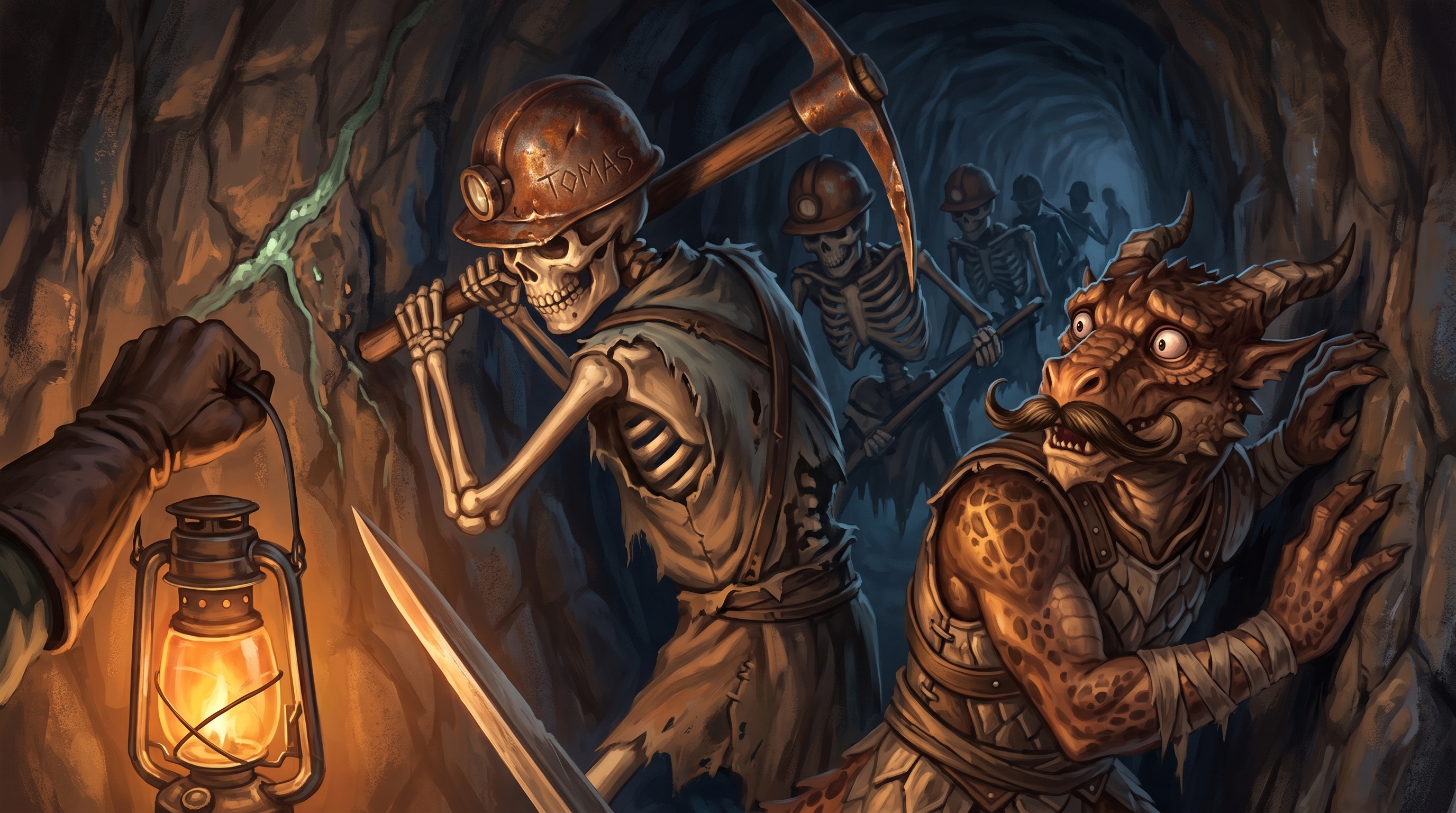
Before. The necromancer wants a black ore dug out of the Cold Hollow mine. The party arrives at dusk and hears picks ringing in the dark. Inside, skeletons in dented miners’ helmets are digging in perfect rhythm. Each helmet has a name scratched inside it.
During. I never say “skeleton.” I say, “a man-shape with no face, swinging a pick like it’s got a quota.” The skeletons don’t attack unless someone stands between them and the rock face. Then a miner’s widow runs in, calling her husband’s name. One skeleton stops. It turns. Then it goes back to digging. Knocked-down skeletons get back up until the party smashes the picks, the tools of the errand, not the bones.
After. The rock face shows what they were digging toward: a stone door with a keyhole shaped like a human hand. The skeletons weren’t mining. They were digging someone out.
Did it scare my players? Nope. Well, actually, the bard refused to walk past that mine for the rest of the campaign. I’m counting that.
Why This Fits How Horror Tables Play
The Errand Method works best as a short arc, and that matches how horror gamers play. Back in 2019, Call of Cthulhu was played by 13% of Roll20 users, second only to D&D 5e. Its games averaged 11.9 hours of total play versus 40 hours for other systems. Horror runs short. So drop a two-session undead arc into your regular campaign, hit all three beats, and get out before the fear wears off.
Quick FAQ
Why do my players laugh at zombies? Usually two reasons: they know the stat block, and nothing is at stake. Also, laughing isn’t proof the scare failed. Dwiz notes that lots of people laugh under stress.
How do I make skeletons scary at level 1 without a TPK? Use Fixes 2 and 5. Make them weird, and let them ignore the party. You don’t need extra damage.
Can zombies still threaten a level 10 party? Their hit points can’t. Their errand can. Aim it at the town.
What do mindless undead do when nobody’s watching? Whatever their errand says. If there’s no errand, they repeat old habits from their old jobs.
Your Undead Just Got a Job
Your undead aren’t boring because the stat block is weak. They’re boring because they show up, swing, and fall over. So give them an errand. Let players catch them mid-task. Hide the name. Make them somebody. Aim at what the party loves. Make death a riddle. Leave a grave behind.
That’s the whole boss fight. Don’t make it weird. Okay, make it a little weird.
Here’s your homework. Grab the next skeleton in your session notes and write three lines. What does it want? What is it doing when the party walks in? What does it leave behind? Five minutes, tops. Then drop your best undead errand in the comments, because I plan to steal it for my next campaign. And if this fixed your crypt crawl, subscribe for more GM guides. Next time, we’re making ghosts that do more than say “boo.”
Now go. Somewhere in your notes, a skeleton is waiting for its orders.

Posted on October 12, 2026, in Blog. Bookmark the permalink. Leave a comment.




Leave a comment
Comments 0