The 90-Minute Halloween Prep Method (For GMs Who Forgot It Was October)
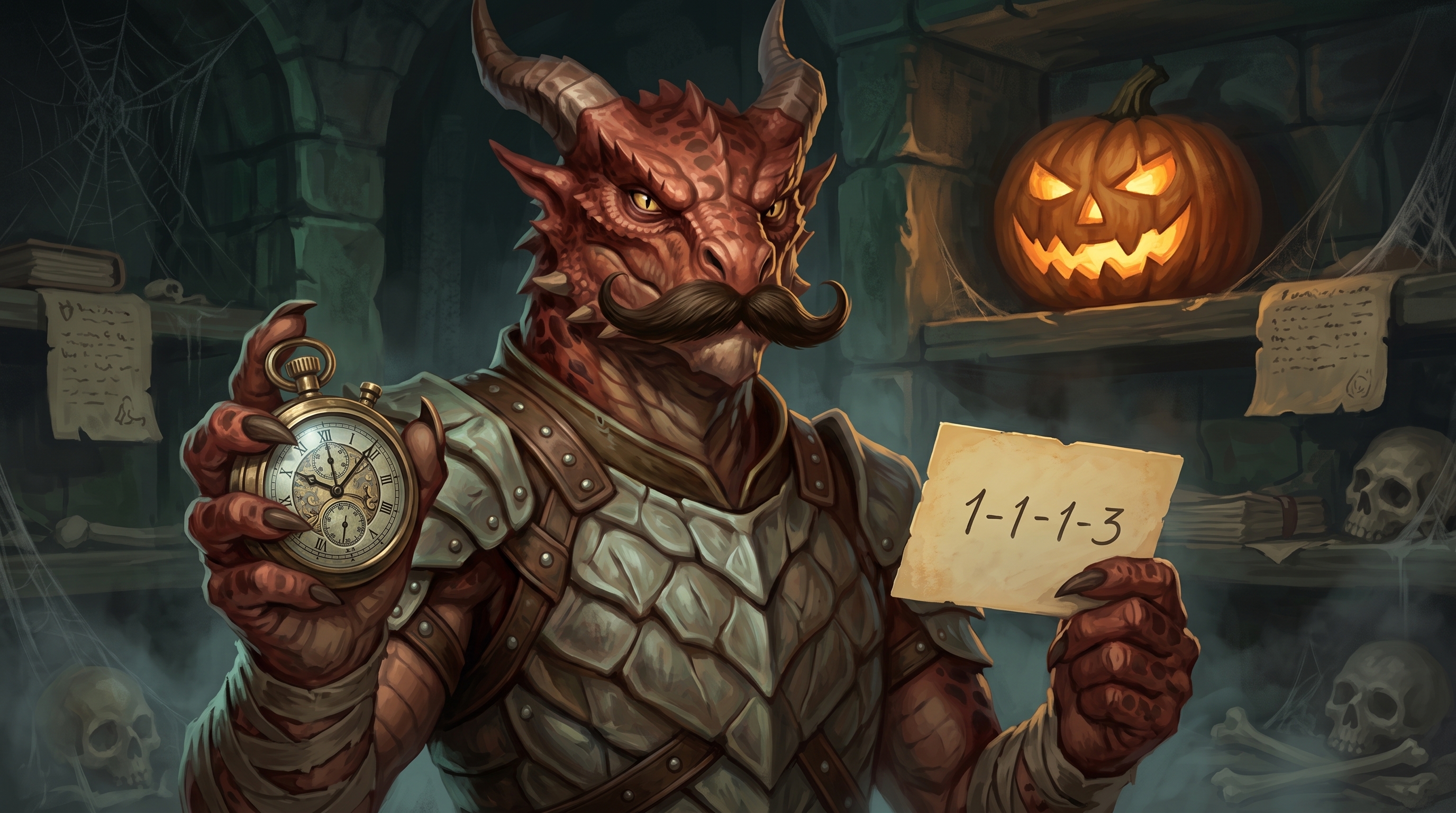
It’s Wednesday night. Game night is Saturday. Somebody in the group chat just posted a pumpkin emoji and two words: “spooky session??”
And you freeze. Like a character who just heard footsteps upstairs in an empty house. Because it’s October. It’s been October for three weeks. Nobody told you. (Everybody told you. You muted the chat.)
Two Octobers ago, I was that GM. My group asked for a Halloween game, and I said “Sure!” with total confidence and zero pages. On Friday at 1 a.m., I was still scrolling adventure roundups, reading reviews of modules for a party level I’d forgotten. Saturday’s session was a goblin cave with a ghost sticker slapped on it. My buddy Jordan called it “Scooby-Doo, but sad.” He wasn’t wrong.
So here’s the good news. You don’t need a free weekend. You need 90 minutes, a phone timer, and a method small enough to fit on an index card. One monster. One location. One secret. Three clues. I call it the 1-1-1-3, and by the end of this post you’ll be able to build a full horror one-shot before your coffee gets cold. Okay, before your second coffee gets cold.
Look, let’s go.
Why a List of 38 Adventures Won’t Save You
Search for a Halloween one-shot and the internet hands you roundups. Top 10. Top 15. One popular post lists 38 Halloween one-shots in a single scroll.
Are those lists bad? Nope. Are they what you need on a Wednesday? Also nope. Well, actually, one of them could be. You just need to read all 38, pick one, buy it, read it again, scale it to your party, and prep the maps by Saturday. That’s not prep. That’s a JRPG fetch quest with no fast travel.
Here’s the thing. Time isn’t the real problem. Mike Shea of Sly Flourish polled 3,663 DMs about prep for a four-hour game. About 10% spend 30 minutes or less, 33% spend about an hour, 28% spend about two hours, and 29% spend three hours or more. So 90 minutes sits right in the middle of normal. Shea himself takes 30 to 60 minutes for a three-hour game, and he once spent a whole day prepping only to find the extra hours barely helped.
The real problem is the blank page. MakeMythic says the empty page, not the monster, is usually what trips up horror GMs. A method fixes blank pages. A list doesn’t.
The 1-1-1-3 Method
Set a timer for 90 minutes. Here’s the whole schedule.
| Minutes | Step | What you walk away with |
|---|---|---|
| 0 to 5 | Pick the mood | Scary or silly, one subgenre, one comfort check |
| 5 to 20 | One monster | What it wants, what it does off-screen, the sign it leaves, a stolen stat block |
| 20 to 35 | One location | Four spots and a reason nobody can leave |
| 35 to 50 | One secret | The truth, who kept it, and what knowing it costs |
| 50 to 80 | Three clues | One clue per scene type, all pointing at the secret |
| 80 to 90 | Open and close | An opening line, two endings, printed pregens |
Hard stop at 90. Shea puts it best: “With constraint comes creativity” (Sly Flourish). The timer is a feature, not a punishment.
1. Pick the Mood (Minutes 0 to 5)
Scary or silly? Slasher teens and cozy monster kids are totally different nights. Pick one, then pick a subgenre: gothic, folk, cosmic, or body horror.
Next, send one group text: “Anything off the table for a horror night?” That’s your safety check, done in two minutes. Some store-run Halloween games now send a consent form at signup. A group text works fine for your living room.
2. One Monster (Minutes 5 to 20)
Write four lines. What does it want? What does it do when the party isn’t looking? What sign does it leave behind? Whose stat block are you stealing? Borrow one and give it a baby bit of reflavor. Do not build a monster from scratch on a Wednesday. That way lies madness, and not the fun kind.
For a gut check, borrow this line from Magpie Games: “you’ll know if it’s scary because it will scare you a little too.” Then plan its screen time. Nerdist’s one-shot advice says players should watch the villain act at least once an hour, even before any fight.
3. One Location (Minutes 20 to 35)
One building beats a whole county. Map four spots: where the party arrives, two places that hold clues, and where the finale happens. Then write the reason nobody leaves. The bridge washed out. The storm rolled in. The gate locked behind them. Cornered players make scared players.
(I just typed “one” nine times in two paragraphs. The method is working on me. Send help.)
4. One Secret (Minutes 35 to 50)
Stay with me here, because this is the step every roundup skips. The monster is not the scary part. The secret is.
The monster is the threat. The secret is the dread. Write three things: the truth, who kept it buried, and what it costs to know it. Make that cost hit something the players care about, not just hit points. Justin Alexander of The Alexandrian points out that horror can go after a PC’s horse, house, or favorite sword and hurt more than a character death.
5. Three Clues (Minutes 50 to 80)
This is the biggest block, because this is where one-shots go to die. Alexander’s Three Clue Rule says it plainly: “For any conclusion you want the PCs to make, include at least three clues” (The Alexandrian). Your conclusion is the secret. So you need three clues pointing at it.
Here’s the trick. Make each clue a different kind of scene:
- Talk: someone lets something slip.
- Search: an object in a room tells the story.
- Chase or fight: the monster guards the proof or drags it away.
Alexander warns that clues found the same way only look like backups. If every clue needs a search and nobody searches, the whole mystery stalls. And never lock a clue behind one failed roll.
Now the math. Three clue scenes plus a finale equals four scenes. Scenes tend to run about 45 minutes each, so four of them fill a three-hour night. That lines up with MakeMythic’s advice to plan three to four hours for a horror one-shot.
6. Open and Close (Minutes 80 to 90)
Write one opening line that drops the party at the door. Write two endings: win at a price, and lose. Print or pick pregens. Done. Go eat something.
Watch Me Build One: The Drowned Mill
Talk is cheap. Here’s a real 90-minute build, with timestamps.
Minute 0. Mood: scary, gothic. I text the group. One player asks for no harm to kids. Easy. Noted.
Minute 6. Monster: Edric, a drowned man. He wants his name spoken at the mill again. When nobody’s looking, he stacks flour sacks into the shape of a person. His sign is wet footprints and the smell of pond water. Stat block: a basic ghost, reflavored so only things Edric owned can hurt him.
Minute 21. Location: Harrow Ford Mill. The party arrives in the yard during a downpour. Clue spot one is the kitchen. Clue spot two is the waterwheel. The finale is the millpond at midnight. Why nobody leaves: the ford flooded and the bridge is gone.
Minute 36. Secret: twenty years ago, Tomas the miller drowned his twin brother Edric to inherit the mill, then told the village Edric ran off. Tomas and his wife Hanna kept it quiet. The cost? Edric won’t rest until the truth is spoken in front of the village. But the village needs Tomas’s mill for winter bread. Truth means a hungry winter.
(See that? The monster is a ghost. The dread is a dinner-table choice about who goes hungry. Monster freaks, this is the good stuff.)
Minute 51. Clues:
- Search: wet footprints on the stairs that walk into the house but never out.
- Talk: at supper, Hanna says “both boys” about the old days, then goes pale.
- Chase: the old millstone by the wheel has two names carved into it, one scratched away. Edric drags it into the pond while they read it.
Minute 81. Opening line: “The ford is rising, the bridge is gone, and the miller insists you stay the night. He keeps glancing at the pond.” Win at a price: the truth comes out, Edric rests, and the party decides what happens to Tomas. Lose: at dawn, a man made of flour dust stands in the doorway, and one PC wakes up soaked, unable to remember their own name.
Minute 88. Pregens printed. Two minutes left to stare at the wall.
Did it scare my players? Nope. Well, actually, it scared one of them so badly she refused to drink water at the table for an hour. I’m counting that.
Running the Night
Prep is half the job. Here’s how to keep the one-shot moving once the dice come out.
Watch the clock, not the map. Every 45 minutes, check in with yourself. If you’re at hour three and the party found one clue, start the finale anyway. Any clue can open it. Edric doesn’t care which one they found. He cares that it’s midnight.
Save the big scare. Use the Frightened condition once, at the reveal. As MakeMythic puts it, “If everything causes fear, nothing does.”
Give them a save room. Survival horror video games know this trick. Resident Evil has save rooms, and your one-shot needs a warm kitchen with stew on the stove. Let players breathe and plan, then let them choose when to step back into the dark. The fear hits harder after the break.
Boss Fights: When the Plan Breaks
Every one-shot has a few ways to faceplant. Here are the three I run into most, plus the fix for each.
- The party kills the monster in round one. Cool. Let them. Edric is a symptom. He comes back at the next clue spot until the secret is spoken. Hit points don’t end this story. The truth does.
- Nobody finds clue two. That’s why there are three. Or move it. Those footprints can show up in the kitchen just as easily as on the stairs.
- The party tries to leave. That’s what the flooded ford is for. If they find a way out anyway, let them go, then put wet footprints in their inn room. The monster respawns wherever the players are.
And if you’re reading this at noon on game day? Run the panic-button version: monster, secret, three one-line clues. Fifteen minutes. Sly Flourish breaks down a similar approach in his piece on prepping a game in 15 minutes.
Next October: Swap One Slot
Here’s where the method pays you back. Before I6 Ravenloft was a published module, Tracy and Laura Hickman ran it every Halloween. A yearly home game turned into a classic.
Your 1-1-1-3 sheet can be your yearly game. Keep the flooded mill and swap the monster. Keep Edric and swap the secret. One changed slot, one new session.
It isn’t locked to D&D either. Nothing on the sheet needs a stat block until the finale, so it runs in Call of Cthulhu, Shadowdark, or Mothership too. That matters. Call of Cthulhu’s share of Roll20 campaigns climbed from about 11% to 16% between the first and second quarters of 2021, second only to D&D. Its games also averaged 11.9 hours of total play versus 40 hours for other systems. Horror tables run short. A one-night method fits how they play.
Quick FAQ
How long should a Halloween one-shot run? Three to four hours. Four scenes fit nicely.
What level should the party be? Any level works. For high-level parties, make the secret something a sword can’t fix.
Do I need pregens? For new players or a mixed table, yes. Tie each pregen to the secret. Maybe one of them knew Edric.
Can I drop this into my running campaign? Sure. Put the mill on the road they were already taking.
Your 90 Minutes Start Now
One monster. One location. One secret. Three clues. Ninety minutes. That’s the whole boss fight. Don’t make it weird.
Here’s your homework. Set a 90-minute timer tonight and build your sheet. Then drop your monster and your secret in the comments, because I want to steal them for next year. And if this saved your Saturday, subscribe for more GM guides. Next time, we’re building pregens in ten minutes flat.
Now go. Your players are already buying candy.

Posted on October 5, 2026, in Blog. Bookmark the permalink. Leave a comment.




Leave a comment
Comments 0