Running Games for Kids Without Losing Your Mind
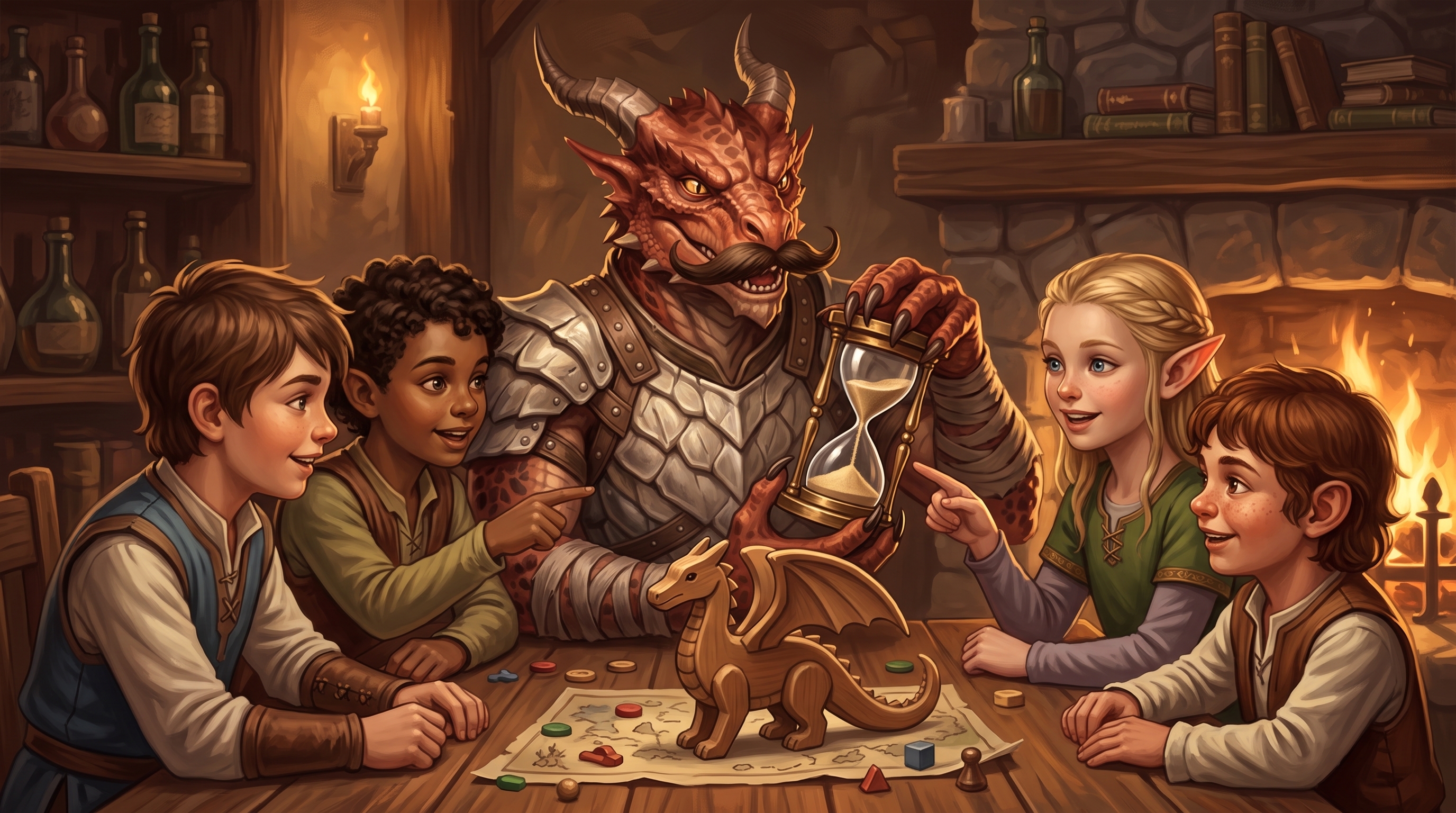
Picture it. Six kids. One dragon. Zero turn order.
The dragon lands on the tower, and every kid talks at once. One wants to fight it. One wants to pet it. One wants to know if dragons like pizza. The quiet kid in the corner says something brilliant, and nobody hears it, including me. Twelve minutes later, nobody had rolled a single die, and a kid named Jonah was under the table.
That was my first kids’ game. I went home, lay face down on the couch, and cursed myself for ever buying the starter set.
Was that session a disaster? Yes. Well, actually, the kids called it the best day ever. So, no. It was only a disaster for me. And it taught me the thing most kids’ guides skip. The kids weren’t the problem. My pacing was.
Here’s the thing about “short attention spans.” You probably heard that people now focus for about eight seconds, less than a goldfish. That number came from a 2015 Microsoft Canada report, and researchers question where its data even came from (Treetop ABA).
Kids aren’t goldfish. Their focus is normal, predictable, and, guess what, measurable. So this post gives you a method built on that math. I call it the 3-Beat Table Method: Clock, Token, Script. Three beats. One calmer table.
Your Kids Aren’t Broken. Your Scenes Are Too Long.
Child development experts use a rough rule. Kids can focus on a structured task for about two to three minutes per year of age, and some experts put the ceiling at five minutes per year (Brain Balance).
Do the math on an 8-year-old. That’s 16 to 24 minutes of focus. Now think about a normal D&D fight with six players, four goblins, and a GM flipping through the Monster Manual. Forty minutes? Easy. We ask kids to run a marathon, then act shocked when they sit down on the track.
Time of day matters too. In a study of about 10,000 kids aged 8 to 11, attention ran higher in the afternoon and lower in the morning (Wikipedia). So that 9 a.m. Saturday game you scheduled so it “wouldn’t eat the whole day”? It’s playing on hard mode. Move it to 2 p.m.
Kid-first game designers figured this out years ago. Hero Kids, a simple d6 system built for young players, writes each adventure to last 30 to 60 minutes on purpose (d20 Collective). They didn’t make kids pay attention longer. They made the game shorter.
Why This Headache Is Worth It
Before we fix anything, a quick pep talk. Kids at the table aren’t a niche anymore.
When Wizards of the Coast shared player data with retailers in 2020, 40% of D&D players were 25 or younger. Sales of the intro boxed sets jumped 300% year over year (ComicBook.com). A lot of parents bought that box, opened it, and thought, “Now what?”
The payoff goes beyond fun, too. A 2025 research review found growing evidence that tabletop RPGs help kids and teens with group problem-solving, communication, and self-regulation (ScienceDirect). Yes, the same kids who can’t wait their turn. That’s the point. The game is the practice.
The 3-Beat Table Method
Each beat fixes one way kids break pacing. The Clock fixes scenes that run too long. The Token fixes everyone talking at once. The Script fixes the moment you lose the table and need it back. Think of them as three party members. Each one alone is fine. Together, they carry.
Beat 1: The Scene Clock
Every scene gets a time limit based on the youngest kid at the table. Here’s my rough guide, built on that attention math:
| Youngest player | Scene length | Session length |
|---|---|---|
| Age 6 | 12 to 18 min | 30 to 45 min |
| Age 8 | 16 to 24 min | 45 to 60 min |
| Age 10 | 20 to 30 min | 60 to 90 min |
| Age 12 | 24 to 36 min | 90 to 120 min |
When the clock runs out, the scene ends. Hard cut. Grab a real timer, like a kitchen timer or a sand timer, and put it where the kids can see it. A visible timer turns “wrap it up” from your nagging into a game rule. Kids argue with grown-ups. They rarely argue with a sand timer.
End every scene on a cliffhanger. The Storymaster’s Tales blog puts it in five words: “Lose the pace, lose the crowd” (Storymaster’s Tales). A scene that stops right as the floor cracks open keeps kids leaning in. A scene that fizzles out sends them under the table.
For sessions over an hour, add a 10 to 15 minute snack break in the middle. Roll & Play Press uses that break to ask kids what they predict happens next (Roll & Play Press). Steal that. You get free plot ideas, and the kids feel like geniuses when you use one.
Not sure where to start? TTRPGkids offers a neat gut check. If a kid’s favorite shows run 30 minutes, start with 30-minute games (TTRPGkids).
Beat 2: Initiative for Everything
Look, most kid chaos isn’t bad behavior. It’s a turn-order problem.
In combat, D&D uses initiative. Everybody knows whose turn it is. Then combat ends, and the game drops into a free-for-all where the loudest kid wins. Adults can handle that. A table of 9-year-olds turns it into a mosh pit.
So run initiative for everything. Talking to the king? Initiative. Searching the library? Initiative. Picking which tunnel to take? You guessed it. Dungeon Master Academy tested this with 8 to 10-year-olds and wrote that “you’d be surprised at how well it removes chaos” (Dungeon Master Academy).
Make it physical. Grab a plush dragon, a giant foam d20, or a rubber chicken. Whoever holds the token talks. When they finish, the token moves to the left. It works like a JRPG battle menu. Your character gets a turn, you pick an action, and the next party member steps up. Kids who grew up on turn-based games get this in about four seconds.
Why does it matter so much? Spotlight. On the EN World forums, one GM pointed out that young players rarely notice when they hog the table, and quiet players rarely speak up when ignored (EN World). The token fixes both. The loud kid gets a cooldown. The quiet kid gets a guaranteed turn.
One more tip: explain the why. TTRPGkids found that telling kids the reason for waiting (so everybody gets heard, including them) sticks far better than a bare “no talking” rule (TTRPGkids).
Beat 3: Steal These Lines
Every guide says “redirect the kids.” Cool. With what words?
Here are my go-to lines. Tape them inside your GM screen.
- Cross-talk: “Hold that thought. The token’s coming your way next.”
- The spotlight hog: “Awesome plan. Let’s see what Priya does first, then we’ll combo it with yours.”
- The side chat about Minecraft: “Your character hears that too. Why is a creeper in this dungeon?” (Then add one. Seriously.)
- Choice paralysis: “You see two doors. One smells like cookies. One is growling. Five-second vote!”
- The meltdown after a bad roll: “Ooh, that miss just set up something big for the next hero.”
- The fudged roll: “Wow, your fourth 24 in a row! Let’s roll in the tray so everyone can cheer.”
- Total table collapse: “Everybody freeze. Something just walked into the room.” Then pause. Silence works better than shouting.
- The kid who wants to quit: “Want to play the monster for one turn?”
None of these shame a kid. Every one points their energy back into the game. That’s the whole trick. You’re not stopping the chaos. You’re aiming it.
Boss Fights: Troubleshooting the Usual Suspects
Every kids’ table spawns the same five mini-bosses. Here’s how to beat each one.
The Roll Fudger. Kids love feeling like they broke the system. One game store GM who runs several kids’ groups makes everyone roll in a shared dice tray. They say the rule rarely lasts past one session, because kids learn that bad rolls are part of the fun (D&D Beyond).
The Miss Streak. Three misses in a row while friends land hits? Cue the tears. Oliver Grigsby, owner of Game Masters for Hire, turns each miss into the setup for the next player’s hit. The goblin dodges your sword, stumbles back, and walks right into your friend’s arrow. Nobody feels useless.
The Rules Lawyer. This kid knows every monster’s hit points and says them out loud mid-fight. Give them a job. Make them the party’s official monster expert, allowed to share one fact per fight. Then swap in weird homebrew monsters they can’t look up. Sorry, buddy.
The Shopping Black Hole. Grigsby once watched a group of kids spend over an hour shopping in Neverwinter. They bought a ballista and tracked down an elephant to pull it. Adorable. Also, an hour. Fix it with a shop menu: three items on index cards and 90 seconds on the sand timer. Want a ballista? Cool. That’s a quest now.
The Kid Who Only Wants to Fight. Let them. Put a quick fight in the first 10 minutes as a warm-up. Tribality pointed out that kids raised on video games expect to level up by beating enemies (Tribality). Feed that urge early, and they’ll sit through the puzzle room later.
Running a Big Table (6+ Kids)
Most advice assumes three to five players. Camps, clubs, and birthday parties laugh at that number.
First, split the party into two squads with separate goals. One squad guards the gate while the other sneaks into the tower. Run Squad A for one scene clock, then switch to Squad B. The waiting squad plans its next move quietly.
Next, recruit a sidekick. Grab one parent, hand them a list of NPC names, and let them run the waiting squad’s planning huddle. Instant co-GM.
Finally, hand out table jobs. Kids who wait are kids who wiggle, so give the wiggle a purpose:
- Map keeper: draws the dungeon as the party explores.
- Initiative tracker: moves the token and calls out whose turn it is.
- Loot scribe: writes down every coin and weird item.
Game shops that run lots of kids’ groups also sort players by maturity, not birthday. A “young” 11-year-old may fit best with the 8-year-olds, and that’s fine.
Protect Your Own Brain
Nobody talks about this part. Running games for kids wipes you out. One GM with a monthly table of four or five kids admitted in the D&D Beyond comments that they feel drained after every session.
My rule? Prep less for kids than for adults. They’ll ignore half your plot anyway. Prep one location, three encounters, and one cliffhanger. Done.
Take the break for yourself, too. When the kids eat snacks, you eat snacks. Don’t spend it fixing next scene’s stat blocks. And pick a table size you can survive. If eight kids melt your brain, cap it at five. A fun GM with five kids beats a fried GM with eight.
(I just wrote “snacks” three times in one paragraph. My dentist would like a word.)
Quick FAQ
Can a 6-year-old play D&D? They can play a version of it. Use premade characters, one d20 roll per turn, and 12 to 18 minute scenes. Or try a kid-first system like Hero Kids.
Should I let a kid’s character die? Usually, no. Knock them out, let the goblins kidnap them, or turn them into a frog. Keep the kid in the game.
How many kids can one GM run? Four or five solo. Six or more? Grab a sidekick parent and split into squads.
Keep the Game Flowing
Here’s the whole post in one breath. Kids aren’t goldfish. Their focus runs about two to three minutes per year of age, so build around it. Clock your scenes. Pass the token. Keep your lines ready.
Grigsby said it best: “The best thing you can do is just keep the game flowing” (D&D Beyond). That’s the 3-Beat Table Method in a nutshell. You don’t need perfect kids. You need a short scene, a rubber chicken, and the right words at the right time.
Here’s your homework. At your next kids’ game, set a sand timer and run initiative outside combat for one full scene. Just one. Watch who talks. Watch who finally gets a turn.

Posted on September 28, 2026, in Blog. Bookmark the permalink. Leave a comment.





Leave a comment
Comments 0