Halloween Props and Handouts Under $20 That Won’t Clutter Your Table
Americans are on track to spend about $13.5 billion on Halloween this year. That works out to roughly $115 per person, according to the National Retail Federation’s 2026 survey.
You don’t need $115. You need one table, on one night, to feel wrong in the best possible way.
But search for prop advice and you get handed two options. Option one is the haul video, where a cheerful person shows you a $90 pile of resin skulls. Option two is the build guide, where you’re told to carve insulation foam. Session 0 Studios recommends papier-mâché for a wall-mounted dragon head, and honestly, respect, but also: no. I work a job. My weekend is already booked by prep.
Here’s the third option nobody writes about. Twenty dollars, total, for a kit that fits in a shoebox and comes back out every October for a decade.
Stay with me here. There’s a spreadsheet involved, and I apologize in advance.
Why most prop advice fails you
Let me tell you about my graveyard.
Two Octobers ago I spent a Saturday and about $94 building a graveyard diorama. Foam headstones. Moss. A little fence made of coffee stirrers. It was the prettiest thing I ever put on a table.
My players looked at it for four seconds and asked where the snacks were.
Did it work? No. Well, actually, it did one thing perfectly. It taught me the difference between decorating a room and changing a game, which is the exact line Dumbest DnD draws in the best post currently written on this topic. A skull on the mantelpiece is scenery. A folded note in a player’s pocket is a problem they carry around for forty minutes.
The money problem is real too. Even the stores selling you this stuff admit it. 1985 Games says outright that budgets on gear like this spiral fast. And The Daily Dungeon Master warns GMs not to let props eat all their prep time or their wallet.
So what screens a good prop from a bad one? Mike Shea, the Lazy DM guy, already answered this. In Tools of the Lazy Dungeon Master he runs every tool through three filters: cheap where most GMs can afford it, quick to use, and flexible when the game turns sideways.
I’m stealing those three and bolting on a fourth.
The Shoebox Rule
Four questions. If an item fails any of them, it doesn’t make the list.
- Does it cost less than a sandwich? Nothing here is a splurge.
- Can I use it in under a minute at the table? No assembly, no painting, no drying time.
- Does it fit in a shoebox with everything else? This is the anti-clutter test, and it’s the one every competing post skips.
- Does it still work in March? A prop that only makes sense on October 31st is a prop you throw away on November 1st.
That fourth question isn’t me being precious about tidiness. It’s what shoppers already want. The NRF found that 34% of Halloween buyers are hunting for items they can reuse next year or repurpose somewhere else. You’re not weird for wanting your $20 to keep paying out. You’re the majority.
One shoebox. Twenty dollars. Let’s go shopping.
The list, cheapest first
I’m running a total down the side, because I got tired of posts that list nine items and never add them up.
| # | Item | Cost | Running total | Footprint |
|---|---|---|---|---|
| 1 | Turn the lights down one notch | $0 | $0 | None |
| 2 | A free ambience loop | $0 | $0 | None |
| 3 | One folded note | $0 | $0 | |
| 4 | The printable handout pack | $0 | $0 | A folder |
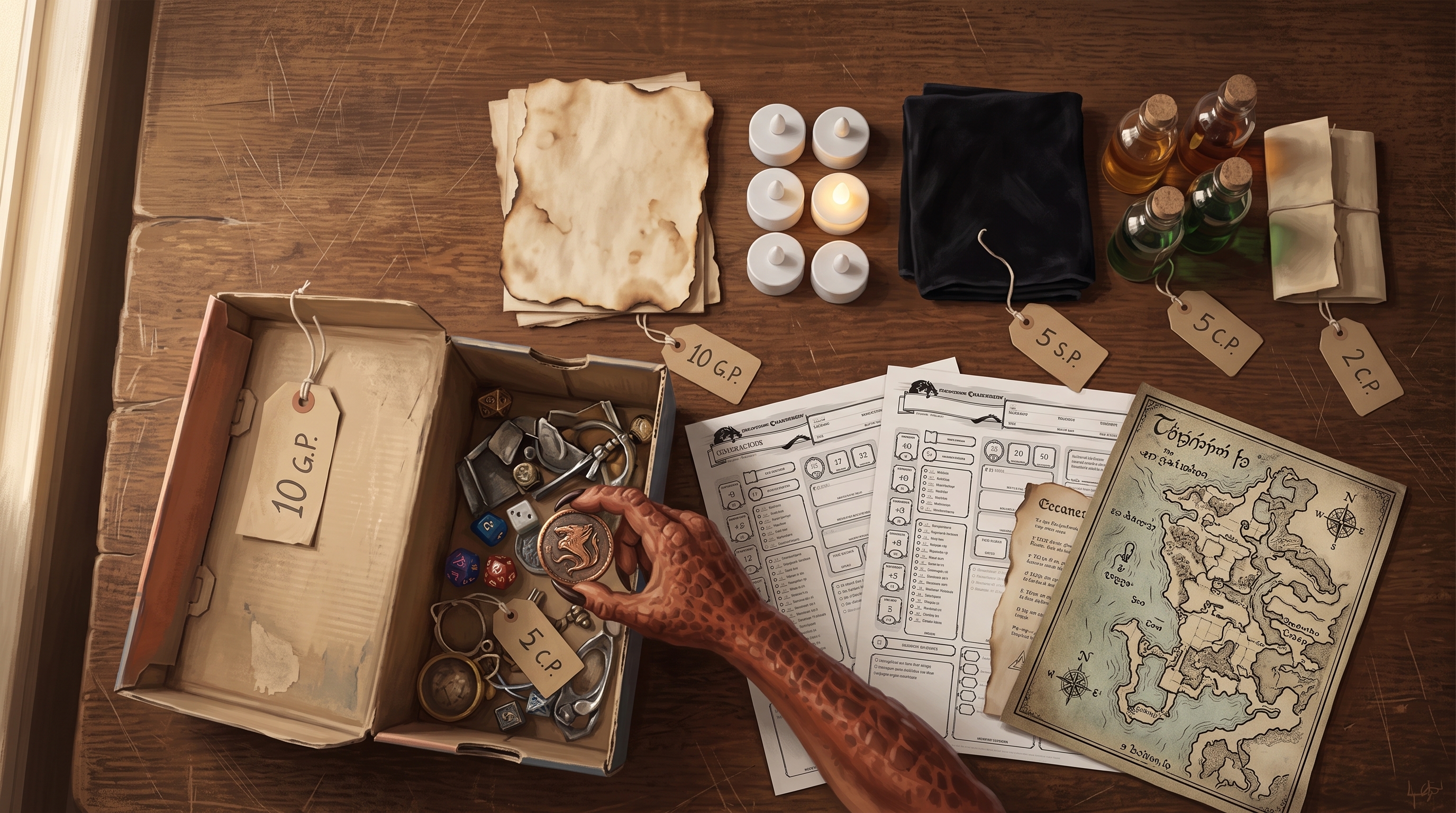
| 5 | LED tea lights, 12-pack | ~$5 | $5 | Palm-sized bag |
| 6 | Parchment-look paper, 50 sheets | ~$7 | $12 | Flat, lives in the folder |
| 7 | A black cloth | ~$2 | $14 | Folds to a paperback |
| 8 | Six small corked bottles | ~$6 | $20 | Half the shoebox |
Prices are what I paid at a discount store and online in the last two seasons. Check before you buy, because tariffs made everything jumpy. And speaking of discount stores: 39% of Halloween shoppers say that’s their first stop, ahead of specialty shops and online, per the NRF. The dollar store is not the sad option. It’s the popular one.
Now, why each thing earns its spot.
1. Lights down one notch. Not blackout. One notch. Far dimmer than usual, still bright to read a character sheet by. Kill the overhead, keep a lamp. A table that can’t read its sheets isn’t scared, it’s annoyed, and annoyed tables ask about snacks. Costs nothing, changes everything.
2. Free ambiance. Tabletop Audio runs in a browser tab, costs nothing, and holds hundreds of loops built for exactly this. Ten minutes of wind and distant creaking is a prop. A big orchestral track is a distraction that ends halfway through the scene and reminds everyone there’s a laptop in the room. And no jump-scare stings. A volume spike gets a laugh, not a scare, and it torches the mood you spent an hour building.
3. The folded note. My favorite trick in the hobby and it costs zero dollars. Hand one player a folded piece of paper. Say nothing. Carry on.
Here’s the beautiful part: it doesn’t matter what the note says. Mine once said “this is nothing, act normal.” My table spent the rest of the session watching that player like freaks. Somebody drew a seating chart. If you’re running a doppelganger, this is your entire prop budget.
4. The printable pack. More on this in a second, because it’s the piece the rest of the internet keeps forgetting.
5. LED tea lights. Buy warm-toned ones that actually flicker, not the steady blue-white kind that make your table look like a dentist’s office. Two jobs. First, they light faces from below, which is free horror. Second, they’re a visible countdown: set out six, blow one out at the end of each scene, and watch your players start rushing decisions when there are three left. No amount of decorating gets you that.
Bonus: Ten Candles, one of the best horror games on the planet, literally runs on tea lights. You bought a game accessory by accident.
6. Parchment-look paper. Seven dollars, and every handout you ever print gets better instantly. A ream lasts years. If you want to go further, tea-stain it: brew a strong cup, wipe it across the page, let it dry, singe the edge over a candle in the sink. CBR has been recommending the coffee-and-tea method for years and it still works. Fifteen minutes, and the page reads as a hundred years old.
7. A black cloth. Two dollars of fabric over the table, dice trays and all. It hides the Cheeto dust, it makes the tea lights pop, and it folds down to the size of a paperback. In March it’s a merchant’s stall cover. In June it’s a wizard’s workbench.
8. Corked bottles. Six little glass bottles with cork stoppers. Fill them with water and food coloring and put them on the table when the party finds the alchemist’s stash. Players who are holding a thing behave differently about that thing than players with “a potion” written on a list.
Full disclosure, these are the one item that pushes the shoebox. Mine currently share a drawer with my socks. My system is bad. My players don’t know that.
Total: $20. If you skip the bottles you land at $14 and gain drawer space, and I’d call that a fair trade.
The handouts, which is where everyone else quits
Here’s the gap I keep banging on about. Every post in this category tells you to “make a handout” and then walks away whistling.
Making handouts is the good kind of prep, though. Shea’s point is that writing the letter forces the real names, real places and real plot into existence. The handout is your session notes wearing a costume. D20 Digest puts the same idea as a rule: prep first what you can’t improvise at the table. You can improvise a goblin. You cannot improvise a coroner’s report at 11pm.
So here’s what to print tonight, on the parchment paper you just bought:
- A torn journal entry that stops mid-sentence
- A ledger page where one line’s been scratched out
- A coroner’s report with the cause of death left blank
- A name written seventeen times, getting messier
- A letter you can fold and seal
Set the words in a public-domain typeface like IM Fell English from Google Fonts, pull the picture from a museum’s open-access collection, print, crumple, unfold. If typing scares you more than the monster does, Tom G’s RPG Handout Builder is free, needs no login, and skips the whole Photoshop nightmare.
The DIY tier used to cost a weekend. Now it costs about nine minutes.
The stuff to skip
Said plainly, so you don’t repeat my mistakes.
Fog machines. The smoke alarm goes off, the neighbor knocks, and the fog is gone in ninety seconds anyway. I invited my landlord to a session once. He was not in character.
A prop for every monster. The bag of plastic spiders comes out, everyone laughs, and the mood dies for twenty minutes. One object per session. One.
Full darkness. See the lights rule. Slow sessions are never scary sessions.
A DM costume. You spend the whole night aware you’re wearing it, and so does everyone else.
Anything that pulls attention off the table. Projectors, light rigs, a second screen. Every second a player spends looking at your setup is a second they aren’t imagining, and their imagination was always going to beat your setup. That’s the boss fight you can’t win, so don’t enter the arena.
Three loadouts
Because you’re probably reading this on October 26th, you naughty boy.
Tonight. Lights down one notch, one printed handout, one folded note to one player, ambience loop in a browser tab. Five minutes of prep, about four dollars of paper, and it beats any fog machine in the province.
This weekend. Add the tea lights as a countdown, the black cloth, and a tea-stained letter with something sealed inside it.
Next year’s box. Now you’re allowed to break the twenty. A wax seal kit runs about $15 and the first time a player has to crack a seal open, you’ll understand. Get a plain stamp, not a dragon one. A plain seal reads as real. A dragon seal reads as a party favor. A small wooden box with a lock is the other one worth adding, because a locked box on a table is a puzzle everyone can see, and nobody in recorded history has ignored one.
Pack it up and use it in March
Here’s the through-line, and it isn’t decoration. It’s inventory management. Every item on this list stays useful because none of it is shaped like a pumpkin.
That matters more than it sounds, because in-person play is still roughly half of all tabletop sessions, according to Dice Cove’s 2026 roundup. Real tables, real hands, real paper. This kit serves all of them, whether you’re running 5e, Call of Cthulhu, Mothership or Ten Candles. Keepers figured the paper-prop thing out decades ago. The rest of us are catching up.
So do the shoebox test on whatever you already own. If a prop fails the March question, it isn’t a prop. It’s storage.
Your homework: before your next session, print one handout and hand one player one folded note that says nothing. Watch what the table does with it. Then come back and tell me in the comments, because I want the tally.

Posted on October 26, 2026, in Blog. Bookmark the permalink. Leave a comment.




Leave a comment
Comments 0