Converting a Halloween Module to Your System Without Breaking It
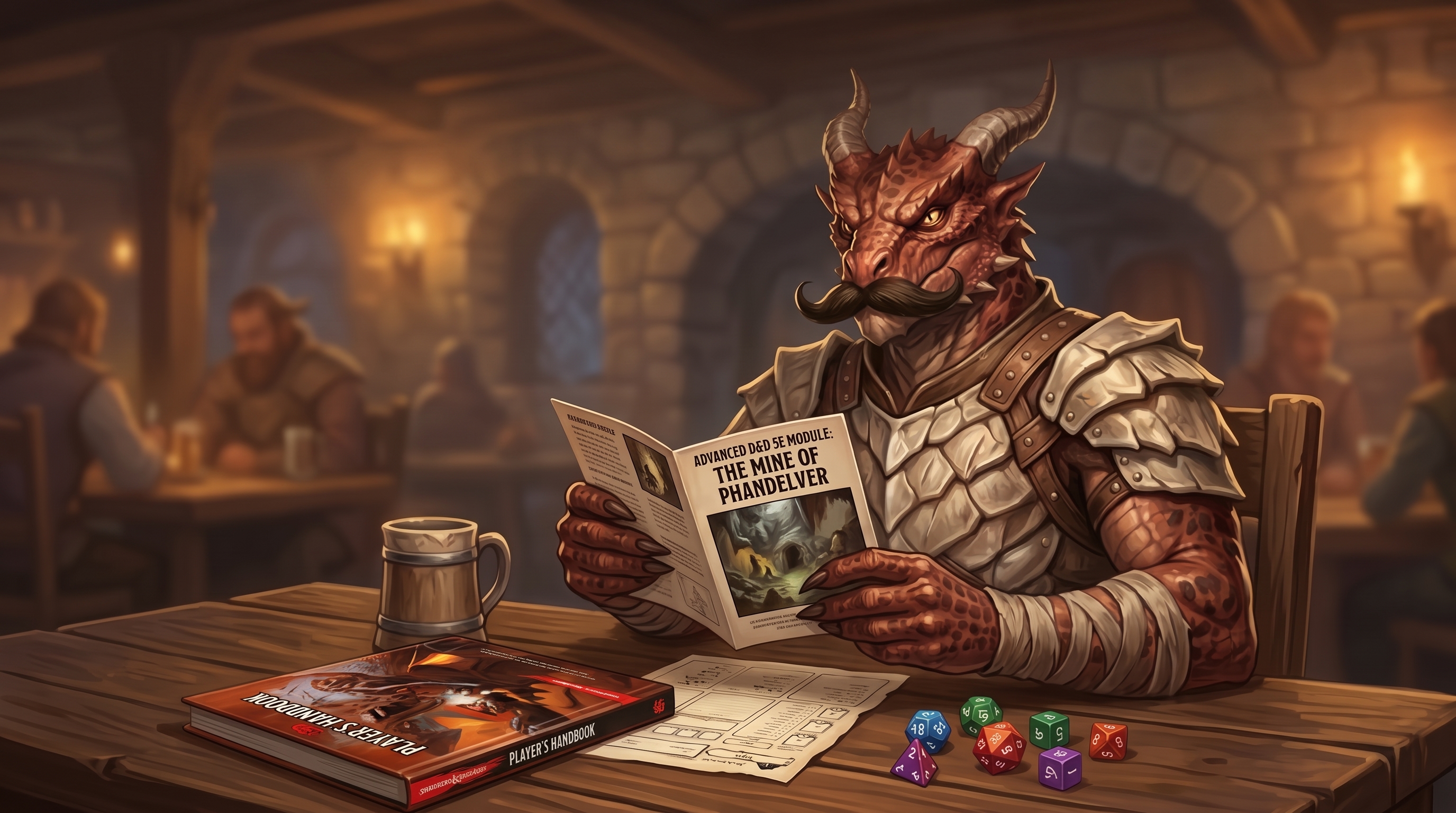
It’s October. You just bought the scary book.
You know the one. Cover art with fake grease stains on it. Forty pages of derelict hallways and wrong-shaped teeth. You read the whole thing in one sitting on your phone in bed, which was a mistake, and now you want to run it at your table on the 31st.
Then you hit the back page and your stomach drops. Wrong stat blocks. Wrong saves. There’s a whole subsystem in there called Stress, and your group plays D&D 5e, where “stress” is what the DM feels when somebody asks about crafting rules.
So you search for a conversion guide. And every single one tells you the same thing. Swap the monsters. Eyeball the DCs. Keep the story, dump the math. Cool. Thanks.
Not one of them mentions the horror rules, which, guess what, are the only reason you bought the book.
Let’s fix that. This post covers why the usual advice fails on horror modules, a three-question diagnostic I call the Load-Bearing Test, and a five-step method for porting a scary module into whatever system your table actually plays.
“Just Go Play the Real Game” (Sorry, No)
The loudest answer online is the blunt one. The Angry GM put it about as plainly as it gets: D&D is not made for horror, and the newer the edition, the worse it gets (The Angry GM).
He’s not wrong. He’s also not helping you.
Because you already bought the module. It’s Thursday. Your group plays what it plays, three of them barely learned their own character sheets, and nobody is downloading a second rulebook by the weekend. “Go run a different game” is technically correct advice that solves nobody’s actual problem.
So we’re doing the other thing. And doing it on purpose, with our eyes open, which beats doing it by accident at the table at 9 p.m.
Why This Keeps Happening to Everybody
This is not a you problem. It’s a math problem baked into the hobby.
Back when Roll20 still published its Orr Reports, D&D 5e sat at 53.7% of campaigns on the platform in Q2 2021, while Call of Cthulhu held second place and jumped from 10.95% to 16.3% in a single quarter (Roll20). Half the tables play one game. A big chunk of the horror material is written for the other one.
It gets better. The same data set showed Call of Cthulhu campaigns running about 11.9 hours of total play, against roughly 40 hours for other systems (Bell of Lost Souls). Horror material is built short. One-shots. Weekend sessions. Exactly the shape of a Halloween slot, and exactly the shape of a thing you bolt onto a campaign that plays something else.
And the supply keeps climbing. Mothership Month in November 2024 pulled $1,001,068 across 21 projects from 23,116 backers (BackerKit). That’s a seven-figure wave of horror modules landing in the hands of people who mostly run something else.
Millions of dollars of scary books. Half the tables playing the one game those books aren’t written for. October every year like clockwork.
The Load-Bearing Test
Here’s where the standard advice falls apart.
“Keep the fiction, drop the mechanics” works fine for a dungeon. A goblin is a goblin. But in a horror module, the subsystem is the fiction. Rip out Sanity and you didn’t simplify the adventure, you deleted its spine and kept the skin.
So before you touch anything, run three questions on the rule you’re about to convert. Ask what it’s holding up.
Question 1: Is it a pacing resource? Sanity works like a health bar for the plot. Every revelation spends some down. The author used it to control how fast the truth arrives. If you delete it, the module doesn’t get easier. It gets shapeless.
Question 2: Is it a pressure gauge? Stress is a number that climbs and makes everything else worse. It doesn’t gate information. It squeezes.
Question 3: Does it remove choice? Panic tables fire at the worst possible moment and take the wheel for a round. That’s the point. That’s also the part your players will hate if you port it badly.
Three different jobs. Three different rules. And they are not swappable.
Mothership designer Sean McCoy got asked directly whether Stress and Panic model the classic descent into madness. His answer was no. Call of Cthulhu already owned that ground, and the “person go cuckoo” vibe isn’t our thing, he said (Grognardia). Stress measures a person cracking under pressure. Sanity measures a person learning too much. Mapping one onto the other one-to-one converts the number and throws away the job.
Convert the job. Not the number.
The Load-Bearing Swap: Five Steps
Alright. Numbered list time, because this is a blog and I know what you’re here for.
1. Steal the Trigger List
Open the module and write down every single thing that costs the players something mental. The basement door. The photograph. The thing in the tank. Write the cost next to it.
That list is the most valuable object in the book, and you paid for it.
It isn’t a rules artifact. It’s the author telling you exactly where they buried the horror, scene by scene, with a price tag attached showing how bad each one is supposed to be. A 1-point loss is a shiver. A 1d10 loss is a sit down and breathe moment.
Copy that list onto one page. Now you own the module’s pacing, and you can run it in literally any system, because a list of scary moments ranked by severity is system-agnostic. Everything after this is bookkeeping.
2. Match the Shape, Not the Number
Now pick a track in your system that climbs the same way.
Going into 5e? Don’t add a Sanity ability score. The Dungeon Master’s Guide already tried that and GMs keep bouncing off it, largely because a short-term madness result can burn 1d10 minutes and yank a player out of an entire fight (Flutes Loot). Losing a turn isn’t scary. It’s a queue.
Build a climbing counter that never skips a turn. Somebody already did the work: a 5e Stress condition where each level subtracts from your d20 tests and panic hits at level 6 (EpicSavingThrow). Numbers on a sheet that get uglier are scarier than a condition that flips on and off.
Why does that work better? One GM nailed the reason after three years of Curse of Strahd followed by one session of Mothership. His table was occasionally Frightened, but never afraid, because an unmodified d20 save never felt earned (seanmcp.com).
A save you pass is a shrug. A number that keeps climbing is a boss health bar pointed at your friends.
3. Do the HP Arithmetic (Yes, Really)
This is the step that breaks modules.
A Call of Cthulhu investigator carries somewhere around a dozen hit points. Two bad rolls and you’re picking a new character. A 5th-level D&D fighter is sitting on roughly 45 hit points, plus death saves, plus a friend with Healing Word, plus a short rest.
Every horror subsystem you’re importing was written assuming a character who can die tonight. Drop it onto a 5e party and the pressure gauge is pointed at a tank.
Don’t think this is theoretical. When Mothership moved from 0e to 1e, weapon damage got cut roughly in half, shotguns going from 4d10 down to 2d10, while some third-party horror HP totals stayed exactly where they were. A Warden ran it and reported it playing badly (itch.io). That’s a same game, one edition apart desync. You’re jumping a much wider gap.
Three fixes, pick one:
- Cap it. Run the module with level 3 characters, max. Cheapest option, works immediately.
- Pull the net. Death saves off, or one death save only. Tell them up front.
- Route around HP. Make the horror track bypass hit points entirely. The Stress counter climbs no matter how beefy you are, and a 60-HP paladin with 5 Stress is still shaking.
Option three is my pick, because you change nothing about combat and everything about the mood.
4. Write Effects, Not Diagnoses
Old horror tables are full of results that name a mental illness and play it for laughs. Modern designers moved off that on purpose, and Mothership specifically pulled clinical language out of its panic results in 1e.
So when you write your table, describe what the character does. “You drop what you’re holding and back toward the door.” Not a label.
Your table will thank you, and it plays better anyway, because a concrete action gives the player something to roleplay and a diagnosis gives them a sticker.
5. Cut One Track On Purpose
Most horror modules run two or three parallel mental tracks. You are going to lose one. Choose which.
A GM running the Mothership module Gradient Descent on a different system reported the real-world version of this: Sanity became Willpower, Stress became Fatigue, and the module’s third track got dropped entirely (itch.io).
That’s the whole game in one comment. Two tracks survived because they mapped. The third just quietly vanished, and the module lost a pillar nobody announced.
Did that ruin their campaign? Nope. Well, actually, kind of, because they never got to find out what the third track was for. But they made the call knowingly, which beats discovering the hole mid-session.
So pick your casualty before session zero, not during scene four.
What It Costs You (The Honest Bill)
Converting a Call of Cthulhu scenario into 5e costs you fragility. Investigators are made of tissue paper, and half the dread comes from knowing it. You can claw some back with step 3, but you will never fully recover the feeling of being a normal person holding a revolver.
Converting a 5e adventure into a horror system costs you the toy box. Class abilities, spell lists, the whole build-craft layer your players enjoy. Some of them signed up for that. Ask first.
And this isn’t uncharted ground, by the way. Liminal Horror publishes a free conversion guide that says outright that replacing Sanity won’t be a one-for-one swap, with actual Stress budgets and system-by-system notes (Liminal Horror). It converts everything into Liminal Horror rather than out, so it won’t solve your 5e problem, but read it. It’s good and it’s free and the author clearly did the reps.
For the general “keep the story, rebuild the mechanics” philosophy, Sly Flourish is still the cleanest writeup going (Sly Flourish). It stops right where the horror starts, which is why this post exists.
Run It Saturday
You’re out of October. Here’s the under-an-hour version.
- Read the module once. Mark every mental cost with a highlighter. Fifteen minutes.
- Copy the trigger list onto one page, sorted small to large. Ten minutes.
- Pick your climbing counter and write six results for what happens when it maxes. Twenty minutes.
- Decide your lethality fix and tell the group before session, not during. Two minutes.
- Pick the track you’re cutting. Thirty seconds, and be honest about it.
That’s it. That’s the prep.
(I just counted and I used the word “track” eleven times in this post. I choose to curse myself and move on.)
Keep the Horror, Ditch the Stat Block Panic
The usual conversion advice treats a horror module like a dungeon with better lighting. It isn’t. The subsystem is the reason the module is scary, and “drop the mechanics, keep the story” quietly throws out the part you paid for.
So run the Load-Bearing Test first. Figure out whether that rule is pacing your revelations, squeezing your players, or stealing their turns. Then swap the job, not the number, and do the hit point math before your unkillable party walks into a scenario built for people who die.
Your homework, and I want you to actually do this one: open the module sitting in your downloads folder right now and build the trigger list. Just that. One page, scary moments ranked by cost. Twenty minutes, tops.
Then tell me what you found. Drop your worst conversion disaster in the comments, the one where the players shrugged off the monster that was supposed to end the campaign. If this helped, subscribe, because next time we’re doing the reverse: running a D&D module in a horror system without the party feeling like they got demoted to level 1.

Posted on October 19, 2026, in Blog. Bookmark the permalink. Leave a comment.




Leave a comment
Comments 0