Fan of the Characters, Faithful to the Dice
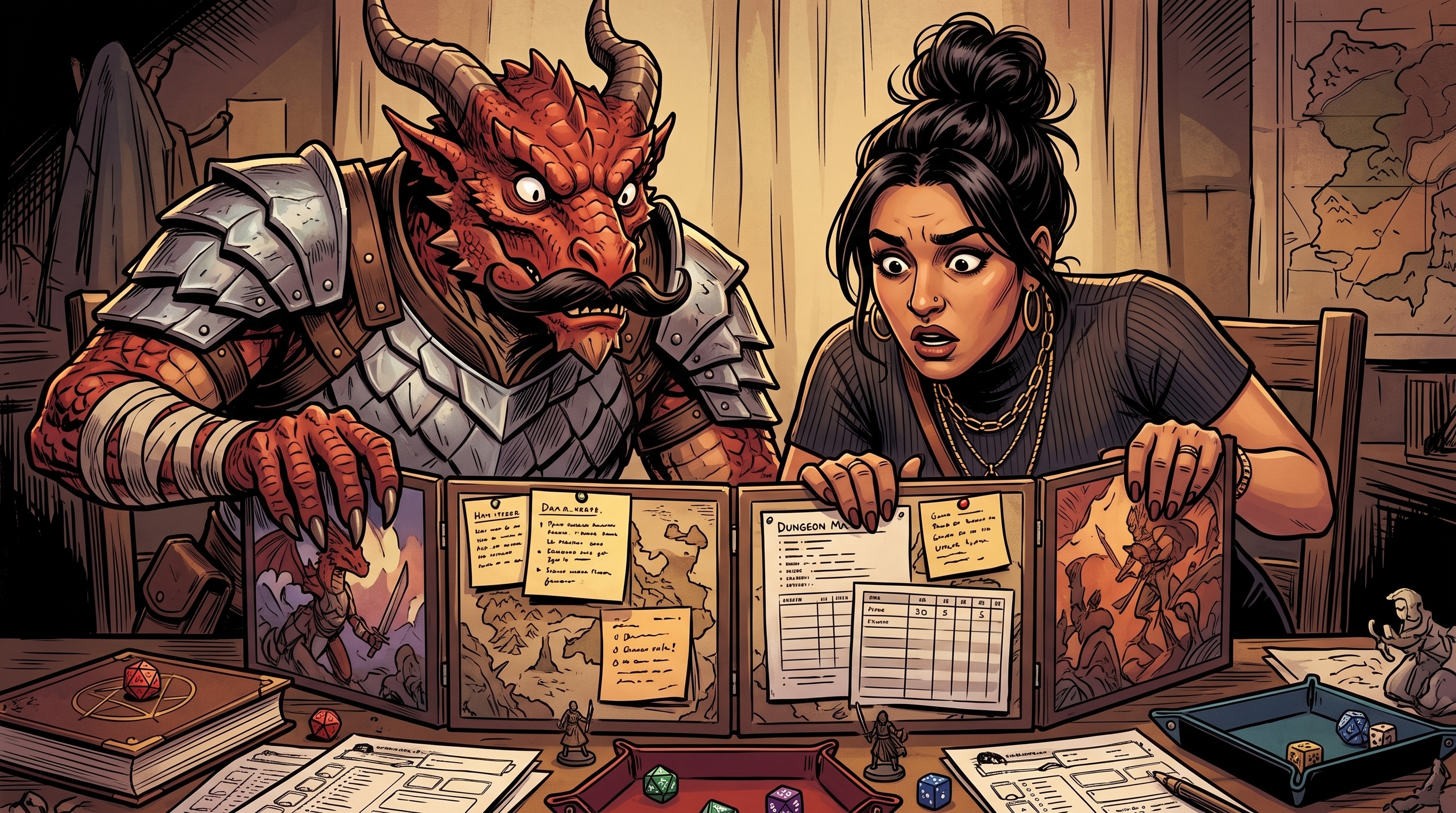
The janni’s turn came up, and for once, I didn’t want it to.
My group was deep into Legacy of Fire, Paizo’s desert adventure path for Pathfinder first edition. Four players. People I’ve run games for over decades. We’ve buried characters together before, and we’ve survived to argue about it over snacks.
Their enemy that night was a janni. A master of deception, illusion, and general thievery, he wanted a scroll the party had just picked up. He also had a nasty trick called Sirocco. Picture an industrial sandblaster. Now picture it aimed at people instead of rusty steel. It doesn’t strip paint. It strips flesh from bone.
The party had survived two Siroccos already. Everyone was gravely wounded. So was the janni. Then he snatched the scroll from a PC’s hands and got ready to bolt.
In desperation, the party surrounded him. Swords out, spells ready, one last push to drop him before he could escape or blast them a third time.
Then his turn came up.
I looked at the map. Everyone stood close to the janni. Everyone was hanging by a thread. One move could end the whole campaign in a total party kill.
So I looked at his sheet. I hunted for a reasonable alternative, something that made sense for him and didn’t risk ending a campaign we’d all poured so much into. Nothing fit. A wounded thief, prize in hand, enemies on every side? He’d use his best weapon. Of course he would.
I looked up at my players. I watched grudging acceptance settle over their faces as I announced it. Sirocco. One last time.
Saves were rolled. Damage was rolled. Half the party fell. The other half stayed standing by a sliver. If that damage roll had been a little better, it would have been over.
I made the right call for the villain. It still felt awful. And in that moment, I thought about Jasmine Bhullar’s reaction at the end of a recent Dungeon Masters episode. I finally understood it.
So let’s talk about her. What happened at her table, why a fair kill still hurts, and how she roots hard for her players’ characters while letting the dice tell the truth.
What Happened at Jasmine’s Table
Spoilers ahead, so pause here if you’re behind.
Dungeon Masters is the official D&D actual play show from Wizards of the Coast, and Bhullar runs it. Its third campaign takes the cast to Azeroth with the new D&D: World of Warcraft rules. The party is a struggling Horde guild called Afterlife.
In Episode 5, “The Mask”, things go sideways fast. Christian Navarro’s goblin rogue, Mistik, is down and dying inside an enemy stronghold. Neil Newbon’s death knight, Greave, scoops him up with one arm, a stolen mask in his other hand, and runs for the barricade.
The table throws everything it has at the escape. Devora Wilde rolls a natural 20. Cargo the party dumped earlier buys them 10 extra feet. For a second, it looks like they’ll make it.
Then the mounted crossbows swivel. A sniper takes two shots. The first one misses. The second one doesn’t. Bhullar rules that the bullet punches through Greave and into Mistik. Navarro rolls a death save.
He fails.
Navarro plays out Mistik’s last moment himself. The goblin sees the partner he lost drawing closer, and he’s at peace. Bhullar closes the scene by sending Mistik to join the goblins killed in Arthas’s betrayal. Then she calls a break.
The second the break starts, she’s in tears. “I hate killing players,” she tells the cast. They rush to reassure her that it’s okay.
Navarro seems to agree. He later told Collider that he fought to keep Mistik alive until the odds were clearly hopeless, and that he found the final fight calm and even satisfying. Death gave Mistik a chance to see the people he loved again.
Why a Fair Kill Still Hurts
Here’s what makes her reaction interesting. Bhullar is not a GM who shies away from pain.
Her first Dungeon Masters campaign was gothic horror in Ravenloft. She told Temple of Geek that her job was to apply just enough pressure to make the characters crack. When a player said D&D was supposed to be fun, her answer was simple: “You cry in D&D!”
So sad endings don’t scare her. Why the tears?
The best clue comes from her live Behind the Screens talk with Matt Mercer. Her very first question to him was whether the bad feeling ever goes away. She admitted she goes home and cries whenever she gets a rule wrong or an encounter falls flat. (Mercer’s answer? Nope. Never.)
Later in the same talk, she explains how she sees her players. Every person at her table, she says, shows her a piece of their spirit through their character. She calls it a privilege to give that piece room to breathe.
Put those two ideas together and the tears make sense. Mistik wasn’t a token on a map. He was a part of Navarro, and Bhullar was the one who had to end him. She did her job fairly. It hurt anyway.
That’s not a weakness. That’s the price of caring.
And it matches what players report. In a Sly Flourish poll of 631 tabletop players from 2019, only 15% said they always enjoy it when their character dies. Another 57% said sometimes, and 8% said never. Character death can be great storytelling. It just isn’t automatically great.
That’s the weight I felt behind my own screen. The janni wasn’t threatening four sheets of paper. He was threatening decades of stories my friends had built.
Be a Fan of the Characters
There’s an old piece of GM advice from the Apocalypse World family of games. Dungeon World tells the GM to be a fan of the PCs. As Angela Murray points out at Gnome Stew, that doesn’t mean making life easy for them. Real fans want their heroes to face hard things, because that’s when heroes get to shine.
Bhullar never quotes that rule, as far as I can find. She just lives it. Here’s what that looks like, pulled from her own words.
She listens more than she talks. In the Mercer talk, she shares a breakdown from producer Michael Schaubach. Mercer writes ballads. Brennan Lee Mulligan writes epics. Bhullar writes prose, a little offbeat. Her own take? She’s a listener. She’s never planning her next line, and she’ll toss her notes the second the players go somewhere better.
Try it: Next session, when a player does something surprising, ask a follow-up question before you react. “What does your character hope happens next?” Then build from the answer.
She holds on gently. Mercer once gave her that advice over ramen, and she says it changed how she sees the whole game. The story isn’t hers. It’s everyone’s. The GM brings a story to share, not one to defend.
Try it: Pick one plot point you’re precious about. Write down two other ways it could go if the players push on it. Now you’re ready instead of rigid.
She lets players break things. When players wreck a key part of her world, she doesn’t panic. She compares it to real history, where one discovery can flip everything people thought they knew. A broken world, she says, feels more lived in.
Try it: When the party derails your plan, list three ripple effects of what they did. Those ripples are your next session.
She reads the room. Bhullar wants peaks and valleys. Silly stretches make the serious moments hit harder. Once, when a player was going stir crazy after too much combat, she made up rules for a slap-fighting tournament on the spot. That player called it the best D&D game of her life.
Try it: If your table has the giggles, slide the big villain speech to next week. Fighting the mood is an uphill battle.
Be Faithful to the Dice
Now for the twist. Being a fan of the characters does not mean rigging the game for them.
Before Dungeon Masters premiered, the cast sat down with mxdwn Television. Newbon jumped in to say they all know she doesn’t fake or fudge rolls. Bhullar backed him up: “I’ve never thumbed the scale.” Sometimes the players flatten a boss she expected to be tough, she explained. Sometimes the boss flattens the players. Either way, it’s real.
That makes her a bit of an outlier. In Sly Flourish polls, 70% of 914 DMs said they hide their rolls (2017). A later poll of 1,321 DMs found 92% were willing to change a monster’s hit points mid-fight (2021). A roundup of fudging surveys at Seed of Worlds puts the share who think fudging is not okay at about one in five. Bhullar sits in that small group, on camera, with the whole internet watching.
Why does it matter? Because a fudged win is a gift. An honest win is an achievement. Your players can feel the difference, even when they can’t prove it.
Look at the Mistik scene again. Her rulings cut both ways. The sniper lost advantage because it was shooting through a torn tent flap. The party’s dumped cargo really did buy them 10 feet. She played fair for the heroes and fair for the villains. So when the bullet landed, nobody at the table felt cheated. They felt gutted. Those are very different feelings.
One honest note: not every great GM draws the line in the same spot. In that same talk, Mercer says the rules can take a back seat when they get in the way of the players’ joy. His example is helping a grieving party find a story path to bring back a disintegrated friend, even if the rules say it can’t be done.
But notice where he bends. Not the roll. The road after the roll. That’s the pattern I see in both of them. The dice decide what happened. The table decides what it means.
That’s also why my janni had to use Sirocco. Any other choice would have been me playing the players’ side instead of the villain’s. The grudging acceptance on my players’ faces wasn’t anger. It was trust.
Root Loudly, Roll Honestly: Five Habits to Steal
So how do you cheer for the characters and still let them die? Here’s the method I’ve pieced together from Bhullar’s table and my own. I call it Root Loudly, Roll Honestly.
1. Have the death talk before the fight
Bhullar told mxdwn she talked with her players at length about how attached they were to their characters. Some arcs, she said, shouldn’t end with a random bullet, so she works with each player on how their story might close.
You can do this in a two-minute private message. “If your character died, what ending would feel meaningful? Would you want the party to try to bring them back?” Now a death has a plan, not just a body.
2. Show the danger before it lands
My janni used Sirocco twice before the deadly third blast. My players knew exactly what was coming, and they chose to surround him anyway. That’s a brave choice, not a trap.
Bhullar’s barricade worked the same way. The crossbows were on the map. The sniper was in the story. Make sure your deadliest threat has been seen before it kills anyone.
3. Run the Mirror Test
Before a villain’s turn that could wipe the party, ask yourself one question: would this choice make sense if my players could read the stat block?
A cornered janni blasting his attackers to escape? Passes easily. A monster ignoring the fighter to stab a downed PC out of spite? That’s you, not the monster. If the choice passes, make it. If it fails, find a better one.
4. Roll the big one in the open
That 70% figure means most of us hide our rolls. Fine for goblin number six. But when a roll could kill someone, put the dice on the table. It turns the scariest moment of the night into one everybody shares. Nobody wonders whether you went easy or went cruel. They saw it.
5. Hand over the final beat, then take a break
When Mistik fell, Bhullar let Navarro play the goblin’s last moment before she narrated anything. Then she called a break. Steal both moves.
Ask the player how their character goes out. Then stop the game for ten minutes. Get water. Let people react. Mercer says he asks his players what they enjoyed after nearly every session, so check in before you pick the dice back up.
And if you need a minute too? Take it. Bhullar cried in front of an audience. You’re allowed to feel it in front of four friends.
The Dice Decide. You Decide What It Means.
It’s easy to think a GM has to pick a side. Be the friendly one who protects the heroes, or be the hard one who lets them die. Bhullar shows that’s a false choice. She roots for her players’ characters with her whole heart, and she still lets the sniper roll.
The tears aren’t a sign she did it wrong. They’re proof she did both jobs at once.
I think about that janni a lot now. Half my party hit the dirt, and the other half was one bad roll from joining them. I didn’t fudge, and I didn’t gloat. I let the villain be a villain and the dice be dice. My friends trusted me to do exactly that, and that trust is worth more than any single character.
So here’s your homework. At your next big fight:
- Send each player that two-minute death-talk message beforehand.
- Run the Mirror Test before any villain turn that could end the campaign.
- Roll the deadliest attack where everyone can see it.
- If someone falls, hand them the last beat, then call a break.
Then come tell me how it went. Drop your own “fair kill that still hurt” story in the comments. Mine involves a janni, a scroll, and a whole lot of sand, so the bar is set.
Root loudly. Roll honestly. And when it hurts, let it.

Posted on November 2, 2026, in Blog. Bookmark the permalink. Leave a comment.





Leave a comment
Comments 0