The Five-Tier No-Mini Stack: Every Battlemap Alternative, Ranked
You spent $150 on the core rulebooks. Your players showed up. Someone asks, “Wait, do we need minis?” and suddenly the whole table is staring at you like you forgot to bring the final boss.
Sound familiar?
Here’s the thing. The TTRPG market is sitting at roughly $1.87 billion globally and growing fast. Tens of millions of people play these games. The vast majority of them do not own a foam-core dungeon tile set or a hand-painted orc collection. And yet somehow, the conversation always circles back to: do you have minis?
No. We don’t always have minis. And guess what? We don’t need them.
This post is for the Game Masters running kitchen-table D&D, pub sessions, or weekend one-shots who need real solutions — not a lecture about how theatre of the mind is philosophically superior (it isn’t, unconditionally, and we’ll get to that). We’re going to break down every tier of alternatives from zero-cost to low-cost, figure out which ones actually work, and rank some household objects along the way.
Why Minis Are a Gear Check You Didn’t Sign Up For
Let’s talk numbers for a second. A single Reaper Miniatures human-sized figure runs about $5 in their best plastic. A pack of three skeleton enemies costs around $7. Want 100 skeletons for your undead army campaign? That’s $231. Just for skeletons. Just for one monster type.
And before anyone says “but you can reuse them” — yes, technically. But you also need to buy them first, store them, transport them, and if you paint them (which you will feel pressured to do), spend weeks of your life on them. Minis are a hobby inside a hobby. They are a subscription boss fight you didn’t know you were queuing for.
The core D&D rulebooks already run around $150. Minis are on top of that. Then there’s the battlemap. Then the dry-erase markers. Then the terrain. Before you know it, you’ve spent more on a dungeon setup than on actual rent — and that’s not even a joke for some players.
So. Alternatives. Let’s go.
The Five-Tier No-Mini Stack
Think of this like a JRPG equipment loadout. You pick the tier that fits your budget, your table, and your session prep time. None of these are wrong answers. All of them work. Some of them work better than minis for specific situations.
Tier 0: Pure Theater of the Mind (The Speedrun Build)
No map. No tokens. No grid. Just descriptions.
Theater of the mind is free. It costs nothing. It fits in a backpack that doesn’t exist. And for the right kind of fight — one big monster, a small group, a quick hallway ambush — it runs fast and keeps the energy high.
Theater of the mind also has a ceiling. The moment you have more than about eight characters and enemies on the field, players start losing track. “Wait, am I next to the archer or the wizard?” becomes a full-minute argument. Fights with mixed troop types, flanking strategies, or area-effect spells get genuinely confusing.
That’s not a flaw in theater of the mind. It’s just the tool’s honest range. Classic D&D combat rules were originally designed for miniatures and then ported over to theater of the mind — and the fit has always been a bit awkward. Don’t force the square peg.
When your fight is small and narrative, Tier 0 rules. When it gets complex, move up.
Tier 1: Abstract Maps and Numbered Dice (The Secret Mid-Tier)
This is the one that doesn’t get enough love. It sits between pure narration and a full grid, and it is genuinely good.
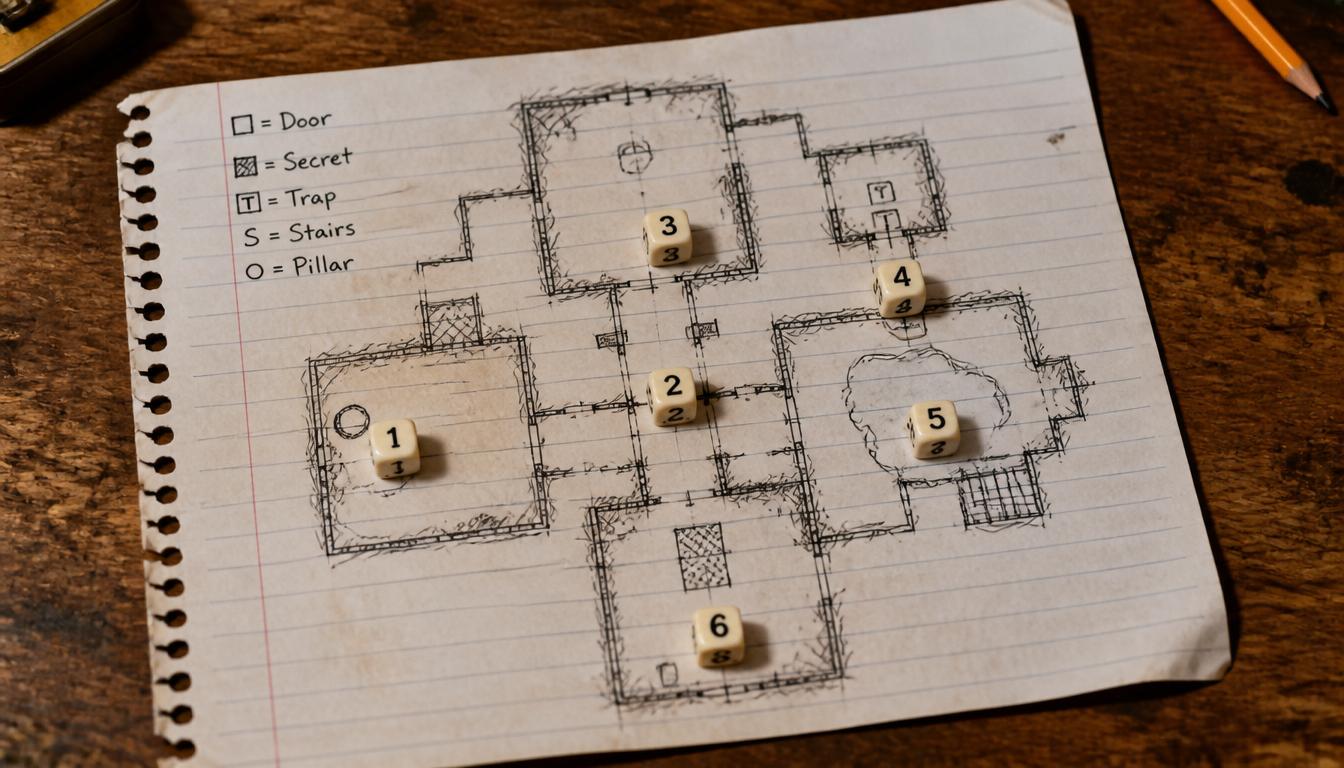
Here’s how it works. Before combat starts, sketch a rough diagram of the space. Not a precise map. Not to scale. Just the important stuff: the door is here, the column is there, the pit is on the right side. Think football play diagram. Think back-of-the-napkin.
You can draw it on scrap paper. On a paper plate. On the back of a takeout menu. On a whiteboard. It literally doesn’t matter.
Now for the monsters? Grab your d6 dice. All of them. Drop them on the sketch.
The die showing “1” is the Goblin Shaman. The die showing “2” is the warrior who already took damage. The die showing “3” is the untouched one who’s about to ruin someone’s day. Number them, label them, track them. It works better than you’d expect, and it takes about thirty seconds to set up.
Abstract maps solve the main complaint people have with theater of the mind: nobody knows who is standing where. The map answers that question without requiring any actual miniatures, grid squares, or prep time.
Tier 2: Zone-Based Combat (The Game Designer Brain Unlock)
This one reframes how you think about the whole encounter space.
Instead of tracking exact 5-foot squares, you divide the battlefield into zones. Front. Back. Flank. High Ground. Chokepoint. Doorway. Characters are in a zone, not on a specific square. Moving from one zone to another costs an action or part of a move. Being in the same zone as an enemy means you’re in melee range.
You still draw it out, but now you’re drawing labeled blobs instead of a precise grid. A napkin sketch of four connected zones takes ten seconds.
Games like 13th Age use this system natively. The indie scene has been running on zone-based combat for years. It is especially good for groups who want some spatial structure without the overhead of counting squares.
Big bonus: zone combat works really well for unusual spaces. Multiple floors. Moving vehicles. Verticality. Try tracking a fight on a moving cart with 5-foot squares. Now try “the cart has three zones and enemies can leap between them.” One of those is fun. The other is a spreadsheet.
Tier 3: Printed Paper Minis (The Craft Table Solution)
OK, so here’s where we get a baby bit craftsy.
Paper minis are exactly what they sound like. You print them, cut them out, fold them into little standees, and slot them into a base. The result looks better than a numbered d6, doesn’t tip over (if you do it right), and gives players a visual they can actually look at.
For D&D-specific art, Printable Heroes is the go-to. It’s a massive library of high-quality paper minis and it’s free for the base versions. OkumArts Games covers sci-fi, horror, and pulp genres if D&D isn’t your thing. On itch.io, creator DiAma1 has released over 200 free printable paper minis — full fantasy roster, just download and print.
The bases are the key upgrade. A tiny square of foam core works. A cheap acrylic base from Litko works even better. Either way, you’re looking at practically zero cost if you have access to a printer.
One veteran DM ran an entire Pathfinder: Reign of Winter campaign with home-printed minis. The process: Google the monster, paste the image into a Word doc sized to one-inch squares, print in black and white, cut out. Disposable. Replaceable. And you can do things no official mini pack will ever give you — custom NPCs, specific creatures, that one very specific frost troll variant that doesn’t exist in any product line.
Is it fiddly? A little. But so is assembling minis, and nobody complains about that.
Tier 4: Acrylic Standees (The “I Want It to Look Good” Solution)
You want something that looks more polished than paper but doesn’t require a paint job. This is your tier.
Acrylic standees are printed images mounted on clear plastic bases. They’re flat, which means some people don’t love them aesthetically. But here’s why they actually win: portability.
ArcKnight standees get mentioned over and over again in DM communities specifically because of this. A full campaign’s worth of ArcKnight standees fits in a single folder. You can run a pub session with your entire monster roster in your backpack. That is a feature worth paying for.
Flat Plastic Minis covers both fantasy and sci-fi, which most standee lines do not. If you run anything outside the standard D&D fantasy genre, that matters.
Cost sits between paper minis and actual plastic minis. Not free, but way below the $7-per-three-skeletons math we did at the top.
Tier 5: Tablet or TV as a VTT (The Tech Table Build)
If your table has a flat screen or a tablet you can lay horizontally, you now have a battlemap. Full stop.
Owlbear Rodeo is the answer here for simplicity. Free tier, no account required for players, runs in a browser. You pull up a map image, drop tokens on it, and your TV is now a tactical grid. Players point at the screen. You move tokens. Done.
Roll20 has over 3.1 million monthly active users for a reason. It works. The free tier covers everything a basic D&D session needs. There’s a learning curve, but if you already run games online, you probably already know it.
The tech route has a setup cost of time rather than money. Worth it if you run campaigns long-term. Overkill for a one-shot at someone’s kitchen table.
The Household Object Tier List (Because We Had To)
You’re reading a TTRPG blog. You know this had to happen.
Coins: S Tier. Different denominations read as different creature sizes. Quarters for medium enemies, dimes for small ones, that one foreign coin you found in a jacket pocket for the BBEG. Stackable. Durable. Already in your wallet.
Candy: A Tier with an asterisk. Works great until a player eats the goblin. Enforce a “no eating the battlefield” rule or watch your encounter dissolve in real time. Gummy bears read surprisingly well as small creatures.
Bottle Caps: B Tier. Good mass. Write on them with a marker. Downsides: you need to drink the bottles first, and writing wears off faster than you’d want.
LEGO Figures: B Tier. Every household has at least three of these hiding under couch cushions. Scale is wrong but nobody cares. The minifig energy is actually kind of great.
Action Figures: C Tier. Scale chaos. The six-inch Batman does not fit next to a one-inch grid square in any meaningful way. Fun for laughs. Not for tactical positioning.
Salt and Pepper Shakers: D Tier. I respect the chaos. I do not recommend the chaos. Someone will grab one mid-combat for actual seasoning purposes and you will lose track of the dungeon boss.
Wait, What If The Problem Is Your Game?
Real talk for a second.
If you are constantly fighting your system to make it work without minis — if zone combat feels like a hack, if theater of the mind always breaks down, if the abstract map never quite captures what you need — maybe the system is the problem, not your setup.
Games like Blades in the Dark, Cairn, and Mörk Borg are built from the ground up to not need grids. Blades in the Dark runs almost entirely in narrative free play. There is no combat grid because the game doesn’t ask for one. Cairn treats combat as a fast, dangerous exchange of fictional positioning, not a tactical puzzle with measured squares.
These are not lesser games. They’re different designs with different priorities. If you love tactical grid combat, D&D and Pathfinder are built for that and paper minis are your solution. If the grid is a pain point rather than a feature, the indie game space has a massive library of systems that removed it entirely.
That’s not a dig at any system. It’s just a flag that says: you have options at the game design level, not just the accessories level.
So. What Do You Actually Do?
Here’s the short version.
Small fight, fast session, you have five minutes of prep: sketch an abstract map and use numbered dice. Done. Zero cost. Works tonight.
You want paper minis: go to itch.io, search DiAma1, download the free pack, print before your session. One hour of work, reusable forever.
You want something that looks sharp and packs small: look at ArcKnight standees. One purchase, portable forever, folder fits in a backpack.
You have a TV or a spare tablet: Owlbear Rodeo. Browser, free, done in ten minutes.
You’re running a long campaign and keep hitting the limits of your current system: look at Cairn or Mörk Borg. Free to read online. Different design DNA. Might fix what’s actually frustrating you.
The main takeaway here is that minis are one solution to a spatial tracking problem. They are not the solution. The $231 skeleton army is optional. The numbered d6 on a napkin map is not a lesser version of the game. It is the game.
Roll initiative.

Posted on June 15, 2026, in Blog. Bookmark the permalink. Comments Off on The Five-Tier No-Mini Stack: Every Battlemap Alternative, Ranked.




 Rokk Talk