Three Archetypes of Side Quests That Never Waste Time
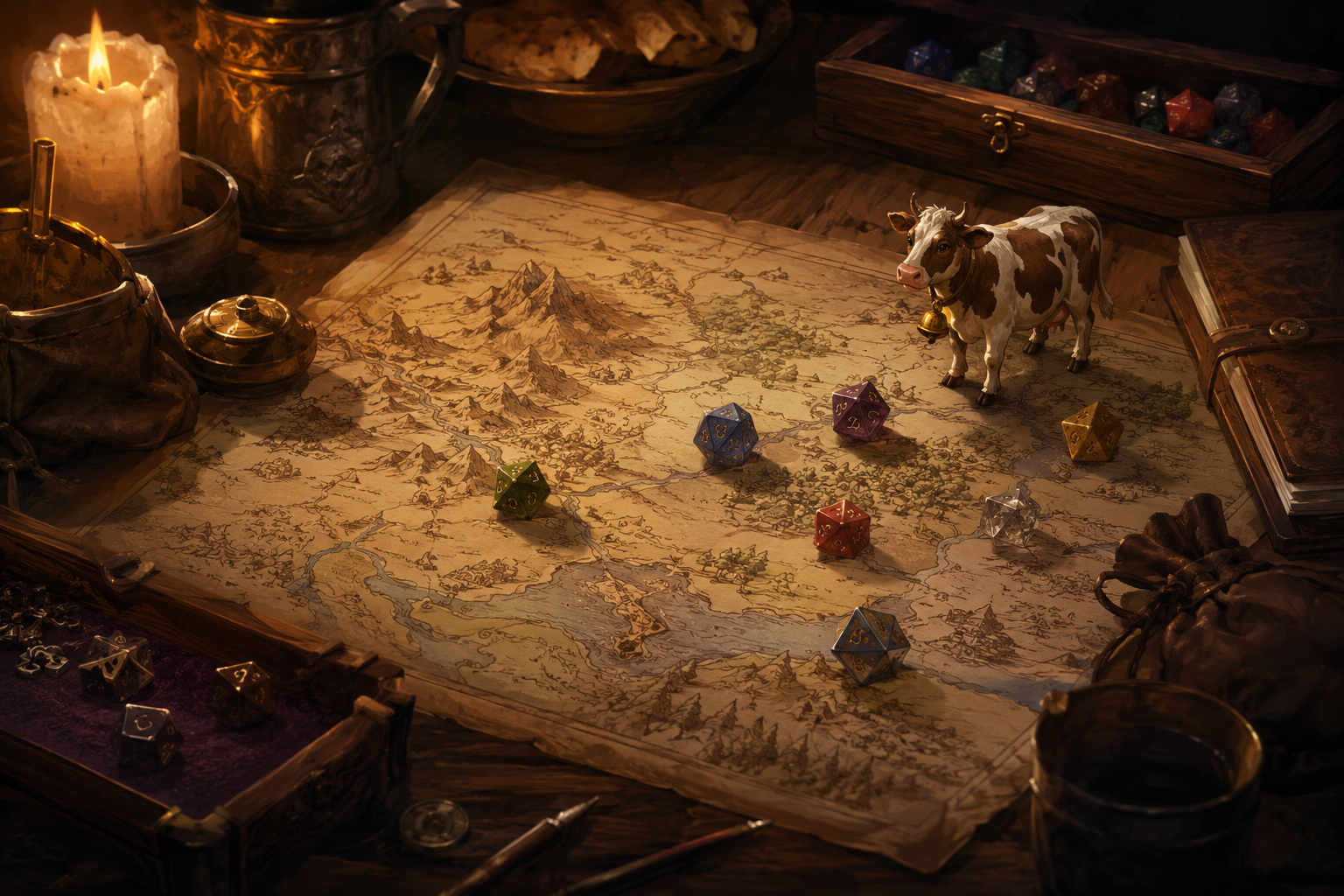
Picture this. Your party just walked into a random town you drew up in fifteen minutes. A farmer runs up, out of breath, and says her cow is missing. “Please, kind adventurers, will you find my cow?”
Your players look at each other. You can see the exact moment their eyes glaze over. One player checks his phone. Another starts doodling on her character sheet. Somewhere, a d20 rolls off the table and nobody chases it.
That’s the sound of a side quest dying on arrival.
Look, we’ve all been there. As a GM, you know your campaign needs texture between the big story beats. You know players want to feel like the world is bigger than the main plot. So you throw together a quick “go find my missing cow” errand, and rather than adding life to your table, it sucks the air out of the room.
Here’s the good news: side quests aren’t the problem. Bad side quests are. And once you know what separates a quest that earns its spot at the table from one that’s just filler with extra steps, you’ll never run a dead-cow errand again.
Stay with me here, because this is going to save you hours of prep and about a dozen “can we just skip this?” looks from your players.
Why Filler Quests Keep Happening
First, let’s talk about why this keeps happening, because it’s not because GMs are lazy. It’s usually the opposite problem.
Side quests can eat up almost as much prep time as your main story, according to the folks over at Master the Dungeon, who point out that GMs often spend nearly as much energy building optional content as they do the “real” plot. That’s a brutal math problem. You’re putting in main-quest levels of work for something your players could skip completely.
So what happens? You cut corners. And the corner-cutting looks the same every time. The site CraftOrb lays out the usual traps pretty well: quests that are too generic (“go kill the monster,” “deliver this item”), quests that drag on way past their welcome, quests where nobody has any real stake in the outcome, and quests so packed with NPCs and plot turns that even you can’t keep track of them.
The Angry GM, never one to soften a punch, goes even further. His argument is that “make it fun” isn’t actually a good reason on its own for a piece of content to exist. A dungeon full of goblins can be fun to run and still be filler if it isn’t doing a job for your game. That’s the trick question buried in a lot of side quest advice: is a quest “good” because your players enjoyed the fight, or because the fight moved something forward? Turns out those aren’t the same question at all.
One of the sharpest examples of this comes from a breakdown of Curse of Strahd. The party is asked to help a grieving priest bury his father. There’s a vampire spawn locked in the basement the whole time, howling and hungry, and the quest never actually makes the party deal with it. You can just walk in, ask the priest a favor, and walk out. That’s not an adventure. That’s a chore with a d20 attached.
So how do you avoid building the RPG version of a fetch-the-cow errand? You start by understanding that not all optional content is created equal. Some quests are built to survive contact with your players. Others fall apart the second someone asks “wait, why are we doing this again?”
That brings us to the method.
The Three Archetypes (Or: How to Never Waste a Session Again)
I want you to think of every good side quest as belonging to one of three families. Miss all three, and you’ve probably built filler. Hit even one of them clean, and you’ve built something worth the table’s time.
Let’s break them down.
Archetype One: The Character Quest
This is the quest that exists because of who your players are, not because of what’s happening in the world.
A Character Quest is built around a PC’s backstory, a personal goal, or a hard moral choice tied to their identity. Think about the rogue who wants fame more than gold, or the cleric whose god just asked them to recover a stolen relic. The site CraftOrb points to exactly this kind of hook, personal stakes tied to backstory, goals, or faction ties, as the fastest way to make a quest feel like it matters.
Here’s why this works. When a quest is tied to a character’s story, the reward isn’t loot. It’s information about who that person is, and a moment where the player gets to make a choice that says something about them. A cleric who chooses mercy over vengeance in a side quest just told the whole table who they are, and that lands harder than any magic sword ever will.
Quick example: one of the players has a backstory where her character’s little brother went missing years before the campaign started. The GM doesn’t plan a whole arc around it. They just drop one rumor, in one tavern, in one random town. The PC chases it for two sessions.
The tell: if you swapped this quest onto a different character and nothing would change, it’s not a Character Quest. It’s just a job with a name attached.
Archetype Two: The World Quest
This is the quest that exists to make your setting feel alive, and it earns that job by actually leaving a mark.
A World Quest reveals lore, shifts a faction’s balance of power, or changes the state of a location so your players notice it later. The blog Mellow Golem Games calls this idea “living quests,” small callbacks that prove the world remembers what the party did. Their example is simple: an NPC remembers a favor and buys the party a round at the tavern months later. Nothing huge. Just proof the world isn’t frozen while your players aren’t looking.
This is also where the “why does this town matter” question gets answered. A piece from TTRPG Games quotes designer Mark Wilson, who frames bringing a setting to life as a solid reason for a side quest all on its own. Not every quest needs to save the world. It just needs to prove the world exists past the edges of the map you drew.
Here’s the trap, though. A World Quest without any actual change is just flavor text with dice attached. If the town looks and feels exactly the same after your players save it from bandits, you didn’t build a World Quest. You built scenery.
The tell: ask yourself, “will this location, NPC, or faction be even a little different three sessions from now?” If the answer is no, go back and add a change, even a tiny one.
Archetype Three: The Payoff Quest
This is the quest that looks optional but is quietly working for your main plot the whole time.
A Payoff Quest gets the party an ally, an item, a secret, or a piece of information that makes the real story easier, cheaper, or safer to pull off later. This is the design idea behind Justin Alexander‘s node-based scenario writing over at The Alexandrian. Rather than one straight line from A to B, your campaign is a web of connected pieces, and side content plugs into that web without breaking anything. Optional doesn’t mean disconnected. It means the party chose one path to the same destination over another.
Say your main plot is “storm the necromancer’s tower.” A Payoff Quest could be helping a retired soldier who happens to know a secret tunnel into that tower. The party isn’t required to help him. But if they do, the final fight gets a whole lot easier. That’s a quest doing double duty: it feels optional in the moment, and it’s quietly load-bearing for everything that comes after.
The tell: if a “yes” to this quest changes how the main plot plays out, even a little, it’s a Payoff Quest. If a “no” changes nothing at all, it’s filler wearing a disguise.
Here’s a fun trick with this archetype: you can build it backward. Start with your main plot’s toughest wall, whatever fight, negotiation, or puzzle is going to be the hardest part of your next big arc, and ask what single piece of help would make that wall smaller. An item. A password. An ally who owes a favor. Now go build a small, optional adventure that hands the party a shot at getting exactly that. You’ve just written a side quest and a main-quest safety net in one move, and your players never need to know you planned it that way.
Running the Diagnostic (Before You Waste Another Session)
Here’s the fast version, the one you can run in your head next time you’re prepping a session at 11pm the night before game night.
Ask three questions about the quest you’re about to write:
- Does this belong to this specific character? (Character Quest)
- Will the world be different after this? (World Quest)
- Does saying yes change the main plot? (Payoff Quest)
Zero yeses means you’ve got filler. One yes means you’ve got a solid, usable side quest. Two or three yeses means you’ve probably got something your table remembers for years.
And no, you don’t need a spreadsheet for this. You need about thirty seconds of thought before you write “the farmer’s cow is missing” on your session notes.
Let’s run the farmer’s cow through it, just to prove the method works on the worst-case example possible. Does it belong to a specific character? Not yet, but give the cow to the farmer whose land backs up against the ranger’s old family farm, and now it does. Will the world be different after? Sure, if the missing cow turns out to be the first sign of a monster nest nobody’s noticed yet, the town changes because of what the party learns. Does saying yes change the main plot? Maybe not directly, but if the monster nest connects to the same forest your villain has been recruiting from, it just became a lead. Same cow. Same farmer. Three fixes, and now it’s a quest worth running rather than skipping.
The Part Where I Convince You This Actually Matters
Quick reality check, because I don’t want to pretend this is some fringe hobby problem. With something like 58 percent of D&D players playing on a weekly basis, according to player data Wizards of the Coast shared through GeekWire, that’s a lot of sessions where a bad side quest could be soaking up table time that never comes back. Multiply one wasted hour by every weekly session in a year-long campaign, and that’s a lot of missing cows.
And look, campaigns can run a long time. One group actually earned a Guinness World Record in October 2025 for the longest-running D&D campaign ever, clocking in at more than 43 years. Whether or not your table is chasing a record like that, every campaign you run is going to need a steady supply of side content that doesn’t drain the energy out of the room. You don’t get that from luck. You get it from a method.
Your Next Move
Next time you sit down to prep, before you write a single side quest, run it through the three archetypes. Character. World. Payoff. If it doesn’t hit at least one of them, don’t scrap it completely, just ask what it’s missing and add that piece in. Maybe that random bandit ambush becomes a Payoff Quest the second you decide the bandit leader knows something about your main villain. Maybe that missing cow becomes a Character Quest the second you tie it to a player’s backstory about growing up on a farm just like it.
Open your prep notes right now and look at whatever side content you’ve got planned for your next session. Run the three questions. If it fails all three, fix it before game night, not during it.
Your players won’t remember the quests that felt like homework. They’ll remember the ones that felt like theirs.

Posted on July 13, 2026, in Blog. Bookmark the permalink. Comments Off on Three Archetypes of Side Quests That Never Waste Time.





 Rokk Talk