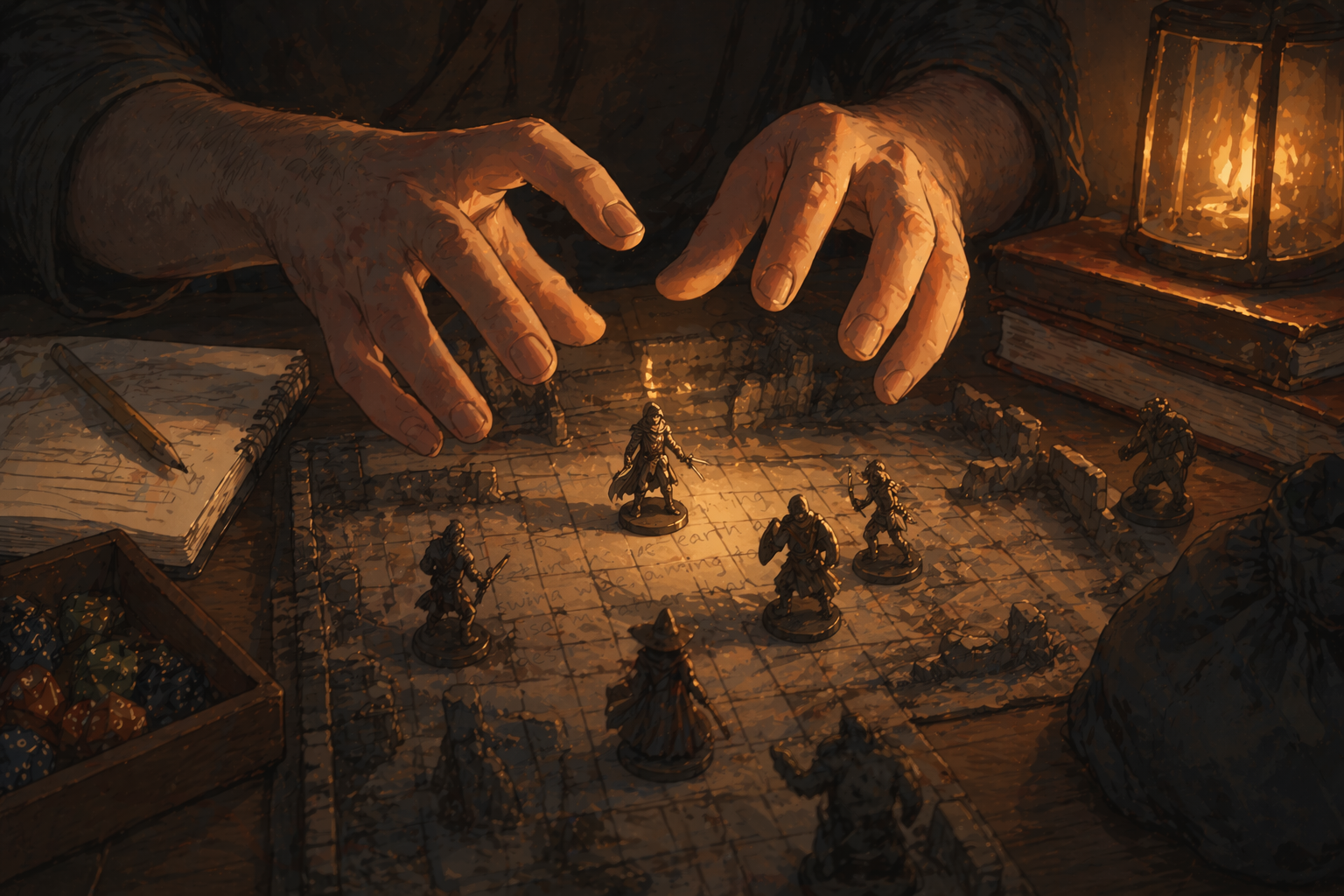
How to Run Games for Neurodiverse Players

You don’t need a clinical background to run an accessible table. You need curiosity, structure, and the willingness to adjust how the game shows up at the table.
Here’s the quiet truth most experienced GMs eventually learn: if your game works well for neurodiverse players, it almost always works better for everyone. Clear expectations reduce anxiety. Predictable pacing keeps energy up. Written reminders prevent rules debates. Scheduled breaks stop burnout before it starts. None of that waters the game down. It sharpens it.
This guide is not about diagnosing players or labeling behavior. It is about running games that respect different ways of thinking, focusing, processing, and communicating. It is a how-to, built for real tables, real time constraints, and real groups that want to keep playing together.
Why this matters more than you think
Neurodiversity is not rare at gaming tables. Depending on the definition and population:
- Autism is identified in roughly 1 in 31 children in the United States.
- Adult ADHD prevalence is commonly estimated at around 2.5%.
- Dyslexia and related learning differences affect millions of adults worldwide, with estimates varying based on diagnostic criteria.
You do not need exact numbers to run a better game. The takeaway is simple: odds are high that neurodivergent players are already at your table, even if no one has said anything. Designing for accessibility by default saves everyone from awkward retrofits later.
A mindset shift that changes everything
Before we talk tools, let’s reframe the goal.
You are not “accommodating problem players.”
You are configuring the table.
Think of your game like software. Different tables need different settings. Subtitles on or off. Dark mode or light mode. Auto-save enabled. None of those settings imply something is broken. They imply intention.
Once you approach neurodiversity as table configuration rather than personal exception, the rest becomes straightforward.
Step 1: Build accessibility into Session Zero
Session Zero is where accessibility succeeds or fails. If you wait until someone is overwhelmed mid-combat, you are already behind.
Use an Accessibility Menu, not a spotlight
Instead of asking, “Does anyone have special needs?” provide a menu of options and let players opt in privately or publicly.
Example language you can use verbatim:
“Everyone processes games differently. Here are some table options I’m happy to use. You can tell me now or message me later which ones help you.”
Your menu might include:
- Scheduled breaks every 60–90 minutes
- Camera optional for online games
- Rules summaries after complex scenes
- Visual initiative tracking
- Written quest objectives
- Reduced cross-talk during turns
- Permission to step away without explanation
- Content warnings before intense scenes
The power move here is that everyone gets the same menu. No one has to self-identify to belong.
Always offer private follow-ups
Some players will not speak up in a group, even when invited. Always end Session Zero with:
“If anything comes to mind later, you can message me one-on-one.”
That sentence alone solves more problems than any safety tool.
Step 2: Design a low-ambiguity game loop
Ambiguity is exciting for some players and exhausting for others. Neurodivergent players often struggle not with complexity, but with unclear expectations.
Your job is not to remove uncertainty from the story. It is to remove uncertainty from the process.
Make the game loop visible
At any moment, players should be able to answer three questions:
- What is happening right now?
- What choices do I reasonably have?
- When do I need to act?
You can support this with simple habits:
- State scene goals out loud.
- Summarize options when players hesitate.
- Use phrases like “You have time to think” or “We’re moving into action now.”
This helps autistic players who need clarity, ADHD players who struggle with transitions, and anxious players who fear making the “wrong” move.
Write things down on purpose
Whiteboards, shared docs, index cards, or VTT notes are not crutches. They are memory aids.
Write down:
- Initiative order
- NPC names
- Quest objectives
- Key rules rulings
When information exists outside someone’s head, cognitive load drops instantly.
Step 3: Engineer spotlight and pacing
Many accessibility issues show up during combat or long scenes. The fix is rarely mechanical complexity. It is spotlight control.
Use predictable turn structure
Tell players when they are “on deck.”
Keep initiative visible.
Announce whose turn is coming next.
This reduces anxiety and prevents attention drift.
If you want a practical rule:
- If a player hasn’t acted in 2–3 minutes, summarize and prompt.
- Offer two or three clear choices rather than an open field.
Reduce dead time, not roleplay
Dead time is poison for ADHD players. Long stretches where nothing is expected of them feel endless, even if the scene is interesting.
Solutions that work:
- Shorter turns with clearer decisions
- Rotating spotlight in social scenes
- Cutting away and coming back intentionally
You are not rushing the story. You are trimming the silence around it.
Step 4: Treat sensory input as a game component
Lighting, noise, seating, and visual clutter matter more than most GMs realize.
In-person tables
Simple changes can have huge impact:
- Lower background music volume or remove it entirely
- Avoid flashing lights or candles near eye level
- Allow quiet fidgeting
- Give players control over where they sit
Normalize movement. Standing, pacing, or stepping outside is not disrespectful. It is regulation.
Online tables
Digital play has its own sensory challenges:
- Camera optional policies reduce burnout
- Text chat summaries help players who miss spoken details
- Clear turn order prevents audio chaos
- Captions or chat logs help players with auditory processing differences
Accessibility online is mostly about permission, not technology.
Step 5: Prepare for overload before it happens
Overload does not always look dramatic. It can look like silence, irritability, rules fixation, or sudden disengagement.
The worst response is freezing because you do not know what to do.
Use a simple traffic-light protocol
You can explain this once and then just use it.
- Green: Play continues normally.
- Yellow: You slow down. Reduce cross-talk. Summarize options.
- Red: Pause. Take a break. No explanations required.
If someone steps away, you do not interrogate them later. When they return, you give a brief recap and move on.
This protocol protects dignity and keeps the game flowing.
Step 6: Safety tools are accessibility tools
Lines, veils, X-cards, rewind tools, and content warnings are often framed as emotional safety measures. They are also cognitive safety measures.
Knowing that you can stop or redirect a scene lowers baseline stress. Lower stress means better focus, better play, and better memory.
Use safety tools early and neutrally. Do not reserve them for emergencies. When tools are normalized, they are used responsibly.
Step 7: Close the loop with micro-debriefs
Accessibility is not a one-time setup. It is a living system.
At the end of sessions, ask two questions:
- What helped tonight?
- What should we change next time?
Keep it short. Two minutes is enough.
This does three things:
- It surfaces small issues before they become big ones
- It models that feedback is welcome
- It gives players permission to advocate for themselves
You do not need to fix everything immediately. You need to listen consistently.
A short story from the GM chair
Barry once ran a game where a player went silent every combat. Not disruptive. Not rude. Just… gone.
His first instinct was mechanical. Maybe combat bored them. Maybe the system was wrong.
The real issue was simpler. They could not track initiative mentally while processing tactics and table noise. Once he put initiative on a whiteboard and announced “on deck,” they became one of the most engaged players at the table.
Nothing about the story changed. Everything about the experience did.
That is what good accessibility looks like. Quiet, effective, and invisible once it works.
Common mistakes to avoid
Even well-meaning GMs fall into these traps:
- Over-explaining diagnoses. You do not need medical language at the table.
- Singling players out. Default options prevent awkwardness.
- Treating accommodations as favors. They are table settings.
- Waiting for a crisis. Proactive structure prevents burnout.
If you avoid these, you are already ahead of the curve.
Why this makes you a better GM
Running games for neurodiverse players improves:
- Pacing
- Clarity
- Player trust
- Table longevity
It reduces miscommunication, prevents burnout, and creates space for deeper roleplay. These are not niche benefits. They are core GM skills.
Accessibility is not about lowering difficulty. It is about lowering friction.
Final thoughts and your next step
You do not need to overhaul your campaign. Start small.
For your next session:
- Add one written aid.
- Schedule one break.
- Make one expectation explicit.
Then ask for feedback.
If you want a concrete takeaway, here it is: design your table so no one has to struggle in silence. When players feel safe asking for what they need, the game gets sharper, faster, and more memorable.
Alternative Initiative Systems That Actually Work

Initiative is not a rule.
It is a queue.
And if your combat feels slow, it is almost never because the math is hard. It is because the queue is bad.
If you have ever watched your table light up during roleplay, only to glaze over the moment someone says “roll initiative,” you already know the problem. Momentum dies. Phones come out. Someone asks whose turn it is. Someone else was not ready. Five minutes later, one sword swing finally lands.
This article is not about clever tricks or novelty mechanics. It is about initiative systems that survive contact with real tables. Systems that speed things up, keep players engaged, and do not quietly implode after three sessions.
Why initiative actually slows combat
Before changing systems, it helps to name the real bottlenecks.
Across tables and systems, the same issues show up again and again:
- Setup drag: Rolling, sorting, writing, reordering, and explaining turn order takes longer than expected.
- Downtime: Players mentally check out when they know their turn is far away.
- Readiness failure: When a turn arrives, the player is not ready, restarting the clock.
- Spotlight friction: Assertive players act quickly, quieter players hesitate, and initiative order amplifies the gap.
- Swinginess: Some systems are fast but create brutal alpha strikes that end encounters before they feel earned.
Most alternative initiative systems solve one or two of these. The good ones tell you clearly which tradeoffs you are making.
The four initiative systems that actually hold up
There are dozens of variants floating around. In practice, almost all tables that change initiative end up orbiting one of these four models.
1. Side Initiative: the fastest possible setup
How it works
At the start of each round, roll once for the party and once for the opposition. The winning side goes first. Within a side, players act in any order they choose.
Why it works
- Setup time drops to seconds.
- No one forgets whose turn it is.
- Players coordinate naturally.
This variant is explicitly supported in the D&D Dungeon Master’s Guide, and for good reason. It is brutally efficient.
Where it breaks
Side initiative is infamous for alpha strikes. If one side wins initiative and focuses fire, the other side can lose key pieces before acting at all. Online discussions consistently flag this as the main downside.
How to patch it
Use one of these dials:
- Staggered starts: Only half of each side may act before the order flips.
- Boss insulation: Major enemies cannot be targeted by more than two attackers before they act.
- Reactive slots: Each side gets one reaction turn that can interrupt the opposing side once per round.
When to use it
- Large groups
- Convention games
- Dungeon crawls where speed matters more than precision
If your combats die because they never get moving, side initiative is the emergency lever.
2. Popcorn Initiative: momentum first, structure second
How it works
The first actor is chosen randomly or narratively. When a creature finishes its turn, it chooses who goes next. Once everyone has acted, the round resets.
Why it works
- Momentum stays high.
- Players stay engaged because they might go next.
- Spotlight feels earned instead of scheduled.
When popcorn initiative clicks, it feels electric. Turns chain together. Players pay attention. Combat starts to feel like a conversation instead of a spreadsheet.
Where it breaks
Two common failure modes show up in real play:
- It quietly becomes side initiative, with players always choosing the same chain.
- Monsters exploit end-of-round, start-of-round double turns, spiking damage unfairly.
Both issues are well documented in GM circles.
How to patch it
Never run popcorn initiative without guardrails:
- No self-selection: You cannot choose someone who just acted.
- Token tracking: Flip a token when a side acts. No side may act twice in a row if the other has unspent tokens.
- Forced handoff: If a side has acted twice consecutively, control must pass to the other side.
These three rules fix almost every horror story associated with popcorn initiative.
When to use it
- Story-forward combats
- Small to mid-sized encounters
- Tables that value flow over rigid fairness
Popcorn initiative rewards attention. If your players lean in when the fiction heats up, this system sings.
3. Alternating Activations: consistency without chaos
How it works
A player character acts. Then an enemy acts. Then a player. Then an enemy. Repeat until the round ends. Within each category, the acting side chooses who goes.
This structure is gaining traction in newer designs and discussion spaces because it solves multiple problems at once.
Why it works
- No one waits long between turns.
- Alpha strikes are naturally limited.
- Spotlight alternates predictably.
Every round becomes a rhythm: player move, opposition response, player move again. The table stays awake because the cadence never stalls.
Where it breaks
- Requires discipline from the GM to keep enemy turns concise.
- Multi-faction battles need a clear alternation order.
How to patch it
- Treat environmental hazards and lair effects as their own “side.”
- Group identical enemies into a single activation.
When to use it
- Tactical combat
- Boss fights
- Tables that want fairness without bookkeeping
If you want initiative to disappear into the background while still feeling structured, this is the safest long-term choice.
4. Card or Deck Initiative: tactile speed without math
How it works
Each combatant is represented by a card. Draw cards to determine order. Acting may reshuffle, discard, or modify future draws.
This model borrows heavily from Savage Worlds-style design, adapted for d20 play.
Why it works
- Order is visible at a glance.
- Drawing is faster than rolling and sorting.
- Variability keeps rounds fresh.
The Alexandrian and others have highlighted how surprisingly smooth this feels at the table.
Where it breaks
- Requires physical components or VTT setup.
- Some players dislike non-die randomness.
How to patch it
- Give bosses extra cards.
- Grant advantage or disadvantage by drawing additional cards instead of modifying rolls.
When to use it
- In-person games
- Tables that enjoy tactile elements
- Groups bored of static turn orders
This system does not just speed things up. It makes initiative feel like part of play instead of preamble.
A quick decision guide
If you only remember one section of this article, make it this one.
- Combat never starts cleanly: Side initiative
- Players tune out between turns: Alternating activations
- Combat feels stiff and mechanical: Popcorn initiative with guardrails
- You want speed plus visual clarity: Card-based initiative
Do not pick a system because it sounds clever. Pick the one that attacks your actual bottleneck.
Initiative is only half the problem
Here is the uncomfortable truth most articles skip:
You can fix initiative and still have slow combat.
Veteran GMs like Sly Flourish and DM David consistently point out that process beats mechanics. No initiative system survives players who are unprepared.
Three table practices matter more than the system itself:
- On deck warnings
Always announce who is next. Always. This alone can cut turn time dramatically. - Delegate tracking
Let a player track initiative. Visibility reduces questions. Ownership increases speed. - Default actions
If a player is not ready, their character takes a basic defensive action. No debate. This rule feels harsh exactly once.
These practices show up again and again in GM advice because they work regardless of ruleset.
Common objections, answered
“Isn’t this less fair?”
Fairness is not sameness. A system that everyone understands and stays engaged with is often perceived as more fair, even if it is less granular.
“Won’t players game the system?”
They will. That is why every system above includes explicit guardrails. Design for exploitation instead of pretending it will not happen.
“What about summons, pets, and hordes?”
Group them. If your initiative system cannot scale, your encounter design is the real issue.
The real takeaway
Initiative is not sacred. It is infrastructure.
Your job as a Game Master is not to preserve a rule. It is to protect momentum.
Pick one of these systems. Patch it deliberately. Pair it with strong table habits. Then run three sessions before judging it.
If your players stop asking whose turn it is, you chose well.