How to Stop One Player From Dominating Your RPG Sessions
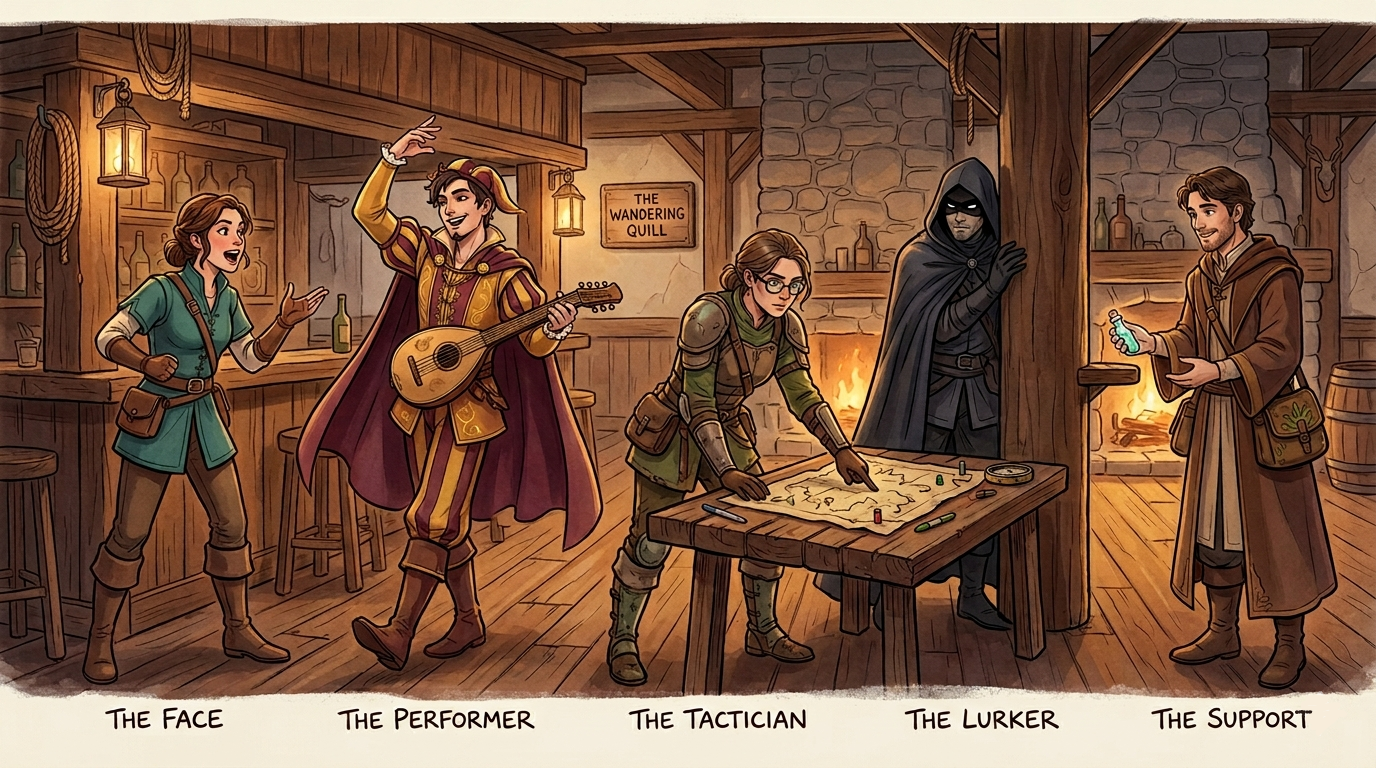
Look at your quiet players. Not the one doing all the talking. The other ones. Look at how they’re holding their character sheets. That’s the tell. The ones who stopped investing an hour ago aren’t scrolling their phones or whispering to each other. They’re just… present. Technically. Dice in hand, waiting to be asked.
You did not build a bad group. You built a bad session.
Many DM’s get this wrong about spotlight problems: the dominant player is not the villain of this story. They’re filling space that your encounter design left open. You built a room with one door and then acted surprised when the loudest person walked through it first. Every session. Forever.
You don’t fix that with a conversation. You fix it with better architecture: encounters and scenes that physically cannot be solved by one person, because they were never built that way. That’s the whole method. Let’s get into it.
Know Who’s Sitting at Your Table
Not so you can manage them. So you can design for them.
The Face talks first, talks most, and has no idea they’re doing it. Silence reads as failure to them, so they fill it: every pause in negotiations, every NPC introduction, every moment where another player is still thinking. They’re not malicious. They’re enthusiastic. Those are different problems with different solutions.
The Performer wants their character’s arc moving forward in front of an audience. They’ll extend a scene past the point of usefulness because the scene feels important to them, and it is. They just can’t tell when it stopped being important to everyone else. They’ll go until you cut them off. Usually you don’t.
The Tactician runs combat for the whole table. They announce the optimal play for every character, including ones that aren’t theirs. This is the player who tells the barbarian where to move. The barbarian’s player nods and does it, and somewhere in that exchange, a little piece of their agency dies.
The Lurker is the most invested player at your table and you probably don’t know it. They’re not disengaged. They can’t cut into the conversation without it costing them something socially, and they know it, so they don’t. Check your group chat after the session. The player with six paragraphs of thoughts they typed out at midnight? That’s The Lurker. They had those thoughts at the table. They just couldn’t get them out.
The Support loves being the person who set up someone else’s big moment. Their satisfaction is not the spotlight. It’s the pass that led to the goal. They don’t need equal airtime. They need encounters that treat their playstyle as a real contribution instead of a footnote.
The mistake is looking at this table and finding a problem player. There isn’t one. You’ve just built encounters with one door.
There Are Three Spotlights. You’re Probably Only Fixing One.
This is where most advice falls apart. “Spotlight” gets treated like a single resource to distribute: give some to this player, less to that one, done. But there are three completely different kinds, and a dominant player in one isn’t the same problem as a dominant player in another.
Roleplay spotlight lives in social encounters, NPC negotiations, and character moments. This is where The Face runs. The problem is structural silence: one conversation, one entry point, one player who will always get there first.
Combat spotlight is your turn. Your one meaningful action before you wait again. This is where The Tactician does the damage, stealing turns not with dice but with advice nobody asked for, delivered before the other player has finished thinking.
Exploration spotlight is who finds the thing, reads the thing, knows the thing. Usually “whoever has the highest Perception,” who is, somehow, always The Face.
Bringing a roleplay fix to a combat problem doesn’t work. Fixing the wrong spotlight is how you spend three sessions tweaking your social encounters while the Tactician is still running the whole battle.
The Fix: Stop Managing. Start Designing.
The rule is simple: you do not tell players how to share. You build situations where sharing is the only path forward.
You cannot instruct a dominant player into taking up less space. But you can build an encounter where their particular skill set isn’t what’s needed right now, and watch the room reorganize itself without anyone feeling called out.
Roleplay: Split the room
Instead of one big social scene where everyone watches The Face handle the tavern owner, give each player their own NPC simultaneously. The wizard talks to the guild archivist in the corner. The rogue follows the suspicious merchant out the back. The cleric sits with the grieving widow at the bar. Assign everyone something to find. The information only assembles when they come back together.
The Face still talks. So does everyone else. The scene has five conversations running in parallel, and none of them can be done by the same person.
Combat: Parallel objectives
The Tactician can command one fight. They cannot command five things at once.
Build combat encounters with multiple objectives that require different characters to act independently. The fighter holds the door. The rogue silences the signal drum before reinforcements arrive. The druid puts out the fire before it reaches the powder kegs. The cleric breaks the enchantment on the villagers. Each of these belongs to a specific character because of what that character can do. The Tactician’s advice becomes noise when there’s no single front to direct.
This also happens to make combat dynamic and worth caring about, but that’s a different article.
Exploration: Build for specific expertise
Stop building dungeons where any skill clears any obstacle. Build the obstacle that only one character can clear, then put it in front of that character.
The passage ahead is covered in religious script nobody can read, except the cleric who grew up in a temple. The door is a mechanical puzzle that would stump anyone, except the artificer. The creature blocking the path communicates through scent markers, except the druid knows exactly what it’s trying to say.
That player gets a moment that belongs only to them, and it rewards the backstory choice they made during character creation. The world feels like it was built with their character in mind, because you built it that way. And The Lurker, who picked ranger because they had a whole thing about tracking and nobody ever asked about it, finally gets asked about it.
Give the Idle Players a Job
When one player is in an extended scene, a villain confrontation, a tense negotiation, a character moment, everyone else stops being players and becomes an audience. That’s a waste of four people who are already emotionally invested in what happens next.
Before the scene starts, assign each idle player one role. Not a character to play. A director’s job.
The Consequence watches the scene and, at the moment of decision, names one thing that changes in the world because of what just happened. Not a suggestion. A statement. The innkeeper locks the door behind them. The sky goes dark outside. The contact burns the note.
The Gut Check describes what emotion shows on the spotlighted character’s face from the outside. The thing the active player might not even know their character is feeling.
The Complication can introduce one small obstacle at any moment: a noise from the hallway, an object that falls, a detail nobody noticed until now.
The rogue is alone with the merchant, trying to extract information. The Face’s rogue is doing well, smooth, in character, working the scene. The Lurker, assigned The Consequence, is leaning forward. The Performer, assigned The Gut Check, is watching. The Tactician, with nothing to optimize, is actually paying attention to the roleplay for once.
When the rogue lands the key persuasion roll, the Lurker says: “The merchant’s hand goes to the letter in his pocket.” The Gut Check player says: “She looks relieved. Like she wanted someone to ask.” The DM builds on both. Four players built that scene instead of one.
The Caveat
Don’t overcorrect.
Not every player wants equal spotlight, and trying to force it is its own failure. The Support player loves setting up someone else’s moment. That’s what fun means to them. The Lurker might find being the center of attention actively uncomfortable, not just a little shy. Shoving them into a solo scene in front of the whole group, “this is YOUR villain, YOUR backstory, you handle it,” breaks trust, it doesn’t build it.
Refer to the character by name, not the player. “What is Berric doing while this happens?” is a question. “Dave, are you doing anything?” is a spotlight. One feels like an invitation. The other feels like a test.
Design invitations. Not demands. If a player doesn’t walk through the door you opened for them, leave it open. The Lurker will come through it when they’re ready, and when they do, when they finally act instead of watch, it’s usually the moment everyone talks about on the drive home.
That’s the goal. Not equal airtime. A table where every player has a moment that’s theirs, and the space to take it.
Stop managing the people. Build the encounters.

Posted on May 25, 2026, in Blog. Bookmark the permalink. Comments Off on How to Stop One Player From Dominating Your RPG Sessions.





 Rokk Talk