The Hidden Problem with High-Level RPG Campaigns
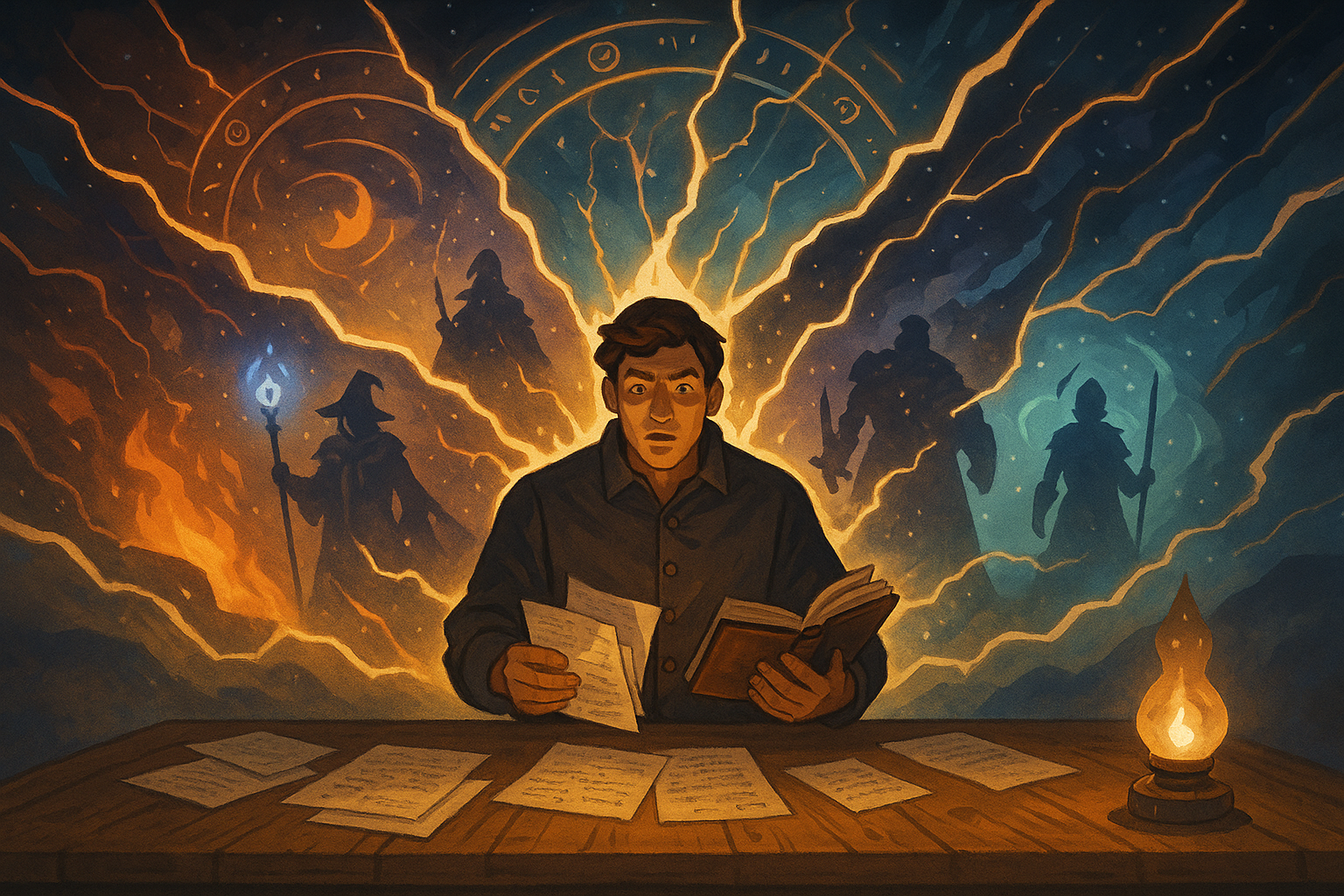
There’s a moment every long-running Game Master quietly dreads.
Your players finally hit the high teens. They’ve earned mythic titles. They have teleport on speed-dial, resurrection in their back pocket, and spell lists that read like reality-editing toolkits. On paper, this is the payoff for years of story.
Instead, the room goes quiet.
You realize the monsters in the book don’t challenge them anymore. Combat takes an hour per round. Every mystery you build collapses under scry, speak with dead, or true seeing. And while you’re trying to keep up with the fireworks, your players are flipping through character sheets that stretch into dozens of abilities they barely remember.
The uncomfortable truth: epic-level play in most RPGs isn’t “hard.” It’s structurally mismatched to how these games are designed and how most tables actually play.
You can absolutely run a great epic-tier arc. Many GMs do. But it’s not the same style of game you run at level 5—or even level 12. It demands a different mindset, a different prep style, and a different campaign structure entirely.
This is why even though many RPGs promise “levels 1–20,” the overwhelming majority of campaigns never see those final chapters. Internal platform data often quoted by designers and analysts shows more than 90% of campaigns end before level 11, and only a tiny fraction (around 2%) reach level 20. Pathfinder 1e openly steers GMs toward ending campaigns around level 20 because the math and support beyond that point degrade sharply.
Let’s break down what actually goes wrong at epic levels, why most tables stall before ever reaching them, and how you can run high-tier stories without burning out.
1. The Numbers Don’t Lie: Most Campaigns Never Reach Epic Tier
If you’ve ever felt guilty for ending a campaign early, here’s the good news: you’re normal.
Across platforms and player surveys, the same pattern repeats:
- Most campaigns end between levels 7–10.
- High-level characters (16–20) make up only a sliver of active play.
- Reaching level 20 requires months—sometimes years—of uninterrupted sessions.
There are practical reasons for this:
- Life schedules change. People switch jobs, move cities, or have kids.
- Campaign energy dips around the middle. The “new campaign glow” fades after several arcs.
- Prep requirements spike around level 12+. More abilities = more edge cases.
- Pacing slows dramatically. High-level combat is longer, not necessarily more exciting.
But the bigger reason is structural.
RPGs like D&D and Pathfinder were originally built around the low-level experience—scrappy heroes facing grounded challenges. Level 18 characters are demigods, and the system doesn’t fully adjust its expectations to handle that shift. Designers focus support on where most people play. Publishers write adventures for levels 1–10 because that’s where campaigns live.
In short: the game assumes epic levels exist, but doesn’t actually build the scaffolding needed to support them.
And as a GM, you feel that tension first.
2. When the Rules Outgrow the Story
Everything you learned as a GM from levels 1–12 quietly collapses at high level.
That locked door? Nothing.
The villain fleeing? Teleport target.
The mysterious clue? Legend lore it.
The consequences of death? A speed bump.
Here’s a simple example.
Low-Level Problem:
A duke is murdered. The PCs must find the killer.
Epic-Level Problem:
The PCs cast speak with dead, commune, legend lore, scry, and true seeing, then review the answers while teleporting to confront the culprit across three planes.
The challenge isn’t that these spells are “too strong.” They’re supposed to be strong. The issue is that the story structure you relied on earlier doesn’t survive contact with them.
At epic level:
- Information is easy to get.
- Distance is meaningless.
- Obstacles vanish.
- Mortality weakens.
- Secrets evaporate.
The physics of your world change, but your setting usually doesn’t.
How many adventures actually describe how kingdoms defend against teleport-assassinations? Or how churches respond to cheap resurrection? Or how any mystery survives divination?
If you don’t address the new physics, your story falls apart. Most systems don’t help you with this jump—they leave you to reverse-engineer an entire metaphysics layer on your own.
As a result, some GMs respond by banning spells, nerfing abilities, or constructing “anti-magic fields” the size of small countries. But that’s a band-aid, not a fix.
The solution is reframing your challenges—not blocking player abilities, but acknowledging what those abilities actually say about your world.
3. The DM Arms Race: When Power Escalation Becomes Work
Epic-tier combat is an entirely different animal. On paper, high-level enemies are terrifying. At the table, things get… messy.
Here’s why.
1. Stat blocks grow faster than your prep time.
A level 18 demon lord might have:
- 5–7 innate spells
- Legendary actions
- Lair actions
- Resistances
- Immunities
- Special abilities
- Summoning
- Regional effects
Running this is a full cognitive load. Running six PCs with similar capabilities is another.
2. High-level fights swing between “trivial” and “TPK.”
The math at epic level pushes two extremes:
- A spell like forcecage can trivialize a major boss.
- A single failed save can drop a PC from full HP to zero.
The variance is enormous. Most systems aren’t built to stabilize that swing. As GM, you end up rewriting monsters on the fly just to avoid anticlimax.
3. “Bounded accuracy” (or its equivalents) stretch too far.
In systems that limit how high numbers can go, epic enemies become gigantic bags of HP. In systems without bounded accuracy, numbers blow past manageable ranges.
Both extremes feel less fun than level-5 combat.
4. Social contracts become strained.
Many tables quietly adopt a truce:
- Players avoid abusing broken combos.
- GMs avoid designing encounters that one-shot the party.
This is functional, but it turns epic play into a gentleman’s agreement rather than a robust game mode.
5. Prep time balloons while payoff narrows.
You can spend six hours preparing a demon citadel with layered defenses, only for the wizard to teleport the party straight to the throne room. And if the fight ends in two rounds because of a good initiative roll, the emotional payoff is gone.
This is the moment many GMs burn out—not because epic play is impossible, but because the cost-to-reward ratio skews unsustainably.
4. Campaign Structure: The Hidden Reason Epic Levels Feel Awkward
Most campaigns accidentally follow a familiar arc:
- Introduce the world.
- Introduce the villain.
- Raise stakes.
- Resolve the story.
That arc typically concludes around levels 9–13. The emotional climax happens right where the rules still run smoothly.
When a campaign keeps going past its natural endpoint, you’re stuck adding villains you never foreshadowed or stretching the story past its intended tension.
This is why epic-level play works best when designed as a short, intentional season rather than the “next chapter” of a traditional campaign.
Think of it like this:
- Tier 1–3: The campaign story.
- Tier 4: The epilogue season.
This framing lets you:
- Introduce stakes appropriate for level 18 characters.
- Design bespoke threats rather than duct-taping mid-tier villains into epic ones.
- Build a finale that embraces the group’s growth rather than running away from it.
If your campaign is already long, adding another year of prep-heavy, complexity-heavy sessions isn’t appealing. But a focused, six-session epic arc? That’s compelling.
5. Systems That Actually Support an Endgame (and What to Borrow From Them)
While mainstream RPGs struggle with epic levels, several systems handle high-power or realm-level play better because they were designed for it.
1. OSR Domain Rules
Old-school frameworks assume characters eventually rule strongholds, command armies, and influence kingdoms.
Borrow this:
- Let PCs command forces rather than fight everything personally.
- Use high-level play to influence societies, not just stat blocks.
2. Adventurer Conqueror King (ACKS)
This system has detailed rules for economics, warfare, domains, and realm management.
Borrow this:
- Create political consequences for high-level actions.
- Let PCs’ decisions reshape borders, factions, or planes.
3. Narrative Systems
Games that scale influence rather than numbers—like certain narrative-driven systems—embrace epic stories without drowning in modifiers.
Borrow this:
- Escalate the meaning of choices, not just the size of monsters.
4. Mythic Systems
Some games separate power gains from raw levels, providing mythic or divine tiers that change how challenges are structured.
Borrow this:
- Treat epic characters as mythic forces and design problems accordingly.
- Introduce planar, cosmic, or philosophical threats instead of “bigger dragons.”
By borrowing these tools, you can build an epic tier that doesn’t rely solely on inflated stat blocks.
6. So How Do You Run Epic Play Well?
You don’t fix epic-level play by banning teleport or rewriting half the book. You fix it by reframing what your game is about.
Here are actionable steps that work at real tables:
1. Make epic play a short, high-impact arc.
Treat it as a six to ten-session season. Build it intentionally, foreshadow it earlier, and design a definitive endgame.
2. Scale challenges sideways, not upward.
Instead of “bigger monster, more hit points,” try:
- A planar crisis.
- A three-faction war.
- An ancient prophecy that twists choices.
- A villain who can see the future.
- A moral dilemma with no perfect solution.
3. Redesign mysteries for epic characters.
If divination exists, the mystery isn’t “Who did it?”
It’s:
- “Why did they do it?”
- “How do we stop the chain reaction?”
- “What do we do with the truth?”
4. Let abilities shine instead of blocking them.
If the wizard teleports, challenge what happens after teleportation.
If the rogue is invisible, challenge what the rogue steals or disrupts.
If resurrection exists, challenge what happens to souls, factions, or the afterlife.
5. Shift encounters to dynamic battlefields.
Static slugfests are death at high level. Use:
- Timed objectives
- Shifting arenas
- Planar hazards
- Moving platforms
- Ritual countdowns
6. Reduce the number of fights. Increase the importance of each one.
Epic PCs don’t need five encounters per session. They need one that matters.
7. Embrace the mythic.
When your players become demigods, give them a stage worthy of that power:
- Planar courts
- Forgotten gods
- Sentient artifacts
- Crumbling realities
- Legions that answer to them
Their actions should echo.
Conclusion: Epic Levels Aren’t Broken—They’re a Different Game
Epic play struggles because we try to run it like the rest of the game.
But level 18 characters aren’t adventurers anymore. They’re forces of nature. They’re icons. They solve problems no mortal can touch. Expecting low-level story structures, pacing, and prep techniques to survive that shift is a recipe for burnout.
When you treat epic levels as a new mode of play—with different assumptions, different structures, and a shorter runway—the experience becomes not just manageable, but unforgettable.
If you want epic play to work, design it intentionally, run it briefly, and aim for a finale your players will talk about for years.
How to Use AI Without Letting It Run Your Game
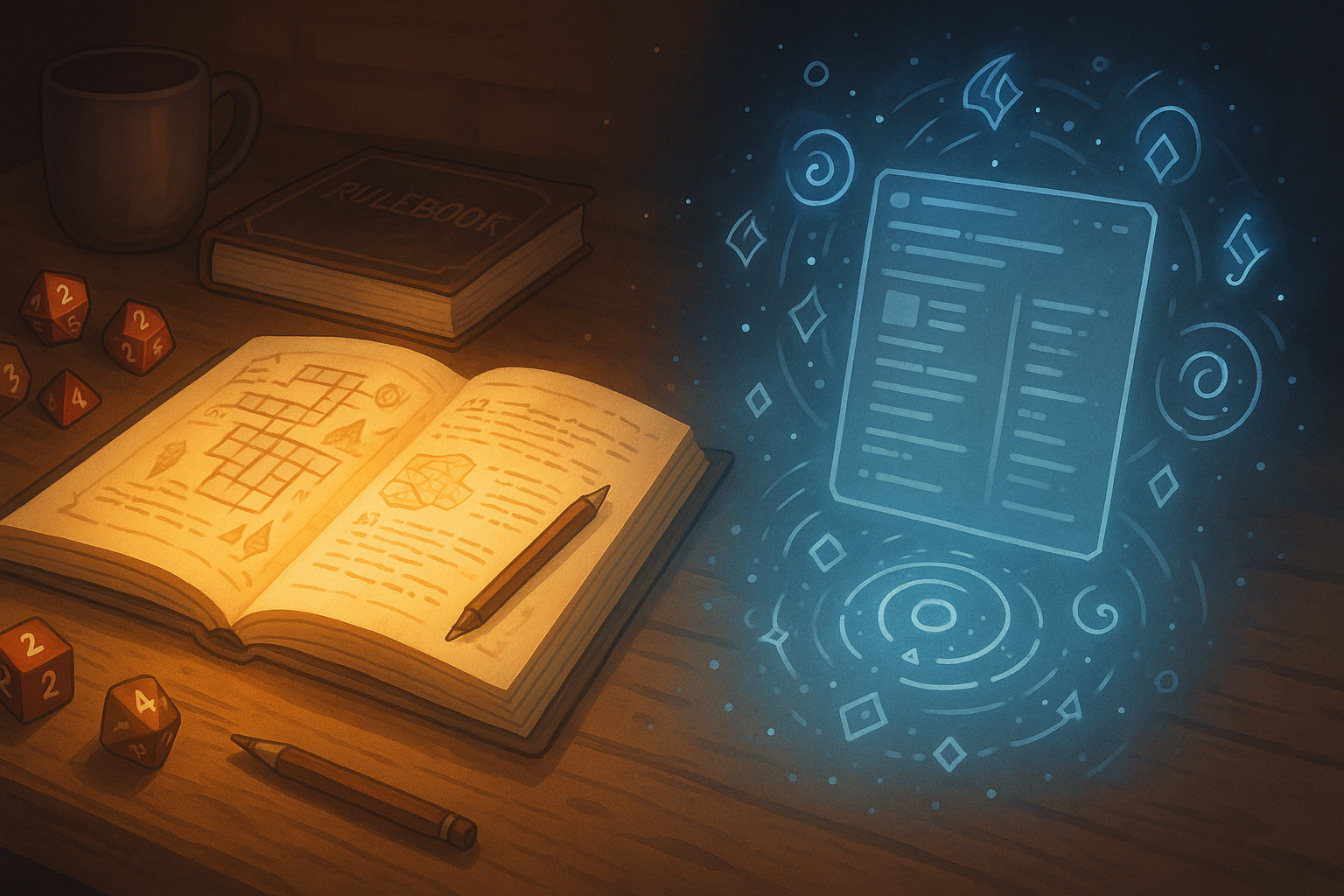
There’s a moment I see happening at tables everywhere.
A GM sits down to prep for the week’s session. They open their notebook, stare at the half-finished dungeon sketch, sigh, and think, I’m too tired for this. I’ll just ask the AI to build something. Five minutes later, they’ve got a full quest line, a named NPC, a tragic backstory, and a color-coded dungeon. It’s fast. It’s convenient. And—if you squint—it almost feels like cheating.
Here’s the truth: AI is already at your table. More than half of adults in North America use AI tools regularly. Among younger players, weekly use is the norm. Even in tabletop communities, plenty of GMs admit they’re using AI somewhere in their prep, whether they talk about it openly or not.
The question isn’t if AI belongs in your game.
The question is who’s in charge.
This article is your bridge between curiosity and control. You’ll see exactly where AI adds magic, where it muddies the waters, and how to use it without losing your voice—or your table’s trust.
Let’s get into it.
The Line That Matters: Tool vs. Pilot
Imagine you’re running a theme park. AI can help with maps, signage, and backstage logistics. But no matter how sharp the tech is, you don’t hand the keys to the roller coaster to the intern who showed up yesterday.
AI is that intern.
It can help you brainstorm, outline, summarize, and polish. But it has no instinct for pacing, tone, or the social contract of tabletop RPGs. It doesn’t know your players. It doesn’t feel tension in the room. It can’t tell when your rogue is about to derail the entire session with a terrible idea.
That’s why your real job—your irreplaceable job—is being the interpreter of the moment.
And that starts with controlling how much authority you give to the tool.
Where AI Shines (and Where It Doesn’t)
Let’s break your workflow into three simple modes: Before, During, and After the game. Each mode has clear opportunities and clear boundaries that keep the fun in your hands.
Before the Game: AI as Your Intern
Think of prep as your workshop. This is where AI earns its keep—so long as you stay in the driver’s seat.
Best Uses
1. Brainstorming ideas when you’re stuck.
Say you need a villain with a motivation beyond “be evil.” Feed the AI a few constraints—location, tone, theme—and let it toss ten options at you. Maybe nine are unusable. That’s still one spark you didn’t have twenty minutes earlier.
2. Creating raw lists—names, locations, rumors.
You know that moment when your players ask, “What’s the name of the blacksmith?” and your brain goes blank? Build a list in advance. Use the AI to generate 50 names themed by culture or region. You don’t need to reinvent the wheel every session.
3. Drafting NPC flavor or item descriptions.
Use AI to produce a starting paragraph. Then rewrite it in your voice. This is the key. If you copy and paste AI text directly, it will feel generic. Your players will feel the tone shift. Your campaign voice matters.
4. Generating reference art.
Portraits, landscapes, props—AI is strong at visualizing ideas. I’ve used it to create “concept art” for a city so I didn’t spend hours googling. But I always tell players if an image is AI-generated so expectations stay clear.
Red Lines
- Don’t let AI write core story beats. If the climax of your campaign comes from a bot and not from you, you’ll feel disconnected from your own world.
- Don’t use it to write PC backstories without explicit player consent. Players need ownership over their characters.
- Don’t let it create complicated statblocks without checking them. AI often mishandles action economy, spell interactions, and CR math.
During the Game: AI as Your Lookup Tool
Once the session starts, your focus shifts. You’re juggling pacing, combat rhythm, player choices, emotional beats, and improvisation. This is where AI needs the tightest leash.
Safe Uses
1. Quick rules summaries.
Not rulings—summaries. For example: “What does the prone condition do again?”
You’re still making the ruling. AI is just giving you the bullet points faster than a book search.
2. On-the-fly names.
Players love meeting unexpected shopkeepers. AI can spit out a name list in advance or during a break.
3. Describing something you didn’t prep.
If players go sideways, you can ask the AI for a few descriptive prompts (not scripts) to inspire your narration.
Unsafe Uses
This is where GMs accidentally hand their campaign away.
1. Don’t let AI adjudicate rules.
AI can be confidently wrong. About spells. About action economy. About monster abilities. The tool was not designed for rules precision at the table. You were.
2. Don’t let AI dictate what happens in the story.
If you ask, “What does the villain do?” you’re handing narrative control to a system that doesn’t understand stakes or pacing. You decide what the villain does. The villain is yours.
3. Don’t let AI write live scene dialogue.
It’s slow, it’s stiff, and it disconnects you from the table’s emotional energy.
After the Game: AI as Your Archivist
This is where AI can save you the most time without harming your table culture.
Use it for:
- Session summaries
- NPC logs
- Encounter notes
- Timeline management
- Inventory tracking
- Lore indexing
- Campaign wikis
You’ve probably seen the stats—AI adoption in the workplace has doubled in the past few years, and people use it most for repetitive, routine tasks. This is exactly where it belongs in TTRPGs: behind the curtain, handling the boring stuff.
But still avoid:
- Creating events that didn’t happen
- “Enhancing” scenes players didn’t see
- Inventing lore your world doesn’t support
- Replacing your campaign voice with AI prose
Your players trust you to remember the story they told—not to let a tool rewrite it for convenience.
AI Session Zero: The Safety Tool You Didn’t Know You Needed
If you’re going to use AI in your game, talk to your players. A quick five-minute conversation now prevents misunderstandings later.
Here’s a simple checklist you can steal for your next Session Zero:
1. What tools will you be using?
Let players know up front if AI helps generate art, dialogue starters, or summaries.
2. What won’t you use AI for?
This is huge. Tell them you won’t:
- Let AI control story outcomes
- Let AI adjudicate rules
- Use AI without reviewing the output
- Write PC content unless asked
3. How can players opt out?
Some players may not want AI art of their characters. Give them that choice.
4. How will AI content be credited?
Transparency builds trust. Even a small “generated with assistance” note is enough.
5. Where does your campaign data go?
If you’re using cloud tools, reassure your players about what you’re inputting and why.
This is how you protect player agency and your table’s social contract.
Four Ways AI Overuse Backfires
Let’s talk about the real dangers—because they’re not the ones people usually expect.
1. Your game loses its voice.
AI prose has a “clean but bland” sound. Overuse makes your campaign feel generic.
Fix: Never use AI text without rewriting it. Use the rhythm and tone your players know.
2. Continuity gets messy.
AI doesn’t remember your canon unless you force-feed it context. It will contradict itself and you.
Fix: Treat AI as notes, not truth. You decide what makes it into the world.
3. Players feel cheated.
If they learn that entire arcs, NPCs, or emotional moments were machine-written, they may feel disconnected from your story.
Fix: Use AI for prep and grunt work, not emotional beats or plot pillars.
4. You stop growing as a GM.
If AI does the creative heavy lifting, your improvisation muscles atrophy.
Fix: Use AI to speed work, not replace skill. Always revise, shape, and decide.
Tools That Keep You in Control
When people talk about AI “taking over,” they imagine monolithic cloud systems doing everything for them. But the safer trend is in the opposite direction: tools that support you, not replace you.
Good examples include:
- Local note-taking assistants
- VTT-integrated helpers that recall your campaign notes
- Prompt organizers for NPCs, dungeons, or items
- Name generators
- Timeline managers
- AI art tools used only for inspiration
The best tools don’t propose new canon. They surface your canon faster.
The Bottom Line: AI Is a Powerful Magic Item—Attune Carefully
Like any rare artifact in your world, AI carries benefits and risks. It saves time. It generates ideas. It keeps you organized. But if you hand it narrative control, it will steer your campaign into uncanny territory.
Use it before the session for brainstorming.
Use it during the session for quick lookups.
Use it after the session for organization.
But the moment you let it write the story or make decisions, you’re no longer the one running the game.
Your players came to see your world.
Your voice.
Your judgment.
Your sense of adventure.
AI helps you build the stage.
You run the show.
Call to Action
Take ten minutes this week and create your own AI boundaries. Decide what AI is allowed to do—and what it’s not. Try an AI Session Zero. Rewrite one AI-generated paragraph in your own voice. Notice how much better it feels.
You don’t need to fear AI.
You just need to keep your hands on the reins.




 Rokk Talk