How to Encourage Roleplay Without Forcing It
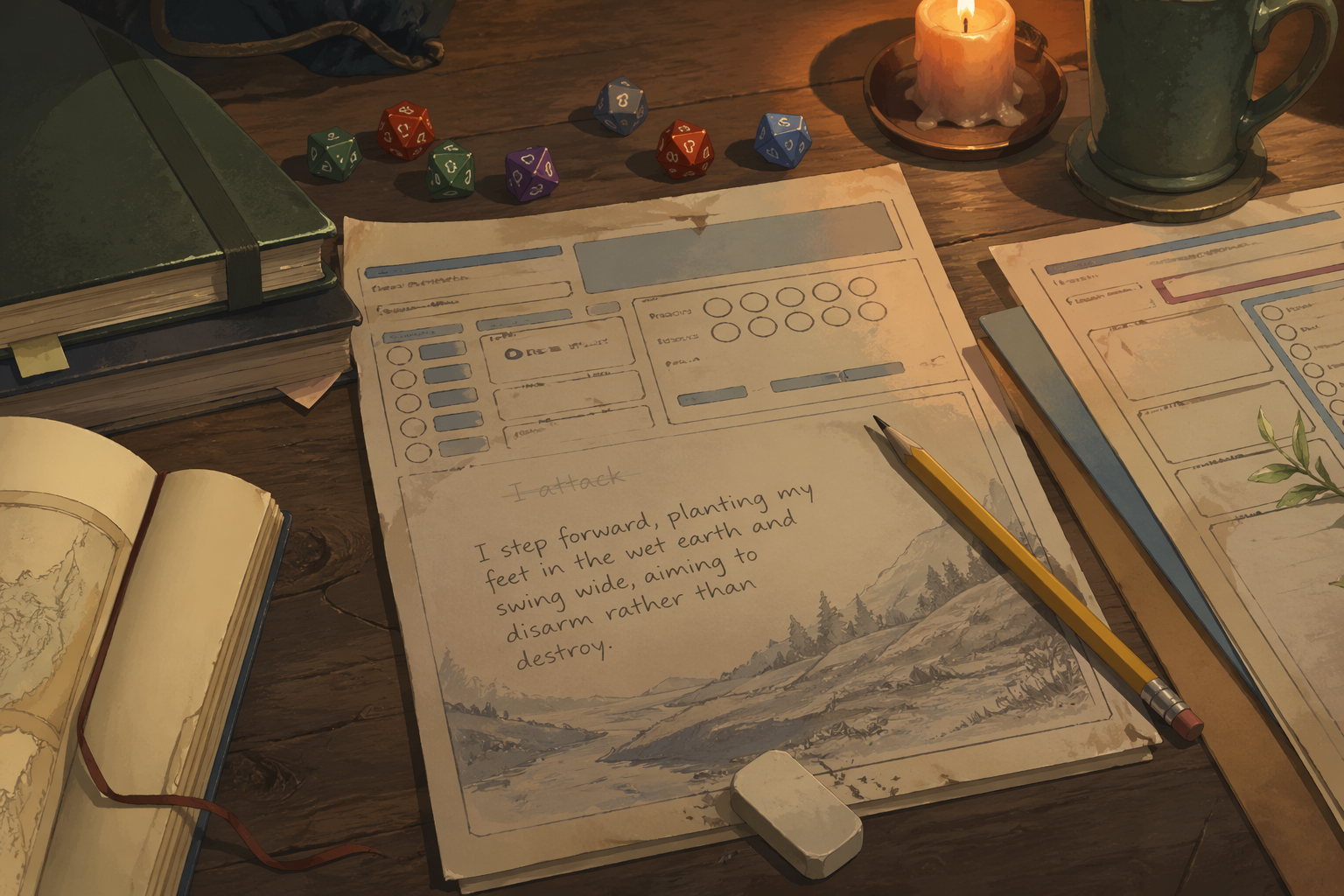
You’ve done everything right. You’ve got a cool world with lore coming out of its ears. NPCs with names and opinions and little secrets. A campaign hook so good it’s basically a crime. You sit down, you crack your knuckles, and you wait for your players to step into this world you’ve built with love and a frankly irresponsible number of sticky notes.
And then Todd says, “I attack the guard,” and everyone goes home having said maybe forty words in character combined.
Now, Todd didn’t fail you. You just haven’t figured out how to make roleplay feel as natural as attacking a guard. And that’s actually fixable. Not by pressure tactics, not by threatening to dock XP, and definitely not by doing what you might have read on some other guide, which is to just “model good roleplay yourself” and hope it’s contagious, like the flu.
We’re going to actually fix this. With a framework, and real techniques, and a clear understanding of why your players resist in the first place. Ready? Let’s go.
First, Let’s Agree on What Roleplay Actually Is
What is the mistake almost every guide makes before giving a single tip? They never stop to define roleplay. So players hear the word and immediately picture Matthew Mercer doing seventeen voices while crying over a dead fictional father. And then they decide that’s not for them, which is, yeah quite fair.
But that’s not what roleplay is. Or at least, that’s not all it is.
Saying “my character would never back down from a fight, so she charges” is roleplay. Describing how your fireball looks — the color, the smell — is roleplay. Asking an NPC about their family instead of just their quest reward? Roleplay. Having your dwarf grumble about the climb while they do it? Roleplay.
Before you run a single technique from this article, set this straight at your table. Third-person narration is roleplay. Body language is roleplay. The voice-acting stuff is the top floor of a building. Most players live on the first or second floor, and that’s completely fine.
The moment you lower that invisible bar, players who thought they “couldn’t RP” realize they’ve been doing it all along. That’s not a trick. That’s the truth.
Why Players Resist
The reason your players default to “I attack” instead of anything more interesting is almost never because they don’t care. It’s because roleplay, in the middle of a TTRPG session, is actually cognitively expensive.
Think about what a player is doing at any given moment: they’re tracking their spell slots, remembering what the NPC said three scenes ago, figuring out what action to take, and managing the social dynamics of four other people at the table. By the time it’s their turn, the creative part of their brain — the part that improvises dialogue and makes dramatic choices — is basically out of juice.
Researchers who study TTRPGs have found this is especially true for players with social anxiety or neurodivergent players. A 2024 study published in the journal Autism found that autistic adults reported that social interactions during TTRPG play felt significantly easier than in everyday life, when the structure supported them. The keyword being: when the structure supported them. Because structure, it turns out, is the opposite of what most people think kills roleplay. It’s what enables it.
There’s also something called “Spotlight Shock”, which I’m going to name here because naming things helps fix them. It’s that freeze response you see when you look directly at a player and say, “So, what does your character do?” The sudden pressure of being put on the spot, in front of everyone, expected to produce something good on demand, can be genuinely paralyzing. Especially for quieter players or newer ones. They’d love to roleplay. They just can’t perform under a spotlight they weren’t prepared for.
And then there’s the Matt Mercer Effect. You know this one. Critical Role is a show where every single cast member is a professional voice actor, and it streams to over 200 million hours of viewers annually. New players find the hobby through it and arrive at your table expecting that. When reality doesn’t match the expectation, they either try too hard and feel embarrassed or give up on RP entirely. Matthew Mercer himself has said that using Critical Role as a benchmark for home games is a recipe for disappointment. Every table should be different, and trying to copy theirs means missing what makes your own table magic.
So to recap: your players resist roleplay because their brains are full, the spotlight is scary, and the bar they’ve imagined is impossibly high. That’s your real enemy. Not their attitude.
The Small Ask Ladder
Now that we’ve covered the yadda yadda, here’s the actual system.
The trick to getting players to roleplay more is not to ask for more roleplay. It’s to ask for less, but to do it more often, and in a way that slowly builds the muscle.
Think of it as a ladder. You don’t start people at the top. You start them at the bottom rung and let them climb.
Rung one: narrate your action. Don’t ask what your character says. Ask what they do. “You kill the orc — how does that happen?” This is nearly zero social risk. It’s not performance. It’s description. And description is where most reluctant roleplayers are totally comfortable. Start every combat encounter with this.
Rung two: what does your character feel? After a significant moment — a plot reveal, a death, a victory — ask one player a single, low-stakes question about their character’s internal state. Not “what do you say?” but “how does Mira feel about this?” That’s a thinking question, not a performance question. It plants a seed.
Rung three: the small prompt. This is where you use their backstory. If your fighter has a dead mentor in their background, have the villain reference mentors. Don’t announce what you’re doing. Just let it land, watch the player’s eyes, and give them space to respond however they want, in- or out-of-character. You’re inviting, not demanding.
Rung four: first-person moments. By this point, with the trust you’ve built through rungs one through three, some players will start speaking as their character naturally. Not all of them, which is fine. But some will. When they do, reward them simply by engaging with their character, not with them as a player. That’s how the fourth rung starts to feel comfortable.
None of this is fast. It’s also not supposed to be. The goal is a table where roleplay becomes the path of least resistance, not the scary alternative.
Match the Technique to the Player Type
Not everyone plays TTRPGs for the same reason, and GMs get it completely wrong by treating all players identically.
Richard Bartle’s player type framework — originally designed for video game design — maps cleanly onto tabletop groups. You’ve got a mix of types at your table, and each one responds to different RP levers.
Your Achievers, the ones who’ve optimized their spell list before session one, aren’t going to suddenly monologue because you asked nicely. But they will roleplay if there’s a mechanical incentive. Inspiration points for in-character moments. A magic item that only unlocks its power when the character confronts their backstory. Give them a reason in their own currency.
Your Explorers love the world you’ve built and want to know everything about it. They’ll engage with NPCs if the NPCs know things. Make certain pieces of lore only available through conversation — not combat, not skill checks, but actual in-character dialogue. Suddenly, roleplay becomes information-gathering, and Explorers eat that up.
Your Socializers are probably already roleplaying more than anyone else at the table, and you can use them. Not as a spy, but as a scaffold. They’ll naturally pull quieter players into conversation if you give them the right NPC hooks. A character at the table who shares something with another character’s backstory. A moment where only two players can solve the problem by talking to each other. Socializers thrive on connection, and they bring others with them.
Your combat-focused players — let’s call them Combatants for clarity — are not lost causes, not even a little. They just express character through action, not speech. “Describe how you kill it” is your best tool here. Ask them to narrate the victory. Let them taunt enemies. Have monsters react to their character specifically. Combat IS their roleplay arena, and they already know how to live there.
The 1-on-1 Pre-Session Move
Between sessions, send a short message to one player. It doesn’t need to be long; it could literally be two sentences. Just check in on their character. “Hey, after what happened last session with the merchant, how is Kira feeling about the guild now?” That’s it.
What this does is remarkable. It signals to that player that you see their character, not just their d20 rolls. It gives them time to think before the spotlight hits them. And when session day comes, that player walks in with something already prepared — a feeling, an attitude, a bit of motivation — that almost always turns into organic roleplay without any prompting from you at all.
You don’t need to do this with everyone every week. Rotate it. Two messages a week, different players. Over a month, your whole table has had that experience of feeling personally seen by the GM, and the table culture shifts because of it.
What Not to Do
Okay, one more numbered list because I love them and the internet knows I’m right.
- Do not make roleplay mandatory. The second you add an RP requirement with a mechanical penalty — “if you don’t speak in character, you lose an inspiration” or whatever — you’ve turned a creative act into homework. Nobody does their best work under that kind of pressure.
- Do not publicly single out the quiet player. Calling on someone by name in front of the group when you know they struggle with the spotlight is not encouragement. It is stress. There’s a difference.
- Do not perform AT your players. There’s a version of “model good RP” that turns the DM into a one-person theater production while the players watch. You want to model approachable RP, not impressive RP. A silly shopkeeper voice breaks the ice better than a perfect three-minute NPC monologue.
- And do not confuse silence with disengagement. Some players are introverted. Some are playing quiet characters. Some process experience internally and show it through their tactical choices rather than their words. A quiet player who is leaning forward, paying attention, and making choices that fit their character? They’re roleplaying. Leave them alone.
Bring It All Together with Session Zero
All of this works better, significantly better in fact, if you set the foundation before the campaign starts. Session zero is not just for rules discussions and content warnings. It’s where you build the table culture.
Spend ten minutes on one question: “What does a good session feel like for each of you?” Let everyone answer. Some will say combat. Some will say story. Some will say spending time with friends and the game is almost secondary. All of those answers are valid, and all of them change how you GM.
When you know what each player actually wants, you stop trying to turn your combat player into a monologue-deliverer and start finding ways to make their version of the game feel rich and character-forward. That’s the whole job, really. Not to force a specific kind of play, but to design an environment where each person’s version of engagement gets to look like roleplay, even if it doesn’t sound like Critical Role.
The Short Version, For the Road
Roleplay resistance is usually a design problem, not a player attitude problem. Your players are not failing you. The’re just operating in a system that hasn’t been set up to make RP feel safe, natural, or worth it.
Fix the system. Start with small asks. Match your approach to each player’s type. Check in between sessions. Lower the definition bar so that the first floor of the building counts. Because over 3.4 million adults in the US alone now play TTRPGs regularly, and the vast majority of them are not voice actors. They’re just people who want to tell a story with their friends without feeling cringe doing it.
Give them permission to do that, and they’ll surprise you.
Now go run your game. And please — tell Todd he’s allowed to describe the attack occasionally. It’ll be fine. I promise.

Posted on April 27, 2026, in Blog. Bookmark the permalink. Comments Off on How to Encourage Roleplay Without Forcing It.





 Rokk Talk