Blog Archives

Age of Worms Session Recap: Flight Risk

Previously…
The Ruinlords entered the Champion’s Games as underdogs, but their first battle proved otherwise. Facing the Crowned Conquerors and their champion, Pake Jaul, they did not just win—they dominated. Pake Jaul, the famed pugilist, fell beneath Tike Myson’s relentless assault. The nobles who had hidden behind their wealth and magic crumbled under the Ruinlords’ fire and steel. When the dust settled, only surrender and silence remained.
But there was no time to celebrate. The next challenge awaited—The Mountain’s Fury, stone giants infused with Theyrium, and the Sapphire Squad, mercenaries from Absalom lurking in the shadows.
Not Sure What’s Going On?
You can check out our Age of Worms Session Recaps to see what started the Ruinlords on the road to stop the demigod of Death, Kyuss!
Rolling Stones and Broken Bones
The Clash of Giants
The first thing Cal noticed—and the thing he wished he hadn’t—was that these giants weren’t just giants. They were something worse. The former clansmen of Mokmurian, once proud warriors, had been twisted by the abyssal ore Theyrium, their bodies humming with corruption, their strength warped into something unnatural.
And they were angry.
The Stone Giant Warriors didn’t just throw boulders—they summoned them. Great slabs of rock ripped from nothing, their edges gleaming with latent power before being hurled across the battlefield. One struck Vaz’non square in the chest, a thunderous impact that sent him skidding across the sand, gasping for breath.
Then came the Dreamwalker.
Its Dreamwalker’s Charm spread like mist, creeping into the Ruinlords’ minds. Tike Myson never saw it coming. One moment, he was with them; the next, his will bent, his fists clenched against his allies.
But Tike was strong.
The Dreamwalker, battered and desperate, lunged for Tike, the Theyrium in its flesh crackling as it reached for one final curse—to petrify him, absorb him, make him part of the nightmare.
But Tike refused. The Stone Giant Dreamwalker crumbled to the ground.
The Stone Giant Warriors endured longer than they should have, their bodies held together by sheer malice, but one by one, they fell. Broken. Beaten. Their deaths were not quick, and they did not die quietly.
The Sapphire Squad, however, had been waiting. They kept to themselves, watching from the far side of the arena, waiting to pound on the battered survivors. But Cal saw them first. He pushed the light away, drawing the shadows from nothing. Darkness swallowed the battlefield, and when it lifted, the Ruinlords were on the Sapphire Squad before they could mount an offense. Outnumbered and outmatched, the final two survivors threw down their weapons rather than die in a fight already lost.
DAY TWO: Ekalim’s Confession
The air in the Coenoby was thick. The scent of sweat, blood, and something heavier—something like dread—clung to the walls.
Ekalim Smallcask approached, smiling as always. But his eyes told another story.
“I had another reason for entering you in these games,” he admitted. “My sister, Lahaka. She disappeared after last year’s Champion’s Games. I believe she was involved with Loris Raknian.”
He hesitated, the kind of pause a man makes when he’s afraid of the answer.
“I need your help,” he finally said. “If you can slip away between battles and search for clues, I’ll give you all the winnings from these games. I just… I just need to know what happened to her.”
DAY THREE: The Silver Flight Arrives
Saint Alduin was watching.
Seated in the spectator box beside Loris Raknian, his face was still, his eyes unreadable.
Day Three of the Champion’s Games saw the Ruinlords face off against only one team this time. That team, however, consisted of Saint Alduin’s followers, the knights known as the Silver Flight.
The knights moved fast. Too fast. Alfie went down first, blood painting the sand. Vaz’non nearly followed. These weren’t just fighters. They were predators—targeting magic and healing, carving through the team with ruthless efficiency.
The Ruinlords fought back. Hard. And when the tide shifted, when the first member of the Silver Flight fell, something shifted in the spectator box. Saint Alduin’s confidence cracked. Just a little. But Loris Raknian saw it. And he grinned.
Cal saw it too.
Invisible, he watched Saint Alduin’s mask slip. The Azlanti tried to remain composed, but his grief seeped through. And then—
Tike Myson broke Jylen the Inferno‘s neck with a devastating, two-punch combo.
And Saint Alduin’s mask shattered. It took him a long time to recover.
Too long.
Now only the black knight, Korvix the Shadowclaw, remained. He was bloody, stunned, and alone. And he knew it. The Ruinlords surrounded him and gave him an out. “Surrender,” they told him. “You don’t have to die here.”
He turned, one last time, to Saint Alduin.
Their eyes met.
Saint Alduin did nothing. Said nothing.
Korvix looked at Jylen’s lifeless body and stared into the red knight’s glassy eyes as he drew his sword.
It was already broken. A moment later, so was Korvix.
Loris Raknian stood. Whatever his feelings were toward the heroes, he still found himself grinning like a devil. “The winners…”
His voice carried over the deafening cheers. He already knew the answer.
“THE RUINLORDS!”
And in the silence that followed, Saint Alduin placed his helmet back on his head.
Then he took flight and disappeared into the skies.

Age of Worms Interlude Six: Worms and War
Want to Follow Their Story?
Check out our Age of Worms Session Recaps and witness the Ruinlords’ struggle against the rising darkness!
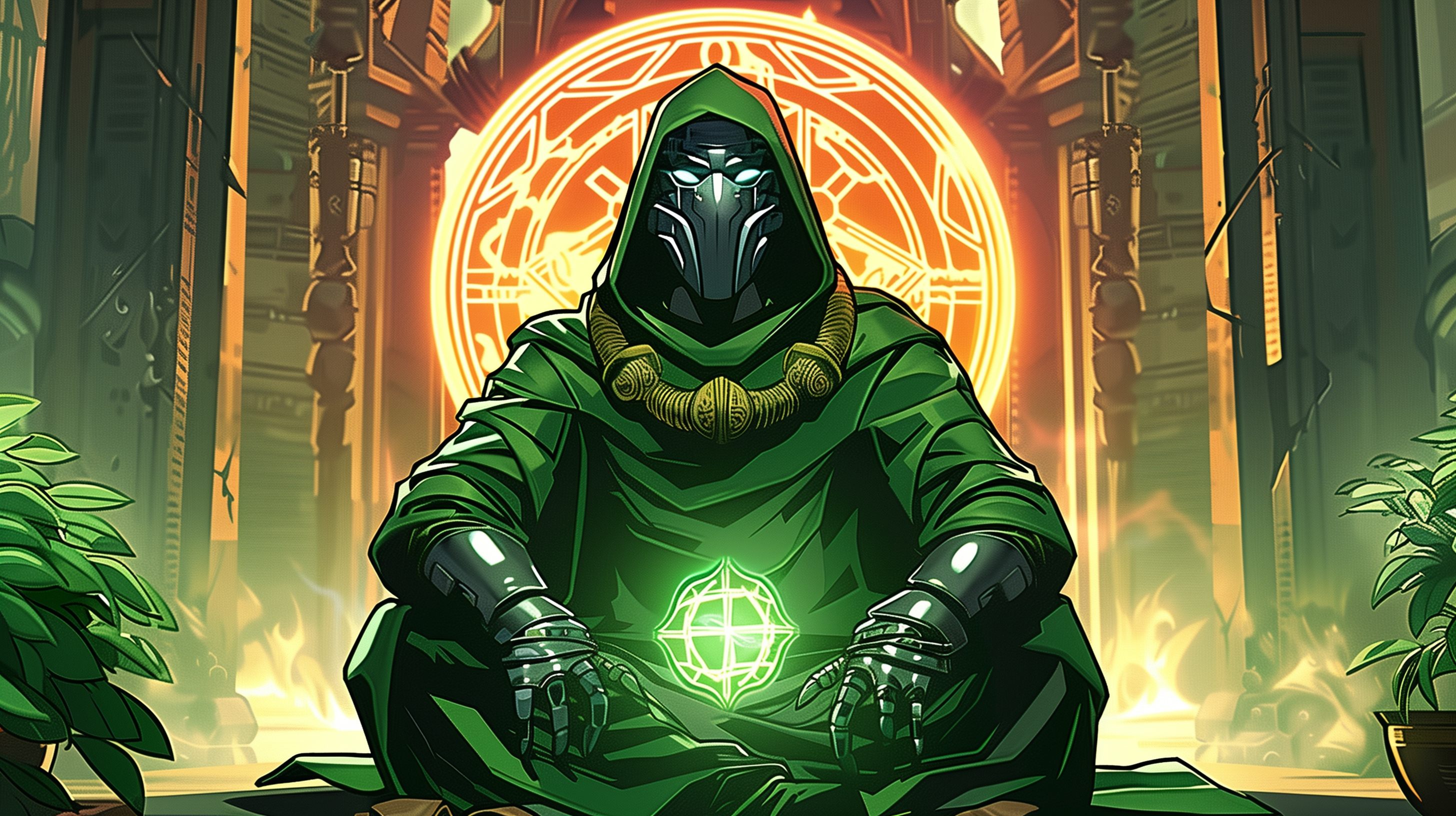
The chamber was deep in shadow, except for the flickering light of the red candles set in haphazard circles across the floor. Wax pooled at their bases, spilling over and solidifying in rough, molten drips. The flames danced, creating an uneven glow that pulsed with life and death in equal measure. In the center of it all sat the Faceless One, cross-legged, his hands resting on his knees, his breathing slow and rhythmic.
He’d been sitting for hours, eyes closed, mind drifting through planes few dared venture into. He was still, like a statue carved from stone, untouched by time or mortal concerns. The faint echoes of distant screams drifted toward him, a dull chorus barely audible over the steady hum of his breath. It was the sound of death, of destruction—and he welcomed it as an old friend.
He sensed the disturbance before he heard it. The clash of metal, the desperate grunts, and the quick, final gasps as life fled the bodies outside his chamber. It didn’t faze him. He was accustomed to the violent sounds that came with his work. It was his world—a world of deals and debts paid in blood.
The door shuddered. He didn’t flinch. It shuddered again, this time harder, and still, he didn’t move, his face hidden behind his iron mask, unreadable, his breath unbroken. The door crashed open, kicked inward with a force that sent splinters flying. The drow Vaelin Sunshadow stormed into the room, his armor splattered in fresh blood, none of it his own. Drops of it slid down the polished steel, catching in grooves and seams, trickling in small rivers. His scimitar, slick with gore, dripped red onto the stone floor.
“Liar!” Vaelin’s voice filled the chamber, raw and ragged, seething with fury. His chest heaved, his eyes blazing with an intensity that almost matched the candles. “Betrayer!”
The Faceless One let out a slow breath, opening his eyes, the faint light glinting off the steel slits in his mask. He took his time, his gaze calm and measured as it fixed on Vaelin, absorbing the fury, the blood, the rage in front of him with a cool detachment. “You’re upset,” he said, his voice low and steady, calm as the surface of a lake.
“Upset?” Vaelin spat, stepping closer. The tip of his scimitar quivered, pointed at the Faceless One’s chest. “You think I’m upset?” He kicked aside one of the candles, and it toppled over, spilling melted wax across the floor.
The Faceless One slowly rose, his robes settling around him, their edges brushing the floor, stirring the stillness in the room. He took a single step forward, his head tilting in a gesture that might have been curiosity, or perhaps amusement. “The worms. Did they not perform as expected?”
Vaelin’s fingers tightened around the hilt of his blade, his knuckles white, his breath coming in harsh, uneven bursts. In a single stride, he was upon the Faceless One, his gloved hand snapping around the man’s throat, fingers digging into the fabric and metal with a force that trembled from the strain. “They killed everything,” he growled, his voice low, choked. “Everything. My people. My soldiers. They tore through them like they were nothing.”
The Faceless One’s eyes glinted beneath his mask, but his voice remained steady, unyielding. “Release me,” he said, his words sharp, measured. “Or I’ll take that hand off your arm.”
For a long, tense moment, Vaelin’s fingers stayed, pressing against the iron mask, his own breath loud in his ears, the taste of betrayal sharp and bitter on his tongue. His grip loosened, just slightly, and then he shoved the Faceless One back, hard, sending him stumbling a step before he regained his balance.
“Your green worms were supposed to kill the serpentfolk,” Vaelin spat. “That was the deal. Not my men. You’ve cursed us to fight a war on two fronts—serpentfolk and the worm-ridden dead. We were fighting a losing battle, and now we are surrounded on all sides because of you!”
The Faceless One straightened, his robes settling, his gaze never leaving Vaelin’s face. “The worms did as intended. They destroyed the serpentfolk, along with anyone else in their path.” He shrugged, the gesture casual, dismissive. “Collateral damage. It happens.”
Vaelin’s fury boiled over, his voice a hiss of barely controlled rage. “Collateral damage? My people are fighting for their very survival. They’re falling, dying, and for what? Because you unleashed these things without control, without care.”
The Faceless One remained impassive, his mask betraying no hint of remorse. He stepped closer, and his voice dropped, low, almost a whisper. “The Age of Worms is upon us. Your people are simply one of many in its path. They will not be the last.”
Vaelin’s hand trembled, his fingers tightening around the hilt of his scimitar. His eyes met the Faceless One’s cold, unfeeling gaze, and he felt something snap, like a thread pulled too tight, stretched beyond breaking.
He lunged forward, his blade flashing in the red candlelight. He drove the scimitar forward, straight through the Faceless One’s chest, feeling the blade sink in, the resistance as it met bone and flesh. He twisted it, his face inches from the iron mask, his voice low and filled with venom. “You betrayed the wrong man.”
The Faceless One staggered, his gloved hand coming up to the wound, fingers curling around the hilt of the scimitar, dark blood seeping through his robes. He took a slow, shuddering breath, and then, with a soft cough, blood trickling from the corner of his mouth, he stepped back, sliding himself off the blade. He looked down at the wound, examining it as if it were a minor inconvenience, a simple scratch.
He raised his head, his eyes meeting Vaelin’s, and his voice was calm, almost gentle. “My turn.”
Before Vaelin could react, pain exploded through his head, sharp and blinding, like a thousand shards of glass driving into his skull. His vision went white, and then red, his thoughts scattering, slipping away. His hand dropped the scimitar, fingers slack, numb. A scream clawed at his throat, but he couldn’t release it; his mouth opened, but no sound came.
And then, darkness.
Vaelin’s body collapsed onto the cold stone floor, his limbs twitching, spasming, before finally stilling. Blood seeped from his nose, his ears, and from the corners of his vacant, unseeing eyes. His skull remained whole—intact—but within, his brain had been reduced to a pulped ruin, liquefied by the raw force of the Faceless One’s will.
The Faceless One let out a slow breath, his gaze fixed on the corpse at his feet, the silence settling heavy and thick around him. He lowered himself to the floor, his knees bending, and he sank down cross-legged, the blood trickling from his wound, staining his robes, pooling beneath him.
He closed his eyes, his breathing slowing, steadying. The pain in his chest faded, the flesh knitting itself back together, mending, as he let his mind slip back into the depths, back into the stillness, the darkness.
The candles flickered, the shadows dancing, twisting, wrapping around him, and he was alone again, the silence absolute, unbroken, as he resumed his meditation.




 Rokk Talk