Alternative Initiative Systems That Actually Work

Initiative is not a rule.
It is a queue.
And if your combat feels slow, it is almost never because the math is hard. It is because the queue is bad.
If you have ever watched your table light up during roleplay, only to glaze over the moment someone says “roll initiative,” you already know the problem. Momentum dies. Phones come out. Someone asks whose turn it is. Someone else was not ready. Five minutes later, one sword swing finally lands.
This article is not about clever tricks or novelty mechanics. It is about initiative systems that survive contact with real tables. Systems that speed things up, keep players engaged, and do not quietly implode after three sessions.
Why initiative actually slows combat
Before changing systems, it helps to name the real bottlenecks.
Across tables and systems, the same issues show up again and again:
- Setup drag: Rolling, sorting, writing, reordering, and explaining turn order takes longer than expected.
- Downtime: Players mentally check out when they know their turn is far away.
- Readiness failure: When a turn arrives, the player is not ready, restarting the clock.
- Spotlight friction: Assertive players act quickly, quieter players hesitate, and initiative order amplifies the gap.
- Swinginess: Some systems are fast but create brutal alpha strikes that end encounters before they feel earned.
Most alternative initiative systems solve one or two of these. The good ones tell you clearly which tradeoffs you are making.
The four initiative systems that actually hold up
There are dozens of variants floating around. In practice, almost all tables that change initiative end up orbiting one of these four models.
1. Side Initiative: the fastest possible setup
How it works
At the start of each round, roll once for the party and once for the opposition. The winning side goes first. Within a side, players act in any order they choose.
Why it works
- Setup time drops to seconds.
- No one forgets whose turn it is.
- Players coordinate naturally.
This variant is explicitly supported in the D&D Dungeon Master’s Guide, and for good reason. It is brutally efficient.
Where it breaks
Side initiative is infamous for alpha strikes. If one side wins initiative and focuses fire, the other side can lose key pieces before acting at all. Online discussions consistently flag this as the main downside.
How to patch it
Use one of these dials:
- Staggered starts: Only half of each side may act before the order flips.
- Boss insulation: Major enemies cannot be targeted by more than two attackers before they act.
- Reactive slots: Each side gets one reaction turn that can interrupt the opposing side once per round.
When to use it
- Large groups
- Convention games
- Dungeon crawls where speed matters more than precision
If your combats die because they never get moving, side initiative is the emergency lever.
2. Popcorn Initiative: momentum first, structure second
How it works
The first actor is chosen randomly or narratively. When a creature finishes its turn, it chooses who goes next. Once everyone has acted, the round resets.
Why it works
- Momentum stays high.
- Players stay engaged because they might go next.
- Spotlight feels earned instead of scheduled.
When popcorn initiative clicks, it feels electric. Turns chain together. Players pay attention. Combat starts to feel like a conversation instead of a spreadsheet.
Where it breaks
Two common failure modes show up in real play:
- It quietly becomes side initiative, with players always choosing the same chain.
- Monsters exploit end-of-round, start-of-round double turns, spiking damage unfairly.
Both issues are well documented in GM circles.
How to patch it
Never run popcorn initiative without guardrails:
- No self-selection: You cannot choose someone who just acted.
- Token tracking: Flip a token when a side acts. No side may act twice in a row if the other has unspent tokens.
- Forced handoff: If a side has acted twice consecutively, control must pass to the other side.
These three rules fix almost every horror story associated with popcorn initiative.
When to use it
- Story-forward combats
- Small to mid-sized encounters
- Tables that value flow over rigid fairness
Popcorn initiative rewards attention. If your players lean in when the fiction heats up, this system sings.
3. Alternating Activations: consistency without chaos
How it works
A player character acts. Then an enemy acts. Then a player. Then an enemy. Repeat until the round ends. Within each category, the acting side chooses who goes.
This structure is gaining traction in newer designs and discussion spaces because it solves multiple problems at once.
Why it works
- No one waits long between turns.
- Alpha strikes are naturally limited.
- Spotlight alternates predictably.
Every round becomes a rhythm: player move, opposition response, player move again. The table stays awake because the cadence never stalls.
Where it breaks
- Requires discipline from the GM to keep enemy turns concise.
- Multi-faction battles need a clear alternation order.
How to patch it
- Treat environmental hazards and lair effects as their own “side.”
- Group identical enemies into a single activation.
When to use it
- Tactical combat
- Boss fights
- Tables that want fairness without bookkeeping
If you want initiative to disappear into the background while still feeling structured, this is the safest long-term choice.
4. Card or Deck Initiative: tactile speed without math
How it works
Each combatant is represented by a card. Draw cards to determine order. Acting may reshuffle, discard, or modify future draws.
This model borrows heavily from Savage Worlds-style design, adapted for d20 play.
Why it works
- Order is visible at a glance.
- Drawing is faster than rolling and sorting.
- Variability keeps rounds fresh.
The Alexandrian and others have highlighted how surprisingly smooth this feels at the table.
Where it breaks
- Requires physical components or VTT setup.
- Some players dislike non-die randomness.
How to patch it
- Give bosses extra cards.
- Grant advantage or disadvantage by drawing additional cards instead of modifying rolls.
When to use it
- In-person games
- Tables that enjoy tactile elements
- Groups bored of static turn orders
This system does not just speed things up. It makes initiative feel like part of play instead of preamble.
A quick decision guide
If you only remember one section of this article, make it this one.
- Combat never starts cleanly: Side initiative
- Players tune out between turns: Alternating activations
- Combat feels stiff and mechanical: Popcorn initiative with guardrails
- You want speed plus visual clarity: Card-based initiative
Do not pick a system because it sounds clever. Pick the one that attacks your actual bottleneck.
Initiative is only half the problem
Here is the uncomfortable truth most articles skip:
You can fix initiative and still have slow combat.
Veteran GMs like Sly Flourish and DM David consistently point out that process beats mechanics. No initiative system survives players who are unprepared.
Three table practices matter more than the system itself:
- On deck warnings
Always announce who is next. Always. This alone can cut turn time dramatically. - Delegate tracking
Let a player track initiative. Visibility reduces questions. Ownership increases speed. - Default actions
If a player is not ready, their character takes a basic defensive action. No debate. This rule feels harsh exactly once.
These practices show up again and again in GM advice because they work regardless of ruleset.
Common objections, answered
“Isn’t this less fair?”
Fairness is not sameness. A system that everyone understands and stays engaged with is often perceived as more fair, even if it is less granular.
“Won’t players game the system?”
They will. That is why every system above includes explicit guardrails. Design for exploitation instead of pretending it will not happen.
“What about summons, pets, and hordes?”
Group them. If your initiative system cannot scale, your encounter design is the real issue.
The real takeaway
Initiative is not sacred. It is infrastructure.
Your job as a Game Master is not to preserve a rule. It is to protect momentum.
Pick one of these systems. Patch it deliberately. Pair it with strong table habits. Then run three sessions before judging it.
If your players stop asking whose turn it is, you chose well.
The Fastest Way to Level in the WoW Midnight Pre-Patch
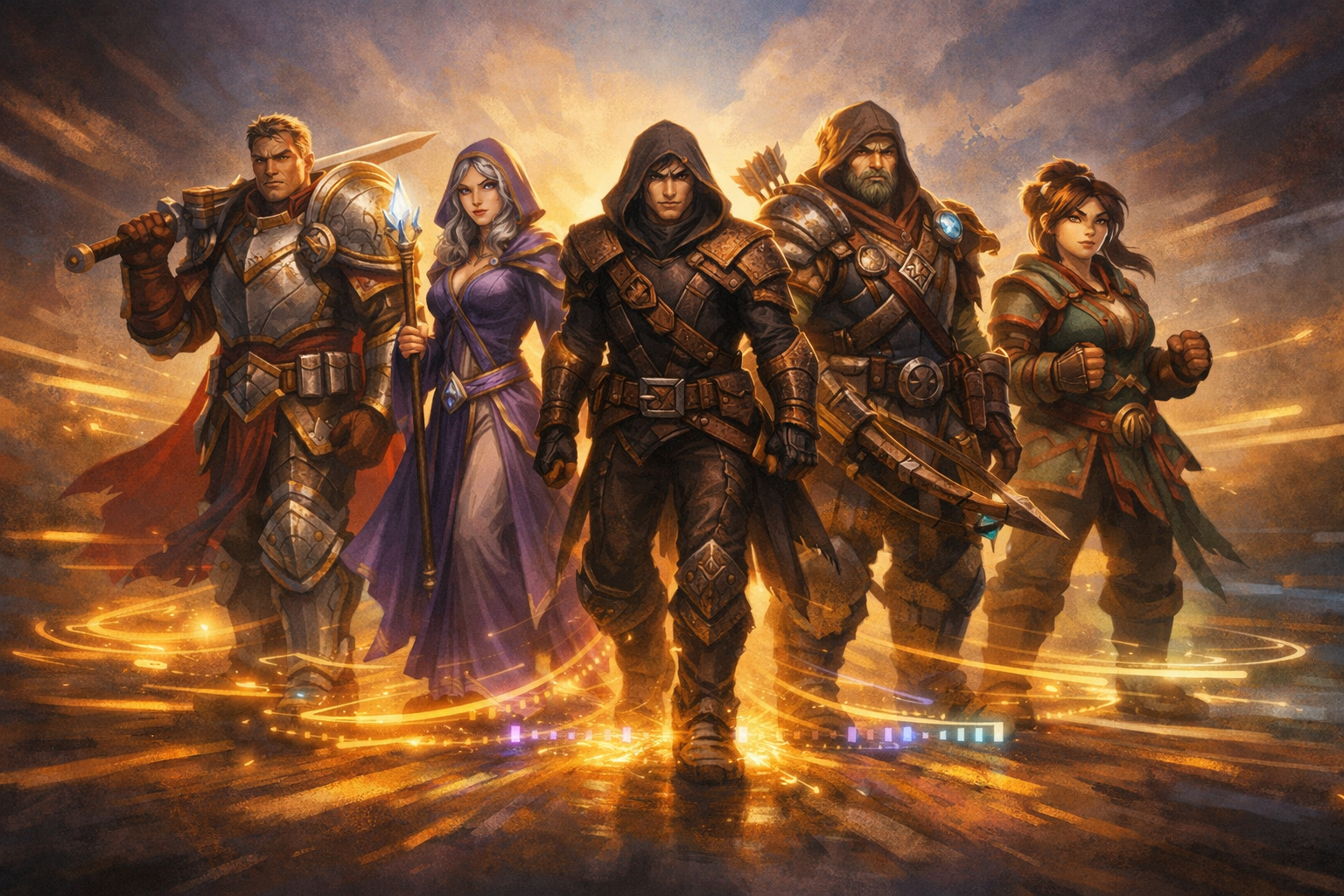
(Editor’s Note: That’s right, a World of Warcraft post. I’m just as shocked as you, but here we are. Now, on to the article.)
The Midnight pre-patch is lying to you.
Not maliciously. Not intentionally. But quietly, structurally, and in a way that catches a lot of players every expansion cycle.
The game puts a big flashy event front and center. NPCs shout at you. The map lights up. Social media fills with screenshots. And the natural assumption is simple:
“This must be the fastest way to level.”
It isn’t.
If your goal is to get characters to cap efficiently, the Midnight pre-patch rewards buff stacking, session planning, and queue leverage, not blind event grinding. Once you understand that, leveling becomes dramatically faster and far less frustrating.
This guide breaks down exactly how to do that, why it works, and how to adapt it to your situation, whether you are leveling one main or an entire roster of alts.
The Core Truth of Pre-Patch Leveling
Every modern WoW pre-patch follows the same hidden rule:
The fastest XP comes from systems designed for alts, not from the headline event.
In Midnight, those systems are:
- Winds of Mysterious Fortune: a 20% XP bonus for characters from level 10–79
- Mastery of Timeways: a 30% XP bonus earned by completing four Timewalking dungeons, lasting three hours
These two buffs stack multiplicatively with almost everything you do. That alone tells you where Blizzard wants players to catch up.
Meanwhile, the Twilight Ascension pre-patch event is designed primarily for:
- Narrative onboarding
- Catch-up gear and currency
- Group spectacle
It is not tuned for maximum XP per hour.
Understanding that distinction is the key to leveling fast without burnout.
Step One: Lock in Your XP Buffs Before You Do Anything Else
Before choosing a route, you want to ensure your character is benefiting from every global XP modifier available.
Winds of Mysterious Fortune (10–79)
This buff provides a flat 20% experience increase across quests, kills, and dungeon completions for characters between levels 10 and 79.
Why this matters:
- It rewards uptime, not activity type
- It stacks cleanly with dungeon bonuses and Timewalking buffs
- It disproportionately benefits short, efficient sessions
If you are leveling alts and this buff is active, you should be leveling. Period.
Mastery of Timeways (30% for 3 Hours)
Completing four Timewalking dungeons grants Mastery of Timeways, a 30% XP bonus lasting three hours. Completing additional Timewalking dungeons refreshes the duration.
Why this matters:
- It turns Timewalking into a launch ramp, not just a leveling method
- The three-hour window encourages burst leveling
- You can carry the buff into questing, world content, and even the pre-patch event
This is where many guides fail. They treat Timewalking as the entire plan instead of the engine that powers the plan.
The Fastest Leveling Framework (Think Like a GM)
If you are a Game Master (or Dungeon Master), this will feel familiar.
Fast leveling works best when you think in sessions, not activities.
Session Design Philosophy
- Short sessions: maximize XP density
- Clear entry condition: buffs active, hearth set, route chosen
- Clear exit condition: buff expires or level breakpoint reached
You are not “grinding.” You are executing a scenario.
Level 10–70: The Proven Fast Path
Phase 1: Trigger Mastery of Timeways
Your first goal is always the same: Run four Timewalking dungeons as early as possible.
Why?
- Dungeon completion XP is front-loaded
- Scaling is generous at low levels
- The 30% XP buff multiplies everything afterward
Role matters here:
- Tanks and healers get near-instant queues
- DPS should queue while questing to avoid downtime
Phase 2: Ride the Buff, Don’t Babysit It
Once Mastery of Timeways is active, you have options.
The fastest players do not stay locked into Timewalking for the entire three hours. Instead, they pivot based on queue time.
If queues are instant or near-instant
- Continue Timewalking spam
- Refresh the buff naturally
If queues slow down
- Switch to Chromie Time questing
- Focus on compact quest hubs with minimal travel
- Avoid long narrative chains and vehicle quests
The buff applies everywhere. Wasting time waiting in queues is the real XP killer.
Chromie Time: Use It Surgically
Chromie Time remains available from levels 10–70, but not all expansions are equal for speed.
General principles:
- Dense quest hubs beat epic storylines
- Short travel beats cinematic pacing
- Kill-and-collect beats scripted events
This is not about immersion. This is about throughput.
Treat Chromie Time like a toolbox, not a commitment.
Level 70–80: Where Most Players Slow Down
The jump from legacy leveling into current expansion content is where players lose momentum.
The mistake is trying to do everything.
The Correct Mindset
At 70+, you are no longer chasing raw XP multipliers. You are chasing completion efficiency.
The goal is not:
- Full zone clears
- Reputation optimization
- Perfect gearing
The goal is:
- Clean quest chains
- Minimal backtracking
- Fast objective density
Players routinely report finishing 70–80 in one to two hours when focused and buffed, especially during pre-patch windows.
This is not about skill. It is about restraint.
Where the Twilight Ascension Event Fits (and Where It Doesn’t)
The Twilight Ascension pre-patch event is not the fastest way to level.
Community sentiment reflects this clearly, and many players express frustration after assuming the event was designed for speed.
That said, the event does have a place.
When the Event Is Worth Doing
- You need catch-up gear
- You want event currency
- You are playing socially and XP speed is secondary
- You are leveling very early characters alongside friends
When to Skip It
- You are optimizing XP per hour
- You are inside a Mastery of Timeways window
- You are leveling multiple alts efficiently
The optimal approach is hybrid:
- Use Timewalking and questing to level
- Dip into the event only when you want its rewards
The mistake is committing to the event as your primary leveling path.
Common Questions, Answered Clearly
“Is the pre-patch event meant for leveling?”
It is meant for onboarding and catch-up. XP is incidental, not optimized.
“Should I only do Timewalking?”
No. Use Timewalking to activate and refresh the XP buff, then pivot based on queue times.
“Does this still work for DPS?”
Yes, but only if you quest during queues. Standing still is the enemy.
“What if I only have 45 minutes?”
Do not start Timewalking unless you can complete four dungeons quickly. Short sessions are best spent questing while Winds is active.
The Meta Strategy Most Guides Miss
The real optimization is not choosing the “best” activity.
It is removing dead time.
Dead time includes:
- Long queues
- Excessive travel
- Over-committing to slow content
- Playing without XP buffs active
Every fast leveling route works because it minimizes those costs.
That principle survives hotfixes, tuning passes, and even expansion changes.
Bringing It All Together
If you want to level quickly in the Midnight pre-patch, stop asking: “What activity gives the most XP?”
Start asking: “What lets me spend the most minutes gaining XP with buffs active?”
That shift changes everything.
The Optimal Loop
- Activate Winds of Mysterious Fortune
- Run four Timewalking dungeons
- Level aggressively during the three-hour buff window
- Pivot between dungeons and questing to avoid downtime
- Use the pre-patch event selectively, not obsessively
Do this, and leveling stops feeling like a grind and starts feeling like momentum.
Your Call to Action
If you have been bouncing between activities and feeling slower than expected, pick one character, commit to a three-hour focused session, and run this plan cleanly from start to finish.
You will feel the difference immediately.
And once you do, you will never level during a pre-patch the old way again.




 Rokk Talk