Category Archives: Blog
How to Keep Distracted Players Engaged at the Table

At some point, every Game Master looks up from their notes and realizes half the table is gone.
One player is scrolling. Another is whispering about something that happened three turns ago. A third is staring into the middle distance like they’ve slipped between realities. You’re mid-scene, the stakes are real, and yet attention is leaking out of the room like air from a cracked hull.
This isn’t a personal failure. It’s not even a player problem.
It’s an attention design problem.
Modern tables sit at the intersection of long-form storytelling, turn-based mechanics, and a world engineered to fracture focus. If you want engaged players, you don’t fix this by banning phones and lecturing about respect. You fix it by shaping the session so that staying present is easier than drifting away.
This article is a practical guide to doing exactly that.
Distraction Is a Symptom, Not the Disease
Let’s start with a hard truth: most distracted players are not bored because they don’t care. They’re bored because the game has stopped asking anything of them.
Research outside of gaming backs this up. Studies from the University of British Columbia found that people who used their phones during face-to-face social interactions reported enjoying the experience less than those who didn’t. Other research shows that even the mere presence of a smartphone can reduce available cognitive capacity. Attention is fragile, and once it slips, it’s hard to claw back.
At the table, distraction usually shows up during three moments:
- Downtime: long waits between meaningful decisions
- Low-stakes scenes: nothing seems to change if they tune out
- Unclear focus: players don’t know when they’re “on”
If you treat the symptom, you get table rules and resentment. If you treat the disease, you get engagement.
So let’s treat the disease.
Step One: Diagnose the Distraction Before You Fix It
Before you change anything, run a quick mental audit during your next session.
Ask yourself three questions:
- When do players disengage?
- Who disengages, and who doesn’t?
- What is happening in the game at that moment?
If distraction spikes during combat, that’s a pacing issue. If it happens during roleplay scenes, that’s a spotlight issue. If it happens whenever one specific player acts, that’s a clarity or tone issue.
Here’s the key insight: disengagement almost always correlates with a lack of agency. If a player hasn’t made a meaningful decision in a while, their brain looks for stimulation elsewhere.
Your job as GM is not to entertain nonstop. Your job is to keep meaningful decisions flowing.
Step Two: Set a Downtime Budget
This is one of the most powerful tools you can adopt.
A downtime budget is a simple rule:
No player should go more than a set number of minutes without making a meaningful decision.
For most tables, that number is somewhere between 5 and 10 minutes.
A meaningful decision is not:
- listening to lore
- watching someone else roll damage
- debating hypotheticals
A meaningful decision is:
- choosing an action
- responding to a question
- committing to a plan
- reacting to consequences
Once you start tracking this mentally, patterns jump out fast. Long monster turns. Rules lookups mid-combat. Scenes that drift because no one is being directly addressed.
You don’t need to eliminate downtime entirely. You just need to budget it.
Step Three: Fix Combat First (Because It’s the Worst Offender)
If phones come out during combat, that’s not because players hate combat. It’s because combat is eating time without feeding engagement.
Here are concrete fixes that work.
Put Players “On Deck”
At the end of each turn, say who’s next.
“Goblin A attacks. Sarah, you’re up. Mark, you’re on deck.”
This single habit cuts decision paralysis and keeps attention forward instead of backward.
Front-Load Decisions
Ask players what they plan to do before their turn arrives.
You’re not locking them in. You’re getting them thinking. When their turn comes, execution is fast.
Reduce Monster Thinking Time
Monsters should act decisively. Pre-roll damage. Use average damage. Group similar creatures into shared initiatives.
If a monster takes longer to decide than a player, you’re bleeding attention.
Narrate Outcomes, Not Math
Describe what changes in the fiction. Numbers are necessary, but story is what keeps eyes up.
Combat should feel like a sequence of consequences, not a spreadsheet.
Step Four: Use the Engagement Loop in Every Scene
Outside of combat, distraction usually comes from unfocused scenes. The fix is structure.
Run every scene through this four-step loop:
- Micro-recap
One or two sentences. Where are we? What just happened? - Direct address
Pick a player. Ask them a question. - Clear options
Present two or three paths forward. Not infinite fog. - Stakes check
Make it clear what might change based on the choice.
Example:
“You’re standing outside the sealed vault. The lock is arcane and unstable.
Kara, what are you doing right now?
You could force it, try to dispel it, or search for another way in.
If you force it, something inside may wake up.”
That loop does three things:
- it anchors attention
- it assigns spotlight
- it creates urgency
Run it consistently, and distraction drops without you saying a word.
Step Five: Channel Side Chatter Instead of Fighting It
Side chatter is not always disrespect. Often, it’s unused energy.
People talk when they’re not needed.
Instead of shutting it down, redirect it.
Assign Table Roles
Give talkers something productive to do:
- initiative tracker
- mapper
- rules lookup
- loot recorder
- recap lead
These roles keep players engaged even when it’s not their turn.
Use Intentional Breaks
Every 60–90 minutes, call a break. Encourage phone checks then.
When everyone returns, do a quick recap and re-establish the scene. This mirrors best practices from facilitation and training environments and works because it respects attention limits instead of pretending they don’t exist.
Step Six: Stop Treating Phones as the Enemy
Blanket phone bans often backfire. They ignore accessibility needs, digital character sheets, and how people actually self-regulate focus.
Instead, set use boundaries, not bans.
A practical phone policy looks like this:
- Allowed: character sheets, dice apps, rules references
- Discouraged: social feeds, videos, unrelated browsing
- Planned: regular breaks to check messages
Explain the why. Phones fragment attention. Fragmented attention weakens the shared story.
Most players respond better to purpose than to rules.
Step Seven: Ask Questions That Can’t Be Ignored
One of the fastest ways to snap attention back to the table is to ask the right kind of question.
Not “What do you do?”
Ask “Why do you hesitate?”
Ask “Who taught you this?”
Ask “What are you afraid will happen if you’re wrong?”
These questions can’t be answered from a character sheet. They demand presence.
Use them sparingly and intentionally, especially when you sense drift. They turn passive listeners into active participants in seconds.
Step Eight: Have the Hard Conversation When You Need To
Sometimes distraction isn’t systemic. Sometimes it’s personal.
If one player is consistently disengaged in ways that disrupt others, talk to them privately. Be specific. Be calm.
Describe the behavior. Explain the impact. Ask what’s going on.
You’re not accusing. You’re diagnosing together.
Many issues resolve here because the player didn’t realize how visible the behavior was, or because something in the game isn’t landing for them.
Avoid public callouts. Handle it like a professional.
Step Nine: Design for Attention, Not Against It
The best tables don’t rely on constant novelty. They rely on rhythm.
They rotate spotlight.
They keep decisions flowing.
They respect cognitive limits.
They build habits that reward presence.
When you do this well, phones stay down without a single rule. Side chatter turns into collaboration. Disengaged players reappear because the game keeps inviting them back in.
This is not about control. It’s about care.
Bringing It All Together
If players are distracted at your table, don’t start by asking how to stop them from checking out.
Start by asking how often the game asks them to check in.
Engagement isn’t enforced. It’s engineered.
So here’s your call to action:
At your next session, pick one change from this article.
Put players on deck.
Run the engagement loop.
Set a downtime budget.
Schedule a real break.
Do it consistently for three sessions.
Then watch what happens to the phones, the chatter, and the energy at the table.
That’s how you keep players engaged, not by demanding attention, but by earning it.
The Hidden Problem with High-Level RPG Campaigns
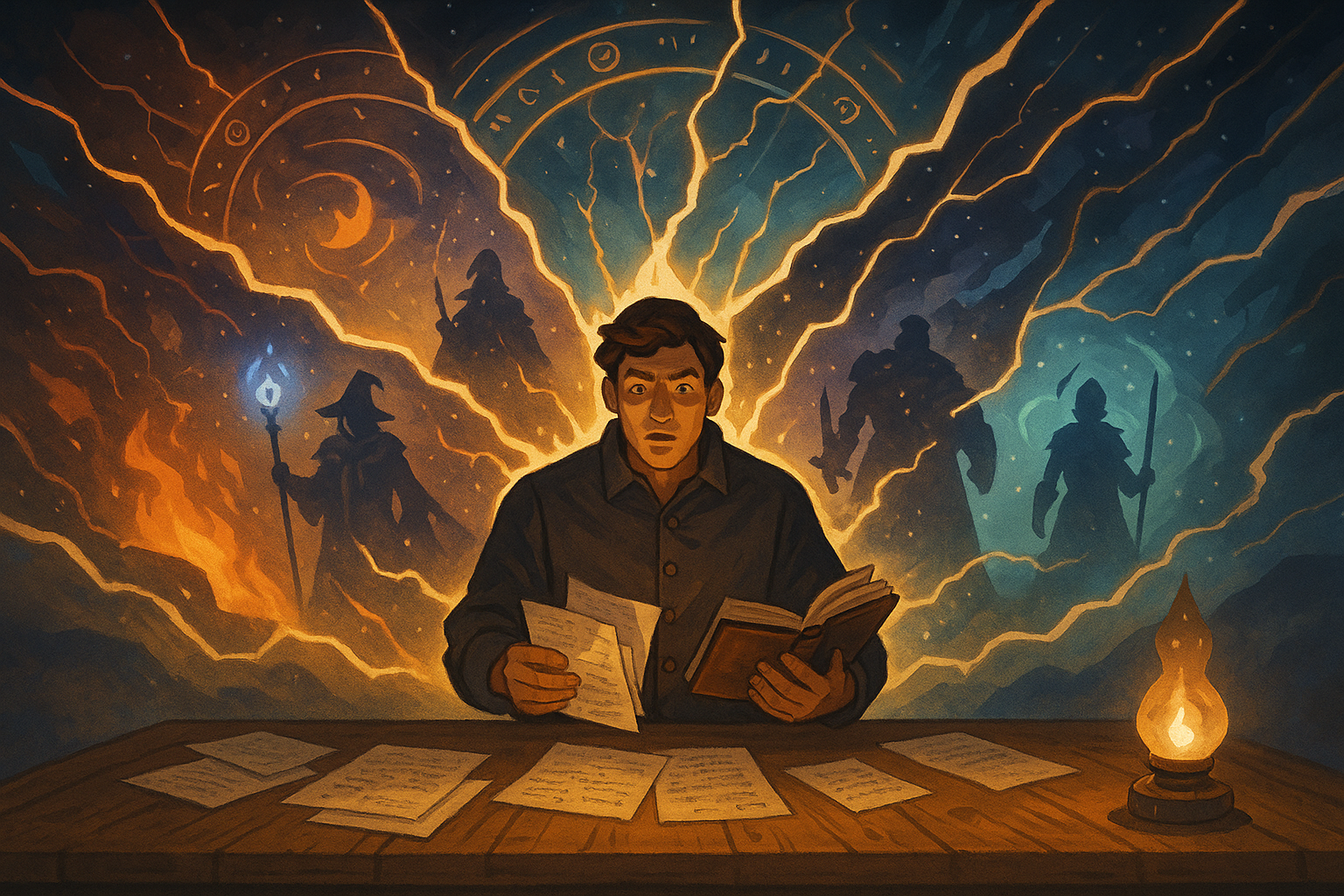
There’s a moment every long-running Game Master quietly dreads.
Your players finally hit the high teens. They’ve earned mythic titles. They have teleport on speed-dial, resurrection in their back pocket, and spell lists that read like reality-editing toolkits. On paper, this is the payoff for years of story.
Instead, the room goes quiet.
You realize the monsters in the book don’t challenge them anymore. Combat takes an hour per round. Every mystery you build collapses under scry, speak with dead, or true seeing. And while you’re trying to keep up with the fireworks, your players are flipping through character sheets that stretch into dozens of abilities they barely remember.
The uncomfortable truth: epic-level play in most RPGs isn’t “hard.” It’s structurally mismatched to how these games are designed and how most tables actually play.
You can absolutely run a great epic-tier arc. Many GMs do. But it’s not the same style of game you run at level 5—or even level 12. It demands a different mindset, a different prep style, and a different campaign structure entirely.
This is why even though many RPGs promise “levels 1–20,” the overwhelming majority of campaigns never see those final chapters. Internal platform data often quoted by designers and analysts shows more than 90% of campaigns end before level 11, and only a tiny fraction (around 2%) reach level 20. Pathfinder 1e openly steers GMs toward ending campaigns around level 20 because the math and support beyond that point degrade sharply.
Let’s break down what actually goes wrong at epic levels, why most tables stall before ever reaching them, and how you can run high-tier stories without burning out.
1. The Numbers Don’t Lie: Most Campaigns Never Reach Epic Tier
If you’ve ever felt guilty for ending a campaign early, here’s the good news: you’re normal.
Across platforms and player surveys, the same pattern repeats:
- Most campaigns end between levels 7–10.
- High-level characters (16–20) make up only a sliver of active play.
- Reaching level 20 requires months—sometimes years—of uninterrupted sessions.
There are practical reasons for this:
- Life schedules change. People switch jobs, move cities, or have kids.
- Campaign energy dips around the middle. The “new campaign glow” fades after several arcs.
- Prep requirements spike around level 12+. More abilities = more edge cases.
- Pacing slows dramatically. High-level combat is longer, not necessarily more exciting.
But the bigger reason is structural.
RPGs like D&D and Pathfinder were originally built around the low-level experience—scrappy heroes facing grounded challenges. Level 18 characters are demigods, and the system doesn’t fully adjust its expectations to handle that shift. Designers focus support on where most people play. Publishers write adventures for levels 1–10 because that’s where campaigns live.
In short: the game assumes epic levels exist, but doesn’t actually build the scaffolding needed to support them.
And as a GM, you feel that tension first.
2. When the Rules Outgrow the Story
Everything you learned as a GM from levels 1–12 quietly collapses at high level.
That locked door? Nothing.
The villain fleeing? Teleport target.
The mysterious clue? Legend lore it.
The consequences of death? A speed bump.
Here’s a simple example.
Low-Level Problem:
A duke is murdered. The PCs must find the killer.
Epic-Level Problem:
The PCs cast speak with dead, commune, legend lore, scry, and true seeing, then review the answers while teleporting to confront the culprit across three planes.
The challenge isn’t that these spells are “too strong.” They’re supposed to be strong. The issue is that the story structure you relied on earlier doesn’t survive contact with them.
At epic level:
- Information is easy to get.
- Distance is meaningless.
- Obstacles vanish.
- Mortality weakens.
- Secrets evaporate.
The physics of your world change, but your setting usually doesn’t.
How many adventures actually describe how kingdoms defend against teleport-assassinations? Or how churches respond to cheap resurrection? Or how any mystery survives divination?
If you don’t address the new physics, your story falls apart. Most systems don’t help you with this jump—they leave you to reverse-engineer an entire metaphysics layer on your own.
As a result, some GMs respond by banning spells, nerfing abilities, or constructing “anti-magic fields” the size of small countries. But that’s a band-aid, not a fix.
The solution is reframing your challenges—not blocking player abilities, but acknowledging what those abilities actually say about your world.
3. The DM Arms Race: When Power Escalation Becomes Work
Epic-tier combat is an entirely different animal. On paper, high-level enemies are terrifying. At the table, things get… messy.
Here’s why.
1. Stat blocks grow faster than your prep time.
A level 18 demon lord might have:
- 5–7 innate spells
- Legendary actions
- Lair actions
- Resistances
- Immunities
- Special abilities
- Summoning
- Regional effects
Running this is a full cognitive load. Running six PCs with similar capabilities is another.
2. High-level fights swing between “trivial” and “TPK.”
The math at epic level pushes two extremes:
- A spell like forcecage can trivialize a major boss.
- A single failed save can drop a PC from full HP to zero.
The variance is enormous. Most systems aren’t built to stabilize that swing. As GM, you end up rewriting monsters on the fly just to avoid anticlimax.
3. “Bounded accuracy” (or its equivalents) stretch too far.
In systems that limit how high numbers can go, epic enemies become gigantic bags of HP. In systems without bounded accuracy, numbers blow past manageable ranges.
Both extremes feel less fun than level-5 combat.
4. Social contracts become strained.
Many tables quietly adopt a truce:
- Players avoid abusing broken combos.
- GMs avoid designing encounters that one-shot the party.
This is functional, but it turns epic play into a gentleman’s agreement rather than a robust game mode.
5. Prep time balloons while payoff narrows.
You can spend six hours preparing a demon citadel with layered defenses, only for the wizard to teleport the party straight to the throne room. And if the fight ends in two rounds because of a good initiative roll, the emotional payoff is gone.
This is the moment many GMs burn out—not because epic play is impossible, but because the cost-to-reward ratio skews unsustainably.
4. Campaign Structure: The Hidden Reason Epic Levels Feel Awkward
Most campaigns accidentally follow a familiar arc:
- Introduce the world.
- Introduce the villain.
- Raise stakes.
- Resolve the story.
That arc typically concludes around levels 9–13. The emotional climax happens right where the rules still run smoothly.
When a campaign keeps going past its natural endpoint, you’re stuck adding villains you never foreshadowed or stretching the story past its intended tension.
This is why epic-level play works best when designed as a short, intentional season rather than the “next chapter” of a traditional campaign.
Think of it like this:
- Tier 1–3: The campaign story.
- Tier 4: The epilogue season.
This framing lets you:
- Introduce stakes appropriate for level 18 characters.
- Design bespoke threats rather than duct-taping mid-tier villains into epic ones.
- Build a finale that embraces the group’s growth rather than running away from it.
If your campaign is already long, adding another year of prep-heavy, complexity-heavy sessions isn’t appealing. But a focused, six-session epic arc? That’s compelling.
5. Systems That Actually Support an Endgame (and What to Borrow From Them)
While mainstream RPGs struggle with epic levels, several systems handle high-power or realm-level play better because they were designed for it.
1. OSR Domain Rules
Old-school frameworks assume characters eventually rule strongholds, command armies, and influence kingdoms.
Borrow this:
- Let PCs command forces rather than fight everything personally.
- Use high-level play to influence societies, not just stat blocks.
2. Adventurer Conqueror King (ACKS)
This system has detailed rules for economics, warfare, domains, and realm management.
Borrow this:
- Create political consequences for high-level actions.
- Let PCs’ decisions reshape borders, factions, or planes.
3. Narrative Systems
Games that scale influence rather than numbers—like certain narrative-driven systems—embrace epic stories without drowning in modifiers.
Borrow this:
- Escalate the meaning of choices, not just the size of monsters.
4. Mythic Systems
Some games separate power gains from raw levels, providing mythic or divine tiers that change how challenges are structured.
Borrow this:
- Treat epic characters as mythic forces and design problems accordingly.
- Introduce planar, cosmic, or philosophical threats instead of “bigger dragons.”
By borrowing these tools, you can build an epic tier that doesn’t rely solely on inflated stat blocks.
6. So How Do You Run Epic Play Well?
You don’t fix epic-level play by banning teleport or rewriting half the book. You fix it by reframing what your game is about.
Here are actionable steps that work at real tables:
1. Make epic play a short, high-impact arc.
Treat it as a six to ten-session season. Build it intentionally, foreshadow it earlier, and design a definitive endgame.
2. Scale challenges sideways, not upward.
Instead of “bigger monster, more hit points,” try:
- A planar crisis.
- A three-faction war.
- An ancient prophecy that twists choices.
- A villain who can see the future.
- A moral dilemma with no perfect solution.
3. Redesign mysteries for epic characters.
If divination exists, the mystery isn’t “Who did it?”
It’s:
- “Why did they do it?”
- “How do we stop the chain reaction?”
- “What do we do with the truth?”
4. Let abilities shine instead of blocking them.
If the wizard teleports, challenge what happens after teleportation.
If the rogue is invisible, challenge what the rogue steals or disrupts.
If resurrection exists, challenge what happens to souls, factions, or the afterlife.
5. Shift encounters to dynamic battlefields.
Static slugfests are death at high level. Use:
- Timed objectives
- Shifting arenas
- Planar hazards
- Moving platforms
- Ritual countdowns
6. Reduce the number of fights. Increase the importance of each one.
Epic PCs don’t need five encounters per session. They need one that matters.
7. Embrace the mythic.
When your players become demigods, give them a stage worthy of that power:
- Planar courts
- Forgotten gods
- Sentient artifacts
- Crumbling realities
- Legions that answer to them
Their actions should echo.
Conclusion: Epic Levels Aren’t Broken—They’re a Different Game
Epic play struggles because we try to run it like the rest of the game.
But level 18 characters aren’t adventurers anymore. They’re forces of nature. They’re icons. They solve problems no mortal can touch. Expecting low-level story structures, pacing, and prep techniques to survive that shift is a recipe for burnout.
When you treat epic levels as a new mode of play—with different assumptions, different structures, and a shorter runway—the experience becomes not just manageable, but unforgettable.
If you want epic play to work, design it intentionally, run it briefly, and aim for a finale your players will talk about for years.




 Rokk Talk