Category Archives: Blog

Age of Worms Session Recap: The Monster Within
Previously…
The Ruinlords faced their toughest battle yet in the Champion’s Games, pitted against stone giants corrupted by Theyrium. Before the dust settled, the Sapphire Squad attempted to strike, but the Ruinlords overwhelmed them, forcing their surrender.
Later, Ekalim Smallcask revealed a personal plea—his sister Lahaka had vanished after last year’s games, and he suspected Loris Raknian was involved. He begged the Ruinlords to help uncover the truth.
Then came the Silver Flight.
Saint Alduin’s elite knights fought with ruthless precision, nearly bringing the Ruinlords down. But the tide turned, and Alduin’s composure cracked. His last knight turned to him for guidance. Alduin said nothing. The knight fell.
The Ruinlords stood victorious once more. The crowd roared. Loris Raknian grinned. And high above, Saint Alduin took flight and vanished into the sky.
Not Sure What’s Going On?
Catch up on the Ruinlords’ journey to stop the rise of Kyuss by reading our Age of Worms Session Recaps!
The third day of the Champion’s Games in Tymon had come to a close with the Ruinlords standing victorious over the Andoran guardians known as the Silver Flight. Battered but unbroken, they returned to the Coenoby beneath the grand arena, sharing uneasy silence with the remaining two gladiator teams—Vixus’ Warband and Phoenix Fire.
As dusk fell, the fight schedule for the next day was posted. Whispers spread quickly through the underground chambers. Vixus’ Warband and Phoenix Fire would clash for a place in the finals, but the Ruinlords were set to face something else. Something called Madtooth the Hungry. And that wasn’t the only oddity—the previous year’s champion, Vixus, was meant to face the beast, as was tradition. But for the first time in the tournament’s history, that rule had been broken.
No one had an answer.
That night, as the other teams settled into uneasy rest, Cal stole away to the nearby Titan’s Ruins. He descended into the still waters of the pool, studying the ancient stone plug at the bottom. The weight of years lay thick upon it—undisturbed for over a year. If Lahaka, the missing sister of the Ruinlords’ coach Ekalim Smallcask, had vanished after last year’s games, then she had never come this way. The revelation left him with more questions than answers. With a quiet curse, he abandoned the search and returned to the Coenoby.
But the night was far from over.
The Visions Begin
Dunner and Alfie, their bellies full from a simple meal, heard a commotion from the direction of Phoenix Fire’s quarters. Then, without warning, a force far greater than mortal senses ripped into them.
Dunner was no longer in the Coenoby. He was on a battlefield, surrounded by the dead—hundreds of them. A storm boiled overhead, unnatural green lightning clawing across the sky. Then, movement. The corpses twitched, shuddered, rose—their flesh splitting open, spilling forth writhing green worms. A churning, mindless hunger filled their empty sockets.
And then, Dunner felt it.
The silence of his god.
The Warpriest of Gorum was alone. For the first time, truly alone. The worms swarmed, gnawing, writhing, crawling into his mouth—
Dunner awoke, gasping.
Beside him, Alfie convulsed, lost in his own nightmare. The cleric of Erastil was locked in seizure, his body betraying him, his mind ensnared. The Ruinlords carried him to safety, his faithful owlbear, Potato, standing vigil over him through the long, uncertain night.
The Library of Dreams
On his way back from the ruins, exhaustion finally took Cal. Weeks without sleep crashed down upon him, and when his vision returned, he was no longer in the Coenoby.
He was in a library.
The scent of parchment, ink, and old leather filled the air. Towering bookshelves stretched into eternity. And before him stood a woman—drow, with deep violet hair, her eyes glistening with unshed tears.
His mother.
Eilistrae, cleric of Silthian, took a slow, reverent step forward. “We will see each other again, my son.” Her voice trembled, but her hands were steady as they reached for him. “But listen—your visions of Kyuss are not without meaning. His bonds weaken. He has never been this strong. And if you and your companions have felt him… it means the world will feel him soon.”
And then, the dream collapsed.
Cal awoke on the ground in the tunnel. His mother was gone.
The Arena’s Greatest Spectacle
The fourth day of the Champion’s Games.
At the eleventh hour, the Ruinlords were once again marched up the long passageways beneath the Arena of Aroden, stepping out onto the bloodstained sands beneath a relentless sun.
The crowd thundered with cheers, their anticipation thick as a storm on the horizon. Their champions had bested the Silver Flight. They had spilled blood in glorious combat.
And today, they would face Madtooth.
But where was the beast?
The announcer, Talabir, filled the silence with bravado, but doubt crept into his voice as the moments stretched long. The handlers were late. Were the wranglers struggling to control the creature?
And then, the sky darkened as a shadow streaked across the heavens.
A golden light descended like a burning comet, faster than any arrow, crashing into the sand with the force of a divine spear. Dust billowed, the ground trembled, and as the Ruinlords shielded their eyes, the figure straightened.
A red cloak, untouched by the dust. A smile, radiant and unshaken. Saint Alduin.
And in his arms, he carried a massive metal box the size of an ogre’s coffin. The runes on its surface flickered. The reinforced bands of steel groaned. Something inside slammed against the walls, desperate to be free.
Alduin’s voice rang out, commanding, charming, calculated.
“You have proven yourselves against my Silver Flight,” he said, touching his chest in a gesture of mourning that held no sorrow. “But today is not a day for sorrow. No, today is a day for glory.”
The crowd roared.
The Ruinlords waited.
And Alduin rested a hand atop the trembling steel box. “Behold, your true challenge.”
A crash. A snarl. The sound of something not entirely bestial.
Alduin’s smile grew.
“He was resistant at first,” he mused, “but with a little encouragement…” He gestured at the box. “He has found his motivation.”
Inside, a voice howled—not just in rage, but pain.
Alduin tilted his head, playful, cruel. “A special blend of dragon’s blood—black and green, venom and acid—running through his veins, urging him toward his true nature.” He turned his gaze to the Ruinlords. “A fitting test, don’t you think?”
And then, the box burst open.
The Riftwalker’s Curse
Acidic vapor filled the air. The crowd gasped. A massive clawed hand, covered in warped, pulsing veins, slammed into the sand. A figure staggered forward.
Dr. Lorien Thalorin.
But not as he once was.
His veins glowed black and green. His flesh cracked as jagged scales pushed through his skin. His nails elongated, twisted into claws before retracting. His mind flickered between intelligence and hunger.
And then, for a moment, clarity.
His wide, terrified eyes locked onto the Ruinlords. “No… no, no, no. You have to stop this.”
His body convulsed, his form stretching unnaturally. “GET AWAY!”
The crowd cheered, oblivious.
But the Ruinlords knew. The Riftwalker wasn’t a myth. He was real. He was dangerous. And if he lost control, Tymon would be nothing but dust.
The Legend of Dr. Lorien Thalorin
Lorien Thalorin had once been a scholar of the arcane, a prodigy from the lost kingdom of Vandekar. He was brilliant—too brilliant. His research took him into forbidden territory, beyond the safe limits of mortal understanding. He sought answers in ancient Cyclopean ruins, delving into the mysteries of dimensional rifts and eldritch containment.
And then, one day, he found something.
The texts spoke of Xaathuun, the Unchained Maw—a cosmic predator described as a Tarrasque-like creature with a hunger that could not be satisfied. The ruins were not a tomb. They were a prison. And Lorien, in his pursuit of knowledge, cracked the seal.
Vandekar was wiped from the map overnight. Not conquered. Not abandoned. Erased. The ground split open. The sky bled. Whatever emerged from the rift devoured the city, leaving behind nothing but scorched wastelands and howling fissures that led to nowhere.
Lorien survived. But he did not escape unscathed.
He became a living conduit for the thing he had unleashed—a part of his body and mind permanently fused to the failing containment field. The energy backlash twisted his very being, marking him as something no longer fully mortal.
He fled, a wanted man. The survivors of Vandekar hunted him, blaming him for their kingdom’s extinction. And in the centuries that followed, stories of The Riftwalker spread. Some claimed he was a sorcerer who had tried to control a god. Others believed he was a mere pawn in a far greater scheme.
But all agreed on one thing: Where Lorien Thalorin walked, ruin followed.
The Unchained Maw
The battle was chaos. Tike Myson and Dunner held the line, blades clashing against scaled flesh, while Vaz’non summoned torrents of fire to contain the monster within the arena’s boundaries. Cal’s whip, Whisperlash, glowed with celestial energy, and in his moment of need, he called forth a spectral figure—Eilistrae herself.
But combat only fed the thing inside Lorien.
With a final, agonized scream, his body broke apart.
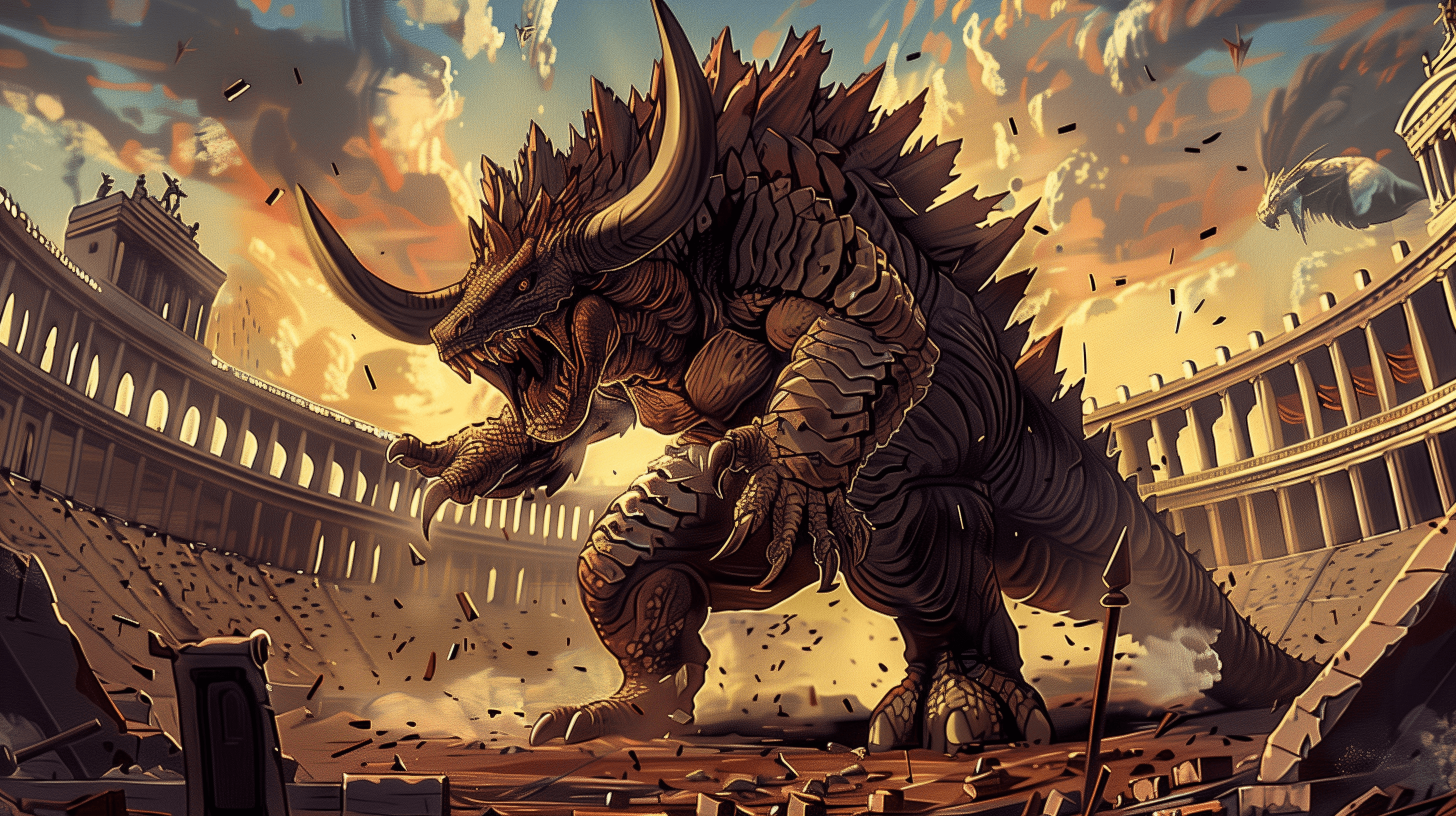
Something vast rose in his place. Eighty feet of unrelenting destruction.
Xaathuun was free.
If only for a moment.
The Ruinlords dodged, evaded, fought for their lives as the crowd finally realized the horror unfolding before them.
But Lorien was still there. Fighting. Holding the creature back.
With one final, desperate push, the Riftwalker forced Xaathuun back into the void.
Then, he collapsed.
And Alduin?
He only smiled.
“You cannot kill him,” he told the Ruinlords. “But tell me… what will you do with him?”

Unleashing the New 2024 D&D Dragons in My Pathfinder Game
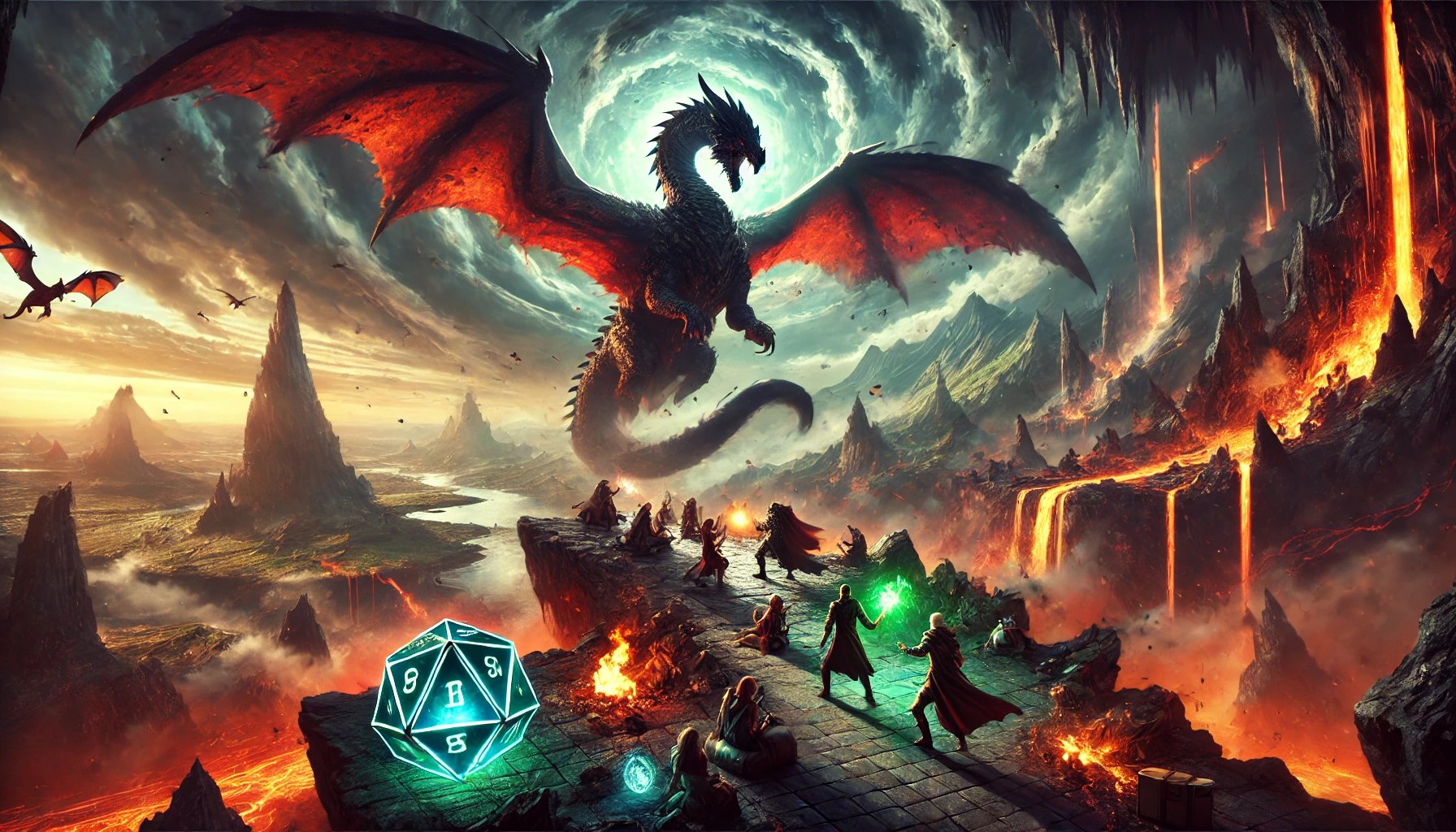
When I heard about the dragon updates in the 2024 Dungeons & Dragons Monster Manual (on sale February 18th, 2025), I couldn’t resist digging into the details. Dragons are the apex of fantasy monsters, full stop. These changes aim to make them feel as legendary in gameplay as they are in lore.
While I’m a die-hard Pathfinder First Edition GM, these updates are too good to ignore. I’m already planning to integrate some of these changes into my game, and I’ll walk you through why they’re a game-changer (pun intended).
Dragons, Elevated: What’s New?
If you’ve ever run a dragon encounter and felt it didn’t live up to the hype, you’re not alone. The new Monster Manual seems to have taken that criticism to heart, overhauling dragons to be more dynamic, dangerous, and memorable. Here’s what caught my eye:
1. Dragons with Complex Mechanics
Dragons are no longer just big lizards with hit points and a breath weapon. They’ve gained mechanical depth, especially at higher challenge ratings.
- Spellcasting Built In:
Adult and ancient dragons now include spells that reflect their cunning and magical nature.- Example: A black dragon can hurl acid with Vitriolic Sphere, while a green dragon can twist minds with Modify Memory or Geas.
- For Pathfinder, I’m considering changing my dragons to have more thematic spells. Why does an adult red dragon not cast Fireball or Wall of Fire?
- Legendary Actions with Personality:
Each dragon’s legendary actions now align with its temperament.- Red dragons dominate others with their commanding presence, while black dragons summon swarms or unleash sonic booms.
- I’ll be tweaking my homebrewed Pathfinder legendary abilities to reflect this, like giving a blue dragon a “storm surge” to call down lightning on enemies.
2. Distinctive Personalities and Lore
One of the more interesting updates is how dragons feel unique at every life stage. They’re no longer just “a bigger version of the same dragon” as they age.
- Chromatic Dragons:
Their destructive tendencies are tied to their themes.- Black dragons thrive on decay, often surrounded by undead minions.
- Red dragons are tyrannical rulers who hoard treasures and command armies.
- For my Pathfinder games, I’m leaning into the undead angle for black dragons. Imagine a necromantic black dragon raising skeletal knights to guard its lair.
- Metallic Dragons:
Now considered heroic but flawed, metallic dragons are no longer perfect do-gooders.- Gold dragons might see themselves as stewards of ancient duties, clashing with adventurers who disrupt their plans (which they tend to do on the regular.)
- Silver dragons, chivalrous and overconfident, could drag your players into their overzealous schemes.
- I love the idea of a silver dragon recruiting the party for a “heroic” crusade, only to discover the mission is more reckless and morally gray than it originally appeared.
3. Artistic Inspiration
The new art direction for dragons is impressive. Each image tells a story, from green dragons lurking in shadowy swamps to ancient red dragons surveying volcanic peaks. It’s a reminder that dragons are more than combat encounters—they’re world-shaping entities, as they should be.
For my Pathfinder games, these visuals are pure motivational gold. I’m already planning to rework lairs to reflect the personality and environment of each dragon. A blue dragon’s cavern, for instance, might crackle with static electricity, while a green dragon’s swamp could ooze with toxic, bubbling pools.
4. Tactically Rich Encounters
Perhaps the best update is how these changes make dragon encounters more dynamic. Dragons now intelligently use their entire suite of abilities, leveraging their environment and legendary actions.
- Lair Mechanics:
Dragons gain extra legendary actions and resistances in their lairs, turning the environment into a weapon.- For Pathfinder, I’m considering giving lairs regional effects—like volcanic eruptions for red dragons or acid rain for black dragons.
- Long-Range Threats:
Dragons aren’t just melee bruisers anymore. They’re deadly at all ranges, with spells, mobility, and legendary actions to dominate the battlefield, which they sorely needed.
Why These Changes Matter
Dragons should feel like epic encounters, not just a tougher troll with wings. These updates elevate dragons to their rightful place as the pinnacle of fantasy monsters, both in combat and story.
Even if you’re running Pathfinder like me, these ideas are easy to adapt. By incorporating thematic spells, tailored legendary actions, and distinct lair mechanics, you can make your dragons unforgettable.
Final Thoughts
Whether you’re a D&D or Pathfinder GM, the 2024 Monster Manual updates are worth exploring. They add mechanical complexity, rich lore, and breathtaking visuals that breathe new life into these iconic creatures.
I’ll definitely be tweaking my Pathfinder dragons with these ideas—what about you? How do you make your dragon encounters legendary? Share your tips in the comments, and don’t forget to check out the video for more inspiration!




 Rokk Talk