The 5 Encounter Dials That Fix RPG Combat for Big Parties
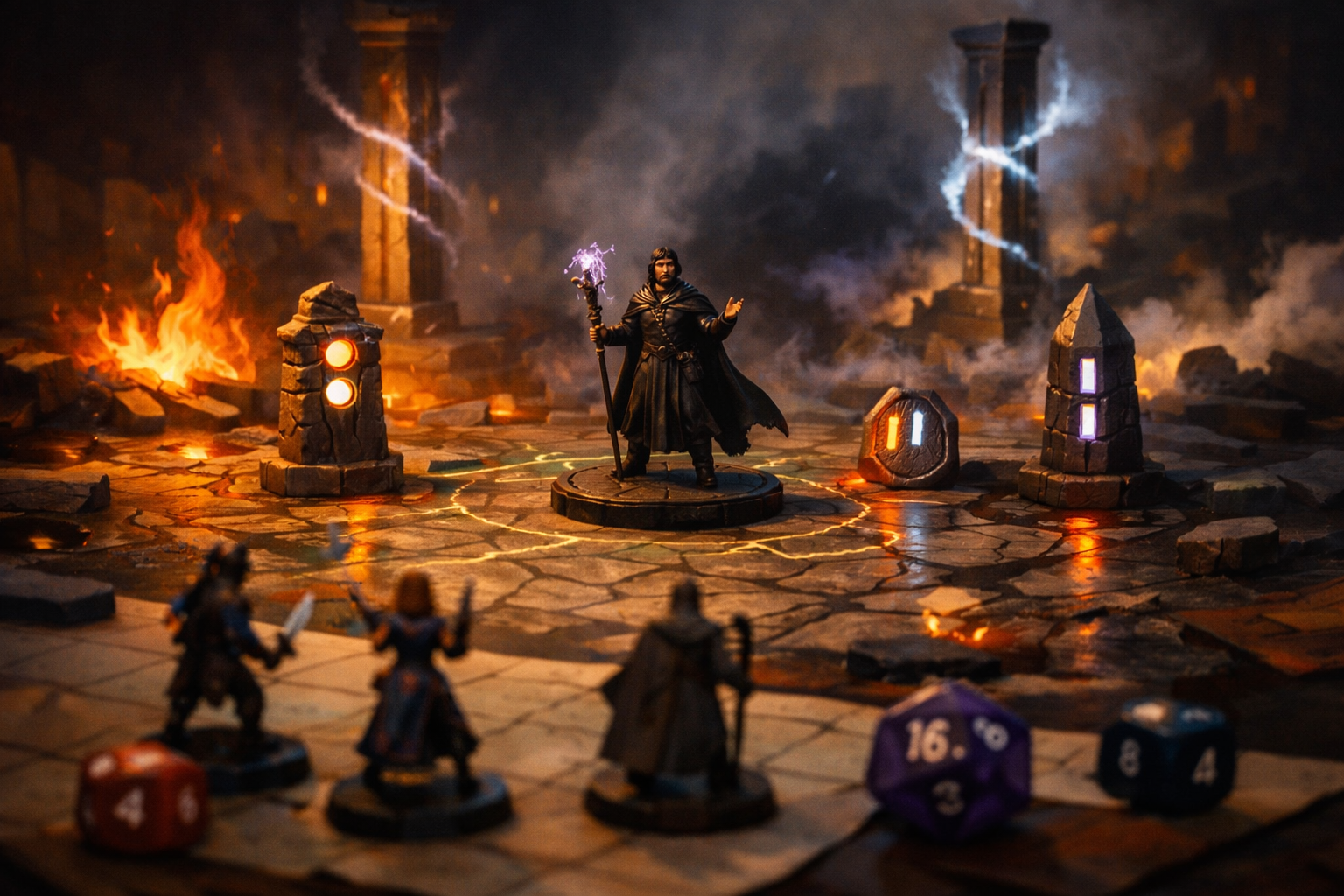
You set the minis on the map. You read the boxed text. Initiative rolls start flying.
And ten minutes later, your carefully chosen “Hard” encounter is a smoking crater.
If you run D&D or Pathfinder for five to seven players, you already know this pain. Published encounters collapse. Bosses get stun-locked. Monsters die before they feel dangerous. And the advice you keep hearing sounds like homework: rebuild stat blocks, recalculate CR, redesign the dungeon.
You do not need to do any of that.
This guide shows how to scale encounters for larger parties without touching the Monster Manual, using fast, repeatable dials you can turn before or during play. These techniques work for published adventures, homebrew dungeons, and one-shots alike. They are designed for real tables, not spreadsheets.
Why 5–7 Players Break Encounters So Easily
Before we fix the problem, it helps to name it.
The issue is not that your monsters are weak.
The issue is action economy.
A party of six characters takes six turns every round. That means:
- Six attacks, spells, or control effects.
- Six chances to crit, restrain, stun, banish, or delete a target.
- Six opportunities to focus fire one enemy into the floor.
The official rules acknowledge this. The encounter-building guidelines state that for six or more characters, you should use the next lowest encounter multiplier, because monsters scale poorly against large parties.
That adjustment helps on paper. At the table, it is rarely enough.
Large parties also bring:
- More overlapping crowd control.
- More burst damage.
- More healing redundancy.
- More player synergy.
All of that stacks fast. If a fight cannot threaten the party by round two, it usually never will.
The Goal: Harder Fights Without Slower Fights
Most advice for scaling up encounters boils down to “add more monsters.”
That works. It also creates new problems:
- Longer initiative orders.
- More bookkeeping.
- More waiting between turns.
- More fatigue at the table.
Your real goal is not “more enemies.” Your goal is more pressure per round.
Pressure is what forces decisions. Pressure is what creates tension. Pressure is what makes a fight memorable without turning it into a slog.
The good news is that pressure comes from many places that do not require rewriting stat blocks.
The Five Encounter Dials (No Rewrites Required)
Think of encounter difficulty as a control panel with five dials. You rarely need to turn all of them. Turning one or two is usually enough.
Dial 1: Enemy Actions, Not Enemy Bodies
If six heroes take six turns, one monster taking one turn will lose. Every time.
Instead of adding more creatures, add more enemy actions.
Examples:
- Give an important enemy a reaction it uses every round.
- Add a simple “at the start of round” effect tied to the battlefield.
- Let a lieutenant act on the same initiative as the boss.
This mirrors what legendary actions already do, but you can apply it to almost any creature without changing its stat block.
Example:
A hobgoblin captain fights six PCs. At initiative count 20, the captain orders a volley. One ranged attack resolves from off-screen allies. No new turns. No new stat blocks. Instant pressure.
This keeps the fight fast while respecting the action economy.
Dial 2: Durability Without the Hit Point Slog
The instinctive fix is to double monster hit points. Sometimes that works. Often, it just makes fights drag.
A better approach is conditional durability.
Instead of more HP, give enemies a way to delay being erased.
Options:
- The monster ignores the first failed save each round.
- The creature drops to 1 HP the first time it would die.
- Damage below a threshold is halved until a condition is met.
This technique is widely recommended by designers like Sly Flourish, who argue that durability should preserve tension, not length.
Why it works:
You buy the monster one or two extra meaningful turns. That is usually all you need.
Dial 3: Pressure Through Space and Consequences
Large parties love standing in optimal formations and unloading. Break that comfort.
You can do this without changing a single stat:
- Collapsing ceilings.
- Rising water.
- Spreading fire.
- Magical zones that move each round.
Environmental pressure forces the party to spend actions repositioning, which is just as valuable as dealing damage.
Example:
In a crypt fight, necrotic mist spreads five feet outward at the start of each round. Anyone inside takes minor damage. Suddenly, standing still is a bad plan.
The monsters did not change. The fight did.
Dial 4: Objectives That Compete With Damage
If the only goal is “kill everything,” six players will do exactly that. Give them something else that matters right now.
Strong objective types:
- Stop a ritual before round four.
- Protect a fragile NPC.
- Hold a position while enemies retreat.
- Escape with an artifact.
Objectives divide attention and actions. That naturally balances large parties without increasing lethality.
This is one of the most underused scaling tools in published adventures.
Dial 5: Reinforcements and Morale, Not Endless Waves
Reinforcements are powerful, but only when used sparingly.
The trick is delayed commitment:
- Enemies arrive in round two or three, not at the start.
- The party sees or hears them coming.
- The fight ends early if morale breaks.
This keeps pacing tight and avoids the “why are there still enemies” problem.
Many experienced DMs on the RPG Stack Exchange recommend this approach specifically for variable party sizes.
A Quick Scaling Baseline for 5–7 Players
Use this as a starting point when prepping or adjusting on the fly.
Party of 5
- Add one extra enemy action per round.
- Increase durability slightly.
- Introduce mild environmental pressure.
Party of 6
- Always add enemy actions or objectives.
- Plan one delayed reinforcement.
- Assume focus fire will delete one target per round.
Party of 7
- Never run solo monsters without extra actions.
- Use objectives that demand movement or protection.
- End fights with morale or escape, not total annihilation.
Three Worked Examples
Example 1: Bandit Ambush (Low Level)
Original encounter:
Six bandits ambush the road.
Problem:
Six PCs kill three bandits in round one. The rest flee or die.
Scaled version:
- At the round start, a horn sounds. One crossbow attack resolves each round from the treeline.
- The bandit leader drops to 1 HP the first time they would die.
- If half the bandits fall, the rest disengage and run.
Same stat blocks. Same number of enemies. More tension. Faster resolution.
Example 2: Dungeon Room (Mid Level)
Original encounter:
Four undead guardians in a crypt.
Problem:
Cleric control trivializes the fight.
Scaled version:
- Necrotic energy pulses every round, forcing Con saves in specific zones.
- One guardian can move as a reaction when another falls.
- The party must secure three runes to end the pulse.
The undead are unchanged. The encounter now demands movement and choices.
Example 3: Boss Fight (High Level)
Original encounter:
A single spellcasting villain.
Problem:
Six PCs delete the boss before their second turn.
Scaled version:
- The boss gains a reaction spell each round.
- A ritual timer triggers environmental effects.
- At 25 percent HP, the boss attempts escape instead of fighting to the death.
The villain survives long enough to matter, and the fight tells a story.
Common Mistakes to Avoid
Mistake 1: Only Adding Hit Points
This creates longer fights, not better ones.
Mistake 2: Adding Too Many Enemies
This slows the game and punishes attention spans.
Mistake 3: Ignoring the Adventuring Day
The rules assume multiple encounters. If your party fights once per session, they will always nova. The D&D Basic Rules explicitly state that most parties can handle six to eight medium or hard encounters per day, a number many tables never reach.
Mistake 4: Scaling Damage Instead of Decisions
Deadlier monsters are not always better. Smarter pressure usually is.
A Personal Rule of Thumb
After years of running tables with six or more players, I use one test:
If the enemies cannot meaningfully threaten the party by round two, the encounter is already decided.
When that happens, I do not add more monsters. I add pressure:
- A consequence.
- A complication.
- A reason to move.
That single shift has saved more sessions than any CR math ever did.
Final Takeaway
Scaling encounters for 5–7 players is not about rewriting monsters. It is about redistributing pressure.
By adjusting actions, durability, space, objectives, and morale, you can make encounters tense, fast, and memorable without touching a stat block. These tools respect player power while still challenging it.
If you want your next big fight to feel earned instead of inevitable, pick one dial and turn it slightly. You will feel the difference immediately.
Call to Action
Try one of these techniques in your very next session. Afterward, ask yourself one question: did the fight force decisions instead of just rolling damage?
If the answer is yes, you are scaling encounters the right way.

Posted on March 30, 2026, in Blog. Bookmark the permalink. Leave a comment.





 Rokk Talk
Leave a comment
Comments 0