Why XP Leveling Fails and How to Fix It
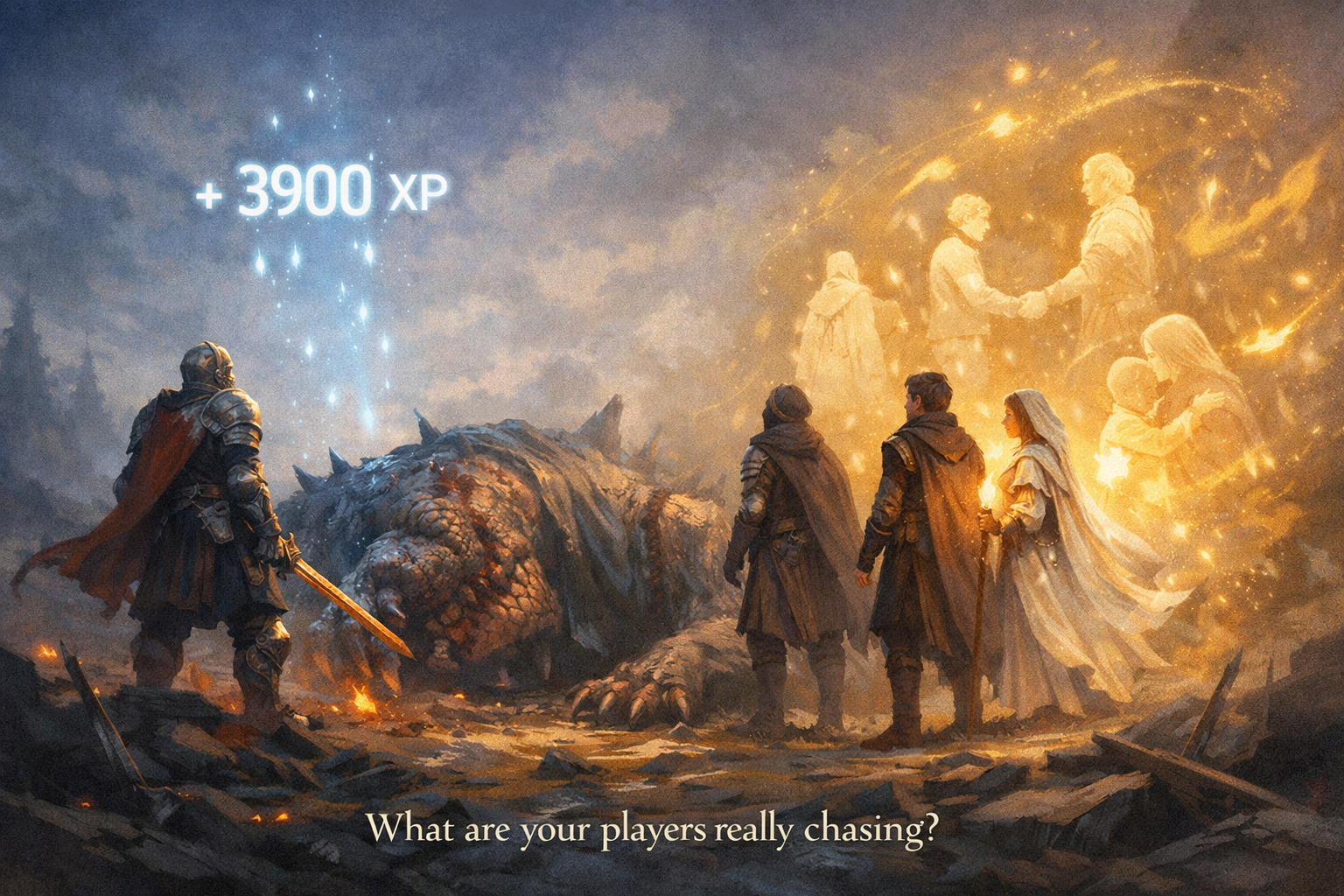
Your party just killed something big.
Not just big—important. The kind of fight that took planning, resources, and a little bit of luck. The wizard is out of spells. The fighter is barely standing. The cleric is doing that thing where they pretend they’re fine.
You tally the numbers.
“3,900 XP each.”
There’s a pause.
No one cheers. No one leans forward. No one says, “That was awesome.”
They just… write it down.
That’s the problem.
Leveling, arguably the most important reward system in your game, has become bookkeeping.
And worse? It’s quietly shaping how your players behave in ways you probably don’t want.
- If XP comes from combat → players chase combat
- If milestones are unclear → players feel disconnected
- If progress is invisible → players feel nothing
Leveling isn’t a reward system. It’s a behavior system.
Once you understand that, everything changes.
Why Traditional XP (and Even Milestones) Fall Short
Let’s start with the uncomfortable part.
Most leveling systems don’t fail because they’re broken. They fail because they’re misaligned with how people actually play.
The XP Problem
XP systems reward what they measure.
So what do they measure?
Combat.
That’s why many tables report that 60–75% of session time becomes combat-focused when using XP systems. Players aren’t being murderhobos—they’re just responding to incentives.
And it gets worse:
- Roleplay becomes optional
- Creative problem-solving gets sidelined
- Non-combat players disengage
The Milestone Problem
So we switch to milestone leveling.
Problem solved, right?
Not quite.
Surveys across communities like Reddit and ENWorld show 70–80% of tables prefer milestone leveling—but many GMs still feel uneasy using it.
Why?
Because it often feels:
- Arbitrary
- Invisible
- Disconnected from player action
Players don’t know why they leveled. They just… did.
And that’s where engagement dies.
The Real Fix: Design Your Leveling System Like a Game Mechanic
Leveling should tell your players what matters in your game.
If you want:
- Roleplay → reward it
- Exploration → reward it
- Risk-taking → reward it
Players will follow the system.
Just like in combat, where mechanics create movement and tension, progression systems create behavior.
So instead of asking: “How should I give XP?”
Ask: “What do I want my players to do more of?”
Now we build from there.
7 Alternative Leveling Systems That Actually Work
Each of these systems:
- Encourages different playstyles
- Solves a specific GM problem
- Can be used alone or combined
1. Milestone+ (Structured Milestones)
Best for: Story-driven campaigns that still want player clarity
Milestones aren’t bad. They’re just too vague. Fix that by making them visible.
How It Works
Instead of “you level when I say so,” give players a checklist:
Level Progress (Level 5 → 6):
- Defeat a major threat (✔️)
- Resolve a faction conflict (❌)
- Complete a personal arc (❌)
- Discover a major secret (✔️)
2/4 complete.
Why It Works
- Players see progress
- Players understand goals
- Players feel in control
Example
Your party is working for the Crownless Company. Instead of random leveling, they know:
“Complete 3 contracts of significance → level up.”
Now every mission matters.
2. Achievement-Based Leveling
Best for: Gamified tables, clear rewards, player motivation
Think of this like video game achievements.
How It Works
Players unlock levels by completing specific achievements:
- “Defeat a CR+3 enemy”
- “Resolve a conflict without combat”
- “Save an NPC at great personal risk”
Why It Works
- Encourages diverse playstyles
- Creates memorable moments
- Gives players agency
Example
A rogue talks their way past a boss fight. Instead of missing XP, they gain:
“Achievement Unlocked: Silver Tongue – Progress toward next level.”
Now, roleplay competes with combat.
3. Session Contribution System
Best for: Tables where engagement varies
Not all players contribute the same way, but they should all feel rewarded.
How It Works
At the end of each session, award points for:
- Roleplay
- Problem-solving
- Team support
- Creativity
Convert points into level progress.
Why It Works
- Encourages participation
- Balances spotlight time
- Rewards effort, not just outcomes
Example
At session end:
- Fighter: +2 (combat + teamwork)
- Bard: +3 (roleplay + creativity)
- Wizard: +1 (quiet but helpful)
Everyone progresses—but differently.
4. Narrative Arc Leveling
Best for: Character-driven campaigns
This system ties leveling directly to personal stories.
How It Works
Each character has:
- 3–5 personal milestones
When they complete them, they gain level progress.
Why It Works
- Deep emotional investment
- Strong character development
- Personalized rewards
Example
A paladin seeks redemption.
Milestones:
- Face their past
- Spare an enemy
- Protect someone they once failed
Each step brings them closer to leveling.
5. Training & Downtime Leveling
Best for: Immersive, world-focused campaigns
Leveling takes time, not just experience.
How It Works
Players must:
- Spend gold
- Find a mentor
- Train during downtime
Why It Works
- Grounds progression in the world
- Adds pacing control
- Creates new story hooks
Example
To reach level 7, the wizard must:
- Find an archmage
- Pay 500 gp
- Train for 5 days
Now, leveling becomes a quest.
6. Risk-Based Advancement
Best for: Tactical, high-stakes campaigns
Reward danger, not just victory.
How It Works
Players gain progress based on:
- Threat level
- Risk taken
- Stakes involved
Not just kills.
Why It Works
- Encourages bold decisions
- Reduces grind
- Rewards smart play
Example
The party avoids a deadly fight through clever planning.
Instead of losing XP, they gain:
Full progress for overcoming a high-risk situation.
7. Objective-Based Leveling (Mission XP)
Best for: Sandbox or guild-style campaigns
Perfect for structured play.
How It Works
Players level by completing:
- Contracts
- Missions
- Objectives
Each has a value.
Why It Works
- Clear progression
- Works in open worlds
- Easy to track
Example
Contracts:
- Minor: 1 point
- Major: 2 points
- Legendary: 3 points
6 points → level up.
Now players choose their path.
How to Choose the Right System
Not every system fits every table.
Use This Quick Guide
| Campaign Type | Best System |
|---|---|
| Story-heavy | Milestone+ or Narrative Arc |
| Sandbox | Objective-Based |
| Tactical | Risk-Based |
| Casual | Session Contribution |
| Immersive | Training System |
The Real Power Move: Hybrid Systems
Here’s where things get interesting.
You don’t have to pick just one.
Example Hybrid
Milestone + Achievement
- Milestones provide structure
- Achievements provide flavor
Example in Play
Players need:
- 3 milestones to level
But also gain:
- Bonus progress from achievements
Now:
- Structure + flexibility
- Clarity + creativity
This is where most competitors stop—and where your system gets better.
Common Mistakes (Avoid These)
1. Making Progress Invisible
If players can’t see it, they won’t care.
2. Rewarding Only Loud Players
Quiet players still contribute—track it.
3. Overcomplicating the System
If it takes longer to track than combat, it won’t last.
4. Removing Player Agency
Players should feel like they earn levels—not receive them.
Or Study the Mystic Art(s) of Keystone Leveling
I wrote a whole blog post. Big deal. Check out Dadi over at Mystic Arts and his take on Keystone Leveling (which inspired a few of my points here.) While you’re there, check out his other videos. They’re amazing!
Why you gotta be so good at this, Dadi?
Final Thought: Leveling Is the Game Behind the Game
Combat gets the spotlight. Story gets the attention.
But leveling?
That’s the system quietly shaping everything.
If you fix that, you don’t just fix progression.
You fix:
- Player behavior
- Engagement
- Pacing
- The entire feel of your campaign
Call to Action
Before your next session, do one thing:
Write down what you want your players to do more of.
Then build your leveling system around that.
Start small:
- Add a visible progress tracker
- Introduce one achievement
- Tie one level to a story moment
Test it. Adjust it. Make it yours.
Because once your leveling system supports your game…
Your players won’t just track progress.
They’ll chase it.

Posted on March 23, 2026, in Blog. Bookmark the permalink. Leave a comment.




 Rokk Talk
Leave a comment
Comments 0