Secrets of Building NPC Factions That Actually Drive the Story
Most Game Masters don’t have a faction problem. They have a momentum problem.
You write a thieves’ guild. A church. A noble house. Maybe even a shadowy cabal with a cool name and a crest you’re proud of. They exist. They have lore. They might even have a leader the party has met.
And then… nothing happens.
Sessions pass. The world feels strangely frozen unless the PCs poke it. Your factions sit in the background like museum displays. Meanwhile, you’re doing more prep every week just to keep things moving.
This post is about fixing that.
Not by adding more lore. Not by turning your campaign into a political simulator. But by turning factions into story engines that reliably generate scenes, pressure, and choices with minimal prep.
If static NPCs don’t move the plot, then factions must. Here’s how to build them so they actually do.
Stop Writing Factions Like Lore. Start Running Them Like Engines.
A faction that doesn’t act without player input is not a faction. It’s set dressing.
Living campaigns work because things happen off-screen. Fronts advance. Plans mature. Opportunities close. Threats escalate.
Games like Dungeon World formalized this with fronts and impending dooms, explicitly stating that bad things will happen unless the players intervene. The principle matters more than the system: the world moves whether the PCs act or not.
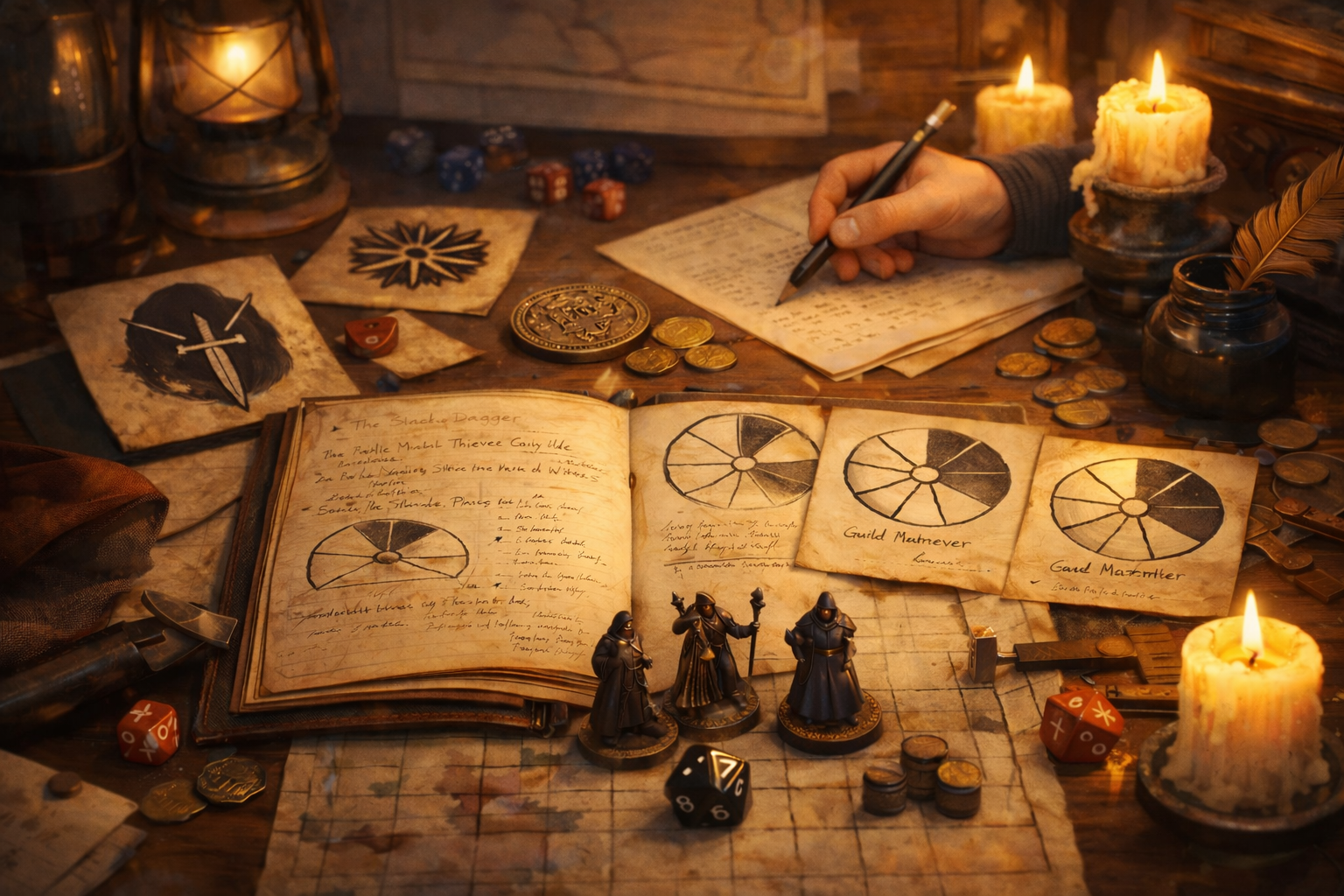
Blades in the Dark went further by introducing progress clocks, a visual and procedural way to track intention over time. A clock is not a plot. It’s a reminder that someone is trying to get something done.
According to long-running GM discussions across RPG communities, the most successful faction-driven campaigns share three traits:
- A small number of active factions (usually 3–5)
- Each faction has a clear short-term objective
- The GM advances those objectives between sessions, not during prep panic
That’s the engine mindset. Let’s build it.
The 5-Minute Faction Sheet (That Actually Gets Used)
Forget encyclopedic writeups. If you can’t summarize a faction on a single index card, it will never hit the table.
Here’s a faction sheet designed to produce play, not prose:
1. Public Mask
What most people believe about this faction.
- “A charitable merchant guild”
- “Devout protectors of the old faith”
- “Just another noble house”
This is what the PCs hear before things get complicated.
2. Real Need
What the faction must secure next to survive or advance.
- Control of a trade route
- Silence around a recent crime
- A lost artifact
- Political legitimacy
If this need is met, the faction stabilizes or grows. If not, it takes risks.
3. Method
How they usually get what they want.
- Bribes and favors
- Legal pressure
- Violence by proxy
- Blackmail
- Public goodwill
This determines the kind of scenes they create.
4. Leverage
What they can offer or threaten right now.
- Gold, shelter, information
- Access to spells or resources
- Legal protection
- Social ruin
If a faction has no leverage, players can ignore it. That’s a design failure, not a player problem.
5. The Tell
One visible sign the faction is acting.
- Guards wearing new colors
- Prices rising
- Rumors spreading
- A known NPC switching sides
The Tell is your delivery system. If players don’t notice change, the faction didn’t move.
That’s it. Five elements. Five minutes. You’re done.
Clocks Without Homework: The 4–8 Tick Rule
Now we give the faction motion.
Each faction gets one clock tied to its Real Need. No more.
- Minor objectives: 4 ticks
- Serious threats: 6 ticks
- Campaign-shaping goals: 8 ticks
Why this works: short clocks create urgency, but long clocks create apathy. Community consensus across GM forums consistently shows that 4–8 ticks is the sweet spot for tension without overwhelm.
When do you advance a clock?
Between sessions, ask three questions:
- Did the PCs help this faction?
- Advance 1–2 ticks
- Did the PCs hinder this faction?
- Reduce or stall the clock
- Did the PCs ignore this faction?
- Advance 1 tick
Ignoring a faction is still a choice. The world responds.
Do you show clocks to players?
Sometimes.
- Public clocks work well for visible threats: wars, plagues, political upheaval.
- Hidden clocks are better for conspiracies and rivals.
The rule of thumb: if the effects are visible, the clock can be visible. If the cause is hidden, keep the clock private.
Faction Turns: A Between-Session Checklist You Can Keep
This is where most GMs stumble. They overcomplicate it.
A faction turn should take 10–15 minutes total, even with multiple factions.
Here’s the loop:
- Review each faction’s Real Need
- Advance or stall its clock based on last session
- Choose one action the faction takes
- Decide one visible outcome for next session
That’s it.
No simulations. No spreadsheets. No dice unless you enjoy them.
The key insight from Stars Without Number-style faction systems is that factions don’t need perfect logic. They need consistent intention.
Make Factions Visible: The 6 Outputs Players Can’t Ignore
If a faction advances but produces no player-facing result, it might as well not exist. That’s it. That’s the take-home point.
Every faction action must produce one of these six outputs:
1. A Rumor
Something people are talking about.
- “Did you hear the docks are under new management?”
- “They say the abbey closed its gates.”
Cheap. Flexible. Perfect for taverns and downtime scenes.
2. A Job
An offer, contract, or request.
- Guard duty
- Retrieval
- Sabotage
- Escort
Jobs are how factions invite PCs into the machine.
3. A Price Change
Goods, services, or favors cost more or less.
- Healing becomes expensive
- Black market prices spike
- Passage is suddenly unavailable
This is subtle pressure that makes the world feel alive.
4. A New Danger
Someone starts hunting, enforcing, or silencing.
- Informants disappear
- Patrols increase
- A rival agent appears
Great for escalation without combat spam.
5. An NPC Defection
Someone changes sides.
- A guard looks the other way
- A priest breaks ranks
- A fixer switches employers
This reinforces that people respond to power.
6. A Control Shift
Territory, influence, or authority changes hands.
- New banners
- New laws
- New leadership
Save this for meaningful clock ticks. It’s loud.
If you ever wonder “what happens next session?” pick one output per active faction and you’re done.
Collision Design: Where Story Really Comes From
News flash: Factions are only interesting when they collide.
Instead of tracking five independent clocks, deliberately create collision points.
Example:
- The Merchant Guild wants exclusive trade rights.
- The Temple needs public support to push new laws.
They can’t both win cleanly.
Design shared resources:
- Trade routes
- Public opinion
- Sacred sites
- Political offices
Now advance clocks toward the same thing. When one ticks forward, another feels it.
This naturally creates:
- Moral dilemmas
- Conflicting jobs
- Reputation consequences
You don’t need twists. You need pressure.
A Short Example Across Three Sessions
Let’s make this concrete.
Faction: The Gilded Compact
- Public Mask: Respected trade consortium
- Real Need: Control the river tolls (6-tick clock)
- Method: Legal pressure and bribes
- Leverage: Money, guards, permits
- Tell: New uniforms on dock officials
Session 1:
The PCs ignore trade politics. Clock advances 1 tick.
Output: A rumor about “streamlined toll collection.”
Session 2:
Prices rise. A rival asks the PCs to smuggle goods.
Clock advances another tick.
Session 3:
The Compact reaches 4/6.
Output: A dockside riot after new enforcement policies. Guards crack down.
Now the players are involved whether they planned to be or not.
That’s momentum.
Common Failure Modes (and How to Fix Them)
“I have too many factions.”
You don’t. You have too many active factions.
Solution: Keep 3–5 factions in motion. Park the rest. Dormant factions can wake up later.
“Players don’t care.”
They care about consequences, not names.
Solution: Tie faction outputs to things players already value: safety, money, allies, freedom of movement.
“This feels like railroading.”
It isn’t. The factions aren’t deciding what the PCs do. They’re deciding what happens if the PCs don’t act.
That’s agency.
Why This Works (and Why It Lowers Prep)
Studies of player engagement consistently show that people respond more strongly to reactive worlds than authored plots. When actions produce visible change, players infer meaning and intent, even if the system is simple.
Faction clocks externalize that logic. They turn “I guess something should happen” into a repeatable process.
And once you trust the engine, you stop overprepping.
You’re no longer asking:
“What’s the plot this week?”
You’re asking:
“Which factions advanced, and what did it break?”
That’s a better question.
Final Thoughts: Let the World Move
You don’t need smarter villains.
You don’t need deeper lore.
You don’t need more prep.
You need factions that want things, take action, and leave fingerprints on the world.
Build them fast. Track them lightly. Make their motion visible.
If the players change course, the factions react.
If the players hesitate, the world doesn’t.
That’s how stories happen at the table.

Posted on March 9, 2026, in Blog. Bookmark the permalink. Leave a comment.




 Rokk Talk
Leave a comment
Comments 0