Five GM-Tested Ways to Speed Up Combat Without Killing Tension
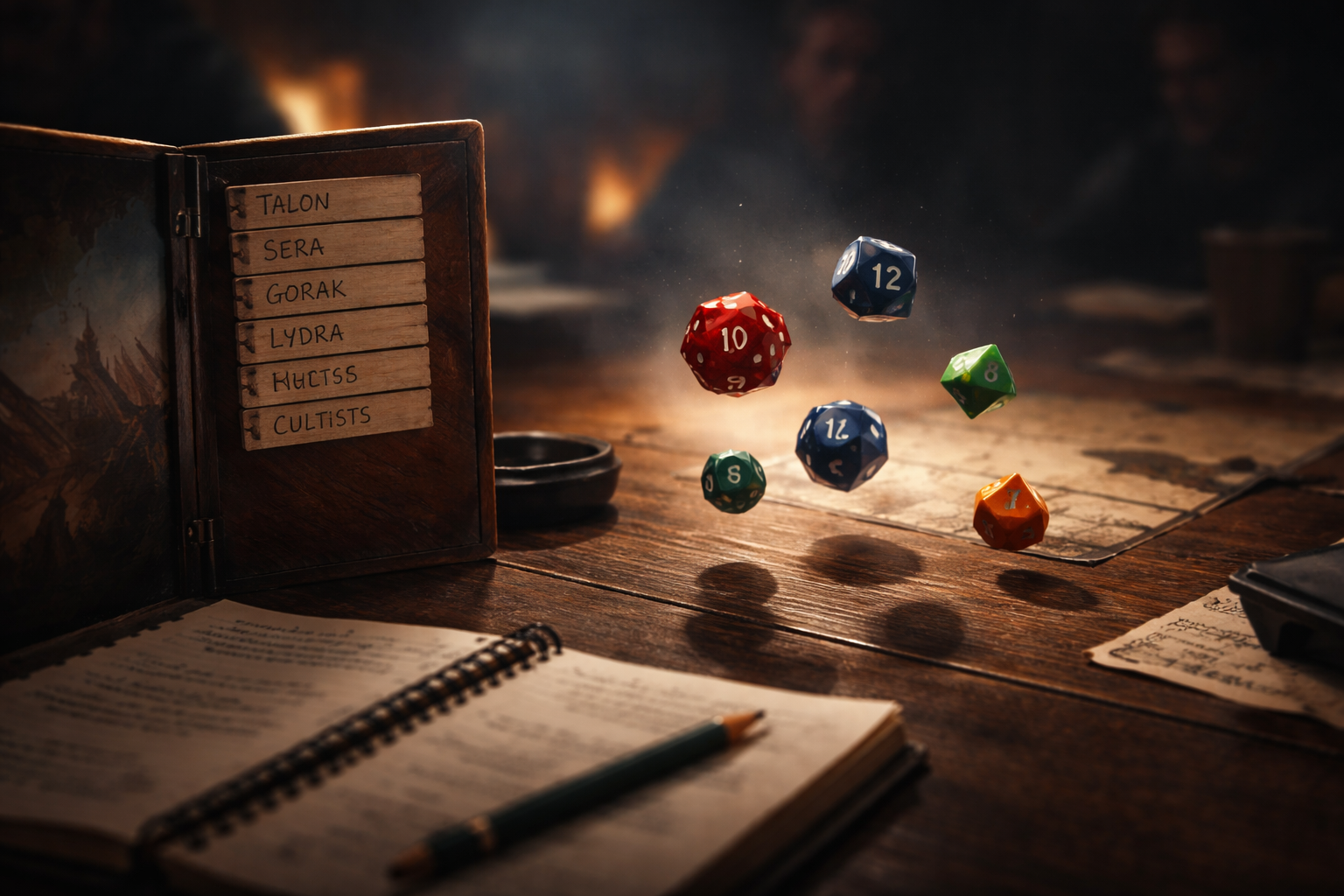
Combat is supposed to be the engine of your session. Instead, it’s sputtering.
You know the feeling. Dice are rolling. Minis are moving. But the energy at the table is leaking out round by round. Players check phones. Someone asks whose turn it is. The villain who was terrifying ten minutes ago is now just… still standing.
When combat drags, it doesn’t just waste time. It kills momentum, tension, and trust. Players stop believing their choices matter because everything feels slow, inevitable, and padded.
The good news is this: slow combat is almost never a single problem. It’s usually one of a few repeatable causes. Fix the cause, and combat tightens up fast.
Below are five proven ways to fix combat that’s dragging on too long. Each one targets a specific failure point, explains why it works, and shows how to use it at the table immediately. No system overhaul required.
First, a 30-Second Diagnostic
Before applying fixes, identify why combat is slow. Most dragging combats fall into one or more of these buckets:
- Too many turns per round
- Too many decisions per turn
- Too many misses and whiffs
- Too much rules or math friction
- No clear end condition beyond “kill everything”
As you read, mentally tag which of these you see at your table. You do not need all five fixes. You need the right one.
1. Cut the Number of Turns, Not the Threat
Symptom: A single round takes forever. Everyone is acting, but progress is glacial.
This is the most common issue, and it has a simple cause: too many turns. Not too much difficulty. Not too much danger. Just too many individual activations.
A fight with ten weak enemies feels dynamic for exactly one round. After that, it becomes accounting.
Why This Works
Time in combat scales with turns, not hit points. If twelve creatures take actions, the round is long even if those actions are simple. Reducing turns while preserving danger compresses time without reducing tension.
This is why so many experienced GMs independently land on the same advice: fewer monsters, harder monsters.
How to Apply It
Group enemies into fewer initiative slots.
- Three goblins act together.
- Six skeletons move as two squads.
- A swarm of cultists becomes “the mob.”
Use minion-style enemies.
- One hit, one failure, they’re out.
- Damage still matters.
- Fear stays high.
Replace quantity with pressure.
- One ogre with a dangerous battlefield effect is faster than six ogres trading attacks.
At the Table Example
Instead of eight bandits with separate turns, run:
- Bandit Skirmishers (one initiative, shared movement)
- Bandit Archer Line (one initiative, volley attacks)
- Bandit Captain (solo)
The fight is still busy. The round is half as long.
Design Note
If you want scale without slowdown, use waves. New enemies enter when old ones fall. The table stays focused, and the initiative order stays short.
2. Lower Hit Points and Raise Damage (On Purpose)
Symptom: Combat isn’t confusing or chaotic. It’s just endless.
This is the classic grind. Attacks hit. Spells land. Nothing changes.
Why This Works
Combat length is largely a math problem. If enemies take six rounds to drop and hit only half the time, you’ve built a slow fight even if nothing else is wrong.
Mike Shea (Sly Flourish) and other designers frequently recommend adjusting hit point and damage “dials” to control pacing. One common rule of thumb is to reduce monster hit points to around 75% while increasing damage slightly. The fight feels just as dangerous but ends sooner.
Alphastream has also demonstrated that lower hit rates dramatically increase required rounds. A monster hitting 75% of the time might resolve in four rounds. At 50%, it can stretch to six or more. Fewer misses means faster resolution.
How to Apply It
- Reduce enemy hit points by 20–30%.
- Increase damage slightly to keep threat credible.
- Avoid stacking high AC with high HP. That creates whiff-fests.
At the Table Example
If a monster normally has 120 HP:
- Run it at 90 HP.
- Let its signature attack hit harder or more reliably.
Players still feel pressure. They just reach the finish line sooner.
Personal GM Note
Many GMs resist this because it feels like cheating. It’s not. Hit points are not realism. They are pacing tools. Use them intentionally.
3. Kill the Whiff-Fest
Symptom: Turns are fast, but nothing happens. Miss, miss, miss, shrug.
Nothing slows a table like repeated failure without consequence. Players disengage because their turns don’t matter.
Why This Works
Miss-heavy combat stretches time and drains emotion. Even when damage numbers are correct, repeated non-events make combat feel longer.
RPG theory discussions consistently point to accuracy as a hidden pacing lever. Slightly lowering enemy AC or granting more advantage-style bonuses can dramatically shorten fights without changing damage output.
How to Apply It
- Lower enemy AC by 1–2 points.
- Increase access to advantage via positioning, flanking, or terrain.
- Replace “miss = nothing” with partial success.
At the Table Example
Instead of: “You miss.”
Try: “Your blade glances off the armor, but you drive the enemy back toward the edge. Take the space.”
Momentum matters more than math.
Optional Advanced Technique
Use progress damage. On a miss, deal a flat minimal amount or advance a clock. The enemy is still wearing down. The story is still moving.
4. Put a Clock on Decisions
Symptom: The round stalls on player turns, not mechanics.
This is decision paralysis. Too many options. Too much optimization pressure. Everyone wants to make the perfect move.
Why This Works
Combat time explodes when players decide during their turn instead of before it. The fix is not punishment. It’s structure.
Many experienced tables adopt a soft decision timer or default action rule. RPG Stack Exchange discussions frequently note that simply requiring a decision keeps combat flowing.
How to Apply It
- Ask players to think during other turns.
- When a turn starts, give a brief window to declare intent.
- If they stall, fall back to a safe default.
Default actions are not penalties. They are safety nets.
Examples:
- Attack the nearest enemy
- Dodge or defend
- Cast a basic cantrip
- Help an ally
At the Table Example
“You have a few seconds. What’s your move?”
If they freeze: “Okay, you take the defensive stance and hold the line.”
The game keeps moving. The player still contributes.
Table Culture Tip
Explain this up front. Framing it as pacing protection, not pressure, keeps it friendly.
5. End Fights with Objectives, Not Corpses
Symptom: Combat technically works, but it feels like filler.
This is the most important fix and the most underused.
Many combats drag because there is no reason for them to end early. Everyone is just reducing hit points until the last body drops.
Why This Works
Objective-based combat creates natural endpoints. The fight ends when something changes, not when numbers hit zero.
This also solves a hidden problem: players often don’t know when they’re winning. Without an objective, every round feels the same.
How to Apply It
Design fights with clear goals:
- Hold the gate for three rounds
- Interrupt the ritual
- Escape the collapsing chamber
- Steal the artifact and run
Make the objective visible and countable.
At the Table Example
Instead of: “Eight cultists attack.”
Try: “The cultists only need three rounds to complete the summoning. Two rounds in, the chanting grows louder.”
Now, combat has a timer. Tension spikes. The fight ends when the story resolves, not when the last cultist drops.
Storytelling Payoff
Objective-based fights feel faster even when they aren’t. Players remember stakes, not round counts.
Pulling It Together
Notice something important: none of these fixes are about rushing. They are about focus.
- Fewer turns
- Fewer misses
- Fewer stalled decisions
- Fewer meaningless rounds
Combat speeds up when every moment matters.
You don’t need to use all five. Pick the one that matches your problem. Test it for one session. Adjust.
One Thing to Try Next Session
If you do nothing else, do this:
Before your next combat, write down how the fight ends if the players don’t kill everyone.
That single question will tighten pacing more than any rule tweak.
Final Thought and Call to Action
Combat dragging on too long is not a personal failure. It’s a system signal. Your table is telling you something about attention, pressure, or payoff.
Listen to it. Adjust one dial. Watch the energy come back.
If this helped, choose one fix and apply it in your next session. Then note what changed. Combat design is a craft. You get better by tuning it deliberately.
And when combat stops dragging, everything else in your game gets sharper too.

Posted on February 2, 2026, in Blog. Bookmark the permalink. Leave a comment.




 Rokk Talk
Leave a comment
Comments 0